

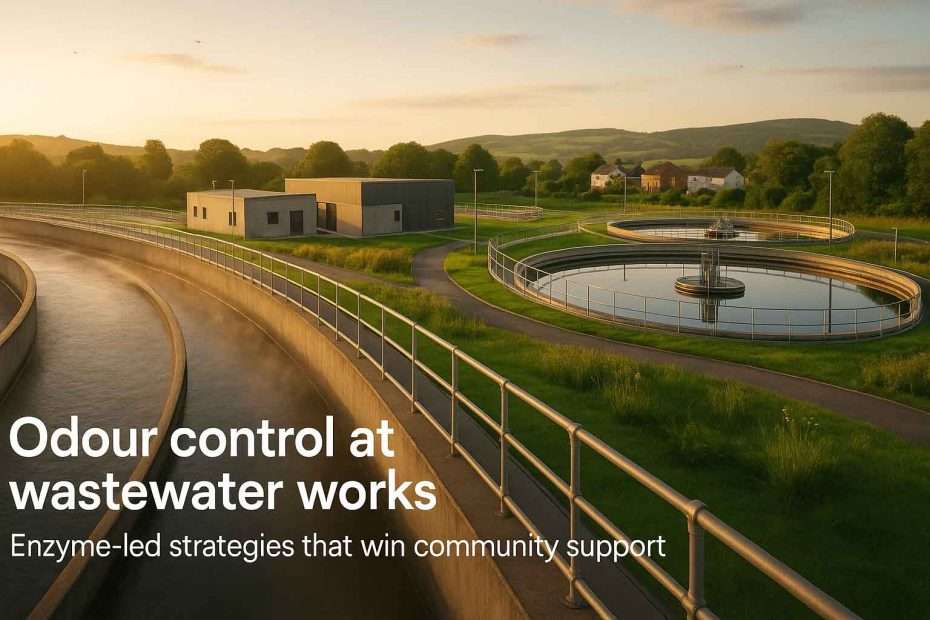
Odour control at wastewater works
Enzyme‑led strategies that win community support
Odour is the single most tangible way the public encounters the wastewater system. People rarely see sewers, digesters or sludge presses—but they know when they smell them. For utilities and their supply partners, effective odour control is therefore not only a technical obligation, it is a social licence issue. When odours drift across homes, schools, shops and parks, community support erodes, complaints escalate, reputational risk rises and regulators take note. Conversely, when odours are consistently controlled, trust grows, staff morale improves, and operational performance tends to follow.
This article sets out an accessible, technically rigorous explanation of where odours come from in wastewater treatment works (WwTWs), why they can be difficult to manage, and how enzyme‑led bioaugmentation offers a practical, organic, and ecosystem‑safe pathway to superior control. It compares chemical scrubbers and dosing with biological approaches, summarises case‑style outcomes relevant to UK utilities, and uses the Problem–Consequences–Solution structure for clarity.
The central message is simple: odour will always be easier, safer and cheaper to prevent than to mask. And prevention is precisely where enzyme‑led strategies deliver—by addressing odour at source, accelerating the breakdown of problem precursors, and restoring microbiological balance without adding harmful load to the environment.
The science of odour at wastewater works: a plain‑language guide
Odours at WwTWs arise largely from anaerobic microbial activity and incomplete or imbalanced biological conversion in wastewater and sludge handling. The principal culprits are:
- Hydrogen sulphide (H₂S): A colourless gas, notorious for its “rotten egg” smell. It forms when sulphate‑reducing bacteria (SRB) metabolise sulphate under anaerobic conditions—common in septic sewers, rising mains, primary sludge tanks, and poorly aerated zones. H₂S is both an odour nuisance and a health and safety hazard; at higher concentrations, it can incapacitate or prove fatal. Even at low parts‑per‑million levels, it corrodes concrete and steel, threatening infrastructure longevity.
- Volatile fatty acids (VFAs): These short‑chain organic acids—such as acetic, propionic, and butyric acids—create sour, rancid, or vinegar‑like odours. VFAs typically build up when complex organics are hydrolysed but not fully oxidised or methanised, either because conditions are suboptimal (e.g., temperature, pH, hydraulic retention, or mixing) or because microbial communities are stressed.
- Other sulphur‑ and nitrogen‑bearing compounds: Mercaptans, thioethers, ammonia and amines can contribute pungent notes. While not always dominant, they add complexity and persistence to odour profiles, particularly around sludge thickening, dewatering, and liquor handling.
- Secondary issues: Foam, scum layers and floating fat/grease can trap gases and release them episodically in bursts—aggravating odour incidents and making monitoring appear inconsistent or unpredictable.
The common thread across these sources is microbial imbalance and uncontrolled anaerobic niches. Where oxygen transfer, substrate availability, and microbial ecology are aligned, odour precursors are consumed in the pathway to stable end‑products (e.g., carbon dioxide, water, nitrate or methane, depending on the process stage). Where any of these are misaligned, odour‑forming intermediates accumulate and vent.
Why traditional odour control often disappoints
Utilities typically adopt a multi‑layered odour control strategy that combines infrastructure, operational practices, and treatment technologies. Common approaches include:
- Chemical scrubbing: Air from odorous zones is extracted and treated through packed‑tower scrubbers. Acidic or alkaline media plus oxidants (such as hypochlorite) convert H₂S and other compounds to non‑volatile forms.
- Chemical dosing to liquid: Nitrate salts, iron salts (e.g., ferric chloride), or oxidants (e.g., peroxide) are dosed into the wastewater or sludge to suppress SRB activity or precipitate sulphides.
- Activated carbon or biofilters: Air treatment using adsorptive media or biologically active beds to capture and biologically degrade odorous compounds.
- Containment and ventilation: Hoods, covers, ducting, and enhanced air changes to reduce ambient dispersion and manage treatment loads.
- Housekeeping and operations: Improved scum control, desludging frequency, and aeration management.
These are proven, practical tools. They are standard for a reason. However, they often treat symptoms rather than causes. Notable limitations include:
- Displacement rather than prevention: Air‑phase systems (scrubbers, carbon, biofilters) manage odour after it is generated. They do little to fix the biochemistry upstream, so the plant continues to create odorous gases that must be captured and treated continuously.
- OPEX and complexity: Chemical consumption, media replacement, energy for fans and pumps, and maintenance all add to operational expenditure. Scrubbers and carbon systems also require skilled oversight to maintain performance, particularly with variable inlet loads.
- Inconsistent field performance: Odour load is rarely steady. Storm events, diurnal patterns, trade effluent variability and shock loads can overwhelm systems sized for average conditions. The result is sporadic spikes and unpredictable complaints.
- Secondary effects: Harsh oxidants and aggressive chemistries can corrode assets, deliver safety risks, and, if overused, upset biological treatment stages downstream. Chemical over‑dosing can increase sludge volumes, alter pH and alkalinity, and raise the cost of sludge handling.
- Carbon footprint and sustainability: Heavy reliance on chemicals and high‑energy systems sits uneasily with net‑zero commitments and circular‑economy aspirations.
Utilities rightly want a strategy that prevents odour formation wherever possible, reduces reliance on chemical “band‑aids,” and still uses proven air‑phase systems as back‑stops rather than primary defences.
Enzyme‑led bioaugmentation: how it works and why it’s different
Enzymes are nature’s catalysts—proteins that accelerate specific biochemical reactions without being consumed. In wastewater, carefully selected and formulated enzymes target steps that control whether organic matter degrades cleanly or yields odorous intermediates. In bioaugmentation, these enzymes are paired with compatible, non‑pathogenic microbial consortia and micronutrient packages to steer the biology in a beneficial direction. The goal is to:
- Break down complex organics faster and earlier, reducing the substrate available to sulphate‑reducing bacteria and VFA‑producing pathways.
- Promote aerobic and facultative pathways that channel organics toward non‑odorous endpoints, even under challenging hydraulic regimes.
- Stabilise microbial ecology so that it withstands variable loads, trade effluent shocks and temperature swings.
- Reduce the need for harsh chemicals by addressing root‑cause biochemistry rather than masking the outputs.
An enzyme‑led strategy focuses on the liquid phase—where odour is born. By shifting the metabolic balance, we reduce gas‑phase loading before it gets to ducts and stacks. Air‑phase systems are still useful as polishers or safety nets, but they no longer shoulder the full burden.
Key elements of an enzyme‑led odour control programme:
- Site‑specific profiling: Every WwTW is different. Influent characteristics, sewer residence times, industrial contributions, sludge handling arrangements and existing assets all matter. A successful programme begins with data: H₂S profiles (in air and liquid), VFA levels, sulphate and sulphide concentrations, COD/BOD fractions, pH, alkalinity, temperature, dissolved oxygen, and microbial indicators.
- Targeted enzyme formulation: Different odour regimes call for different catalytic toolkits. For example:
- Lipases and esterases to break down fats, oils and greases (FOG) that otherwise create scums and trap odorous gases.
- Proteases and peptidases to deconstruct proteins into simpler, more readily oxidised molecules, limiting putrefaction.
- Amylases and cellulases to accelerate carbohydrate hydrolysis into pathways that prefer aerobic or denitrifying consumption.
- Redox‑modulating co‑factors and trace nutrients to support beneficial microbial guilds over SRB.
- Delivery and dosing design: Depending on the odour source, dosing may occur at the headworks, within rising mains, at primary settlement, or in sludge handling lines. Slow‑release carriers can maintain enzyme availability along pipe runs or within tanks. Dosing is tuned to flow, temperature and load.
- Monitoring and optimisation: Programmes are not “set and forget.” Operators track H₂S (ppb/ppm) in air, dissolved sulphide in liquid, VFA profiles, complaint logs and asset condition. Dosing is seasonally and operationally adjusted to maintain performance at minimum cost.
- Ecosystem stewardship: A core advantage of enzyme‑led solutions is ecological compatibility. Enzymes act on specific bonds; they do not persist, bioaccumulate or produce toxic residues. When paired with appropriate microbes, the system trends toward a resilient, self‑regulating state that aligns with environmental objectives.
Problem – Consequences – Solution: framing odour control for utilities and communities
Problem
- Anaerobic niches in sewers, primary tanks and sludge handling produce H₂S and VFAs.
- Load variability, temperature shifts and process upsets exacerbate odour generation.
- Air‑phase systems treat odour after it forms, and chemical dosing can be costly, corrosive, and operationally brittle.
Consequences
- Community complaints: A small number of high‑impact odour episodes can dominate local sentiment and media coverage.
- Health and safety risks: H₂S exposure hazards for staff and contractors; ammonia and amines can also affect comfort and wellbeing.
- Infrastructure degradation: Sulphide oxidation to sulphuric acid in headspaces corrodes concrete, steel, and electrical systems—shortening asset life and inflating capex.
- OPEX burden: Continual chemical spend, media replacement, energy consumption, and maintenance overheads.
- Compliance and reputational pressure: Odour abatement notices, additional monitoring requirements, and strained relationships with councils, neighbours and regulators.
Solution
- Enzyme‑led bioaugmentation that prevents odour at source by accelerating benign biochemical pathways, depriving SRB and VFA‑forming routes of substrate, and stabilising microbial ecology.
- Integrated with smart dosing, process control, and selective use of air‑phase systems as polishers rather than primary protection.
- Measured, evidenced improvements in odour reduction, safety outcomes, infrastructure preservation and OPEX.
Sources of odour in detail: where to intervene and why
- Rising mains and septic sewers
- Risk profile: Long residence times, low oxygen, warm temperatures and high organic loading—textbook conditions for SRB growth and sulphide formation.
- Typical symptoms: Elevated dissolved sulphide at the discharge manhole, H₂S spikes at wet wells and inlet works, black water, slime layers.
- Enzyme‑led intervention: Dosing lipases/proteases upstream, supported by carriers that persist along the main, reduces complex organics and discourages SRB dominance. Where nitrate dosing is used as a conventional measure, enzyme programmes can reduce nitrate demand by lowering oxygen debt and VFA formation.
- Inlet works and primary settlement
- Risk profile: Disruption of scum layers or turbulence can release trapped gases; primary tanks can stratify and become locally anaerobic; VFA generation is common.
- Typical symptoms: Intermittent odour bursts, stronger odours after warm weekends or storms, visible scum build‑up.
- Enzyme‑led intervention: Targeted formulations break down FOG and proteins rapidly as flows enter the works, minimising scum and fostering aerobic uptake through subsequent stages. This improves primary sludge quality and reduces odour release during desludging.
- Sludge thickening and dewatering
- Risk profile: Concentrating organics and disrupting matrices releases odourous compounds; polymer use may trap and then liberate odours downstream.
- Typical symptoms: Persistent odours around centrifuges or belt presses; complaints correlating with dewatering shifts; staff discomfort.
- Enzyme‑led intervention: Pre‑conditioning sludge with enzyme packages reduces VFA and sulphide formation, improves dewaterability, and can lower polymer consumption. The result is fewer odour spikes during handling and a more predictable work environment.
- Liquor returns and sidestreams
- Risk profile: Concentrated ammoniacal and VFA‑rich liquors re‑enter the main process, potentially destabilising nitrification and oxygen demand, creating knock‑on odour effects.
- Typical symptoms: Subtle, chronic odour increases and nitrification stress; DO control instability.
- Enzyme‑led intervention: Targeted breakdown of VFAs and improved carbon‑to‑nitrogen balance supports nitrifiers and reduces air demand, indirectly suppressing odour formation across the plant.
Chemical scrubbers versus bioaugmentation: an honest comparison
It is not either/or. The optimum odour strategy for most UK WwTWs will mix biological prevention with physical polishing. However, it is useful to compare the approaches:
- Mode of action
- Scrubbers treat air that already contains odorous gases. Their performance depends on gas–liquid contact, reagent strength, residence time, and inlet loading.
- Enzyme‑led bioaugmentation reduces gas formation by altering liquid‑phase biochemistry upstream.
- Cost profile
- Scrubbers have significant capex and ongoing OPEX: reagents, media change‑outs, pump/fan energy, instrumentation calibration, and maintenance.
- Enzyme programmes are OPEX‑led with minimal equipment needs. When upstream odour loading falls, downstream energy and chemical use can also drop.
- Robustness to variability
- Scrubbers can be challenged by sudden inlet spikes; breakthrough causes immediate community impact.
- Enzyme‑led control tends to smooth variability by stabilising the biology; spikes reduce in magnitude and frequency.
- Environmental and safety footprint
- Oxidants and strong pH operation require careful handling; potential for corrosion and secondary emissions exists.
- Enzymes are non‑toxic catalysts; they do not create hazardous residues, and they align with sustainability goals.
- System role
- Scrubbers remain valuable as a final barrier and for localised hotspots that cannot be easily treated upstream.
- Bioaugmentation should be the baseline preventive measure to reduce reliance on high‑intensity mitigation.
In practice, utilities that adopt enzyme‑led control often retain scrubbers but operate them less intensively and with fewer alarm events, realising combined benefits.
Community‑centred outcomes that matter to UK utilities
- Fewer odour complaints and better neighbour relations
Communities judge utilities on lived experience. When the background odour footprint drops and spikes become rare, complaint volumes decline. Many sites report a step‑change effect: complaints fall not just in number but in tone, shifting from angry escalation to constructive dialogue. This makes engagement with councillors and environmental health officers far more positive and reduces the time operational managers spend on reactive comms. - Safer working environments
Lower H₂S in headspaces and wet wells directly improves safety. Alarm rates on fixed gas monitors decline; the need to don escape sets or halt tasks due to readings is reduced. Staff can plan maintenance with greater confidence, which improves productivity as well as wellbeing. For contractors, a steadier odour profile is practical proof that site controls are working. - Asset preservation and capex deferral
Lower sulphide loads mean less biogenic corrosion. Concrete crown loss in sewers and covers slows; metal fittings and ductwork last longer; electrical equipment suffers fewer corrosive failures. Over a multi‑year horizon, this can translate to significant life extension and avoided capex. - OPEX savings and operational resilience
- Chemical consumption: Programmes often reduce nitrate, iron salt or oxidant dosing needs, because the biological drivers of odour weaken.
- Energy: With fewer odour spikes, aeration control can be optimised for process needs rather than odour firefighting. Lower air‑phase treatment intensity also saves fan and pump energy.
- Labour and maintenance: Fewer call‑outs for odour events, less fouling on carbon beds, fewer scrubber upsets and less scum management translate to operational headroom.
- Regulatory alignment and ESG value
Organic, ecosystem‑compatible odour control aligns with net‑zero trajectories, reduces chemical dependence, and signals a commitment to community impact. For utilities reporting on environmental and social governance, enzyme‑led results are tangible metrics to share.
Case‑style outcomes: what utilities typically observe
While each site is unique, the following patterns are commonly documented when enzyme‑led odour programmes are deployed at UK wastewater assets. These are illustrative outcomes rather than claims for a specific site.
- Rising main odour reduction
- Baseline: Dissolved sulphide at discharge manhole fluctuating between 2–8 mg/L; frequent inlet H₂S peaks in the hundreds of ppm during early morning surges; recurring community complaints within a 300 m radius.
- Intervention: Upstream enzyme dosing targeting FOG and protein hydrolysis with slow‑release carriers; dose tuned seasonally to flow and temperature.
- Outcome (3–8 weeks): Dissolved sulphide stabilised between 0.3–1.0 mg/L; inlet H₂S peaks reduced by 60–80%; complaints fall to near zero; nitrate dosing reduced by 30–50% without odour resurgence.
- Primary settlement and scum management
- Baseline: Heavy scum mats, intermittent odour bursts on windy, warm days; operator time spent on skimming and deodorising; elevated VFA in settled sludge.
- Intervention: Enzyme formulation applied at headworks; minor process adjustments to mixing.
- Outcome (4–6 weeks): Scum layer thickness halved; odour bursts become rare and less intense; VFA in primary sludge drops; fewer nuisance episodes around desludging operations.
- Sludge dewatering halo
- Baseline: Persistent odour complaints linked to centrifuge operation; staff discomfort; polymer dose trending upward.
- Intervention: Enzyme pre‑conditioning of feed sludge; microbial balance support in thickened sludge storage.
- Outcome (6–10 weeks): Noticeable reduction in odour around presses; fewer H₂S alarms; polymer dose reduced by 10–20% with equal or better cake solids; improved workplace perception.
- Integrated site impact
- Baseline: Mixed odour sources, seasonal spikes, scrubber load trending high with frequent pH/ORP interventions.
- Intervention: Site‑wide profiling; targeted enzyme dosing at two points; scrubber retained as polisher.
- Outcome (8–12 weeks): Air‑phase odour loading drops 40–70%; scrubber reagent consumption down materially; complaint volume and intensity fall; operators report “calmer” plant behaviour and fewer call‑outs.
These patterns reflect the central principle: address odour biochemistry at source, and everything downstream becomes easier.
Implementation pathway: from survey to steady‑state
- Diagnostic survey and baseline setting
A competent programme begins with a structured survey. This includes:
- Mapping odour sources and pathways: sewer lines, pumping stations, headworks, primary tanks, sludge routes.
- Instrumented monitoring: Continuous or periodic H₂S in air; dissolved sulphide and sulphate; VFA speciation; DO, pH, temperature; COD/BOD fractions.
- Complaint and alarm history: Time‑of‑day patterns, weather correlations, operational triggers.
- Asset condition review: Corrosion indicators, scum management burden, scrubber performance logs.
The outcome is a root‑cause hypothesis with clear success criteria: target reductions in H₂S/VFA, complaint reduction, chemical cuts, and safety indicators.
- Formulation design and dosing plan
Based on the baseline, a tailored enzyme package is specified. Considerations include:
- Substrate profile: FOG‑heavy influent demands more lipase/esterase emphasis; high protein load calls for protease balance; carbohydrate‑rich contributions benefit from amylases/cellulases.
- Temperature and pH: Enzyme blends selected for the seasonal range.
- Delivery method: Liquid dosing, slow‑release, or combination; dosing control linked to flow or level; redundancy and fail‑safes.
- Integration points: Coordination with existing nitrate or iron dosing to avoid counterproductive interactions.
- Commissioning and early‑phase optimisation
Initial weeks focus on establishing the new biochemical regime:
- Close monitoring: More frequent sampling and sensor checks to track response.
- Dosing adaptation: Adjusting rates to real‑world behaviour, particularly during wet weather and diurnal peaks.
- Operator engagement: Training on signs of progress—changes in scum, odour character, sensor trends—and on safe handling (which is straightforward given the benign nature of enzymes).
- Steady‑state operations and continuous improvement
Once stable, sites typically move to maintenance dosing with periodic campaigns during high‑risk periods (summer heatwaves, trade effluent turn‑ups). Scrubber set points may be relaxed, and chemical stocks optimised. Quarterly reviews consider long‑term asset impacts and potential to extend the programme upstream (e.g., key pumping stations).
Safety, ecology and regulatory considerations
Enzyme‑led programmes are designed to be safe for operators, the public and the environment:
- Non‑toxic, non‑corrosive: Enzymes act on targeted bonds and do not carry the hazards associated with strong oxidants or extreme pH reagents.
- No harmful residues: Enzymes denature over time and do not bioaccumulate. The approach reduces the overall chemical inventory on site.
- Ecosystem compatibility: By favouring balanced microbiology, enzyme‑led strategies complement existing biological treatment rather than competing with it.
- Compliance synergy: Lower off‑site odour impact supports odour abatement requirements; reduced corrosion supports asset management plans; less chemical reliance supports environmental reporting.
As with any site activity, standard COSHH assessments, handling guidance and PPE policies apply, but risk profiles are materially lower than for many traditional odour chemicals.
Practical questions operators often ask
- How quickly do results appear?
Some improvements—such as the character of odour and reduced peaks—can be noticed within days to a couple of weeks. More stable, measurable reductions in dissolved sulphide and VFA typically consolidate over 3–8 weeks as the microbial ecology adjusts. - Will enzymes harm the biology?
No. Properly formulated enzymes support and enhance biological pathways. They do not “burn through” processes or sterilise systems; they catalyse desired reactions, enabling microbes to work more effectively. - Can we stop chemical dosing entirely?
In some contexts, yes, but the pragmatic goal is sensible reduction, not risky elimination. Many sites see significant cuts in nitrate or iron salts while maintaining or improving odour control. Air‑phase systems remain as polishers or contingency. - What if loads spike?
By stabilising the biology, spikes usually diminish in magnitude and frequency. For extraordinary events, scrubbers and carbon still provide insurance. Enzyme dosing can be temporarily increased to handle known high‑risk periods. - How do we know it’s working?
Use a balanced scorecard: H₂S in air, dissolved sulphide and VFA in liquid, complaint counts and severity, scrubber reagent usage, and operator observations (scum thickness, odour character). Over months, corrosion indicators and maintenance demands provide further evidence.
The economics of prevention
Odour control investments are judged not only by technical success but by economic impact. Enzyme‑led strategies contribute across multiple cost lines:
- Chemical spend: Reduced need for nitrate/iron/oxidant dosing; scrubber reagents and carbon media last longer.
- Energy: Lower fan and pump run‑hours; more efficient aeration control when odour firefighting is reduced.
- Maintenance and parts: Less corrosion, fewer unscheduled interventions, reduced media change‑outs.
- Labour and management time: Fewer complaint escalations, less reactive troubleshooting, smoother planned works.
- Risk reduction: Avoided fines, fewer abatement notices, improved staff safety (reducing potential incident costs).
Because enzyme programmes are OPEX‑based and modular, they are relatively quick to adopt and scale compared to capital odour schemes. They can be trialled at a single hotspot, evidenced, and then rolled out strategically.
Integrating enzyme‑led control into a UK utility’s playbook
A modern odour control playbook for WwTWs can be framed as follows:
- Prevent at source
- Use enzyme‑led bioaugmentation to minimise sulphide and VFA formation in sewers, headworks and sludge lines.
- Maintain aerobic and facultative pathways; reduce scum and foam that trap and release gases.
- Capture and polish sensibly
- Retain covers, ducting and scrubbers where appropriate, but recalibrate once the upstream load drops. Treat them as polishers, not the primary defence.
- Monitor what matters
- Combine continuous H₂S monitoring with liquid‑phase sulphide/VFA testing. Correlate with complaints, weather and operations to build a predictive model.
- Design for resilience
- Anticipate seasonality and trade contributions; use slow‑release carriers and adaptive dosing. Build in contingency protocols for high‑risk events.
- Communicate transparently
- Share odour performance improvements with neighbours and regulators. Demonstrate reductions in complaint frequency and intensity, and explain how organic, ecosystem‑safe methods are at the heart of the change.
A note on sludge and the circular economy
Odour control is closely linked to how we manage sludge. Enzyme‑assisted sludge conditioning can:
- Improve dewaterability, reducing transport and disposal costs;
- Lower VFA content, making dewatering areas more pleasant and reducing air‑phase load;
- Enhance downstream digestion stability (where applicable), supporting biogas yields and energy recovery.
In a sector moving towards resource recovery and net‑zero, enzyme‑led approaches reduce chemical load, support biogenic energy pathways and enhance the sustainability narrative.
Operator experience: what “good” feels like
When enzyme‑led odour control beds in, the day‑to‑day experience at site changes in ways that are obvious to those who work there:
- The background smell is simply lower and less “spiky.”
- Fewer alarms for H₂S; gas monitors become confirmatory tools rather than constant beepers.
- Scum is manageable; skimming routines are less onerous.
- Scrubbers still run, but without constant intervention; pH tanks do not need as much attention.
- Call‑outs for odour incidents drop, giving teams time to focus on optimisation and preventative maintenance.
- Visitors and neighbours remark on the improvement, shifting conversations from complaints to collaboration.
These qualitative changes support the quantitative metrics and create a virtuous cycle of performance and morale.
Limitations and good practice
Enzyme‑led strategies are powerful, but they are not magic. Good outcomes depend on good practice:
- Right problem, right formulation: A one‑size‑fits‑all enzyme mix is unlikely to deliver. Proper diagnosis and tailored formulation are essential.
- Integration with operations: Dosing must be coordinated with pumping regimes, storm control, and existing chemical programmes.
- Data discipline: Baselines, targets and tracking turn anecdotes into evidence and allow confident optimisation.
- Realistic expectations: Some assets—especially with extreme industrial contributions or legacy corrosion—will still need robust air‑phase controls. The goal is to reduce load and risk, not to abandon sensible safeguards.
Bringing communities with you
Odour control success is not only measured in ppm and mg/L. It is measured in how a community feels about its local works. Enzyme‑led strategies make it easier to:
- Offer credible narratives: “We are preventing odour at source using organic, enzyme‑based methods that are safe for the environment.”
- Report progress: “Complaints have fallen by X%, and scrubber chemical use is down by Y%, reflecting lower odour load.”
- Engage constructively: Host open days without worry about disruptive odours; show monitoring dashboards that demonstrate stability.
- Build trust: Demonstrable, durable improvements create goodwill that supports future site upgrades and planning.
Summary: why enzyme‑led odour control is the modern choice
- It targets the biochemistry of odour formation, preventing H₂S and VFA build‑up rather than masking their effects.
- It reduces reliance on harsh chemicals and energy‑intensive systems, cutting OPEX and aligning with sustainability goals.
- It improves safety by lowering headspace H₂S; it protects assets by reducing biogenic corrosion.
- It is flexible, scalable and evidence‑driven—well suited to the heterogeneity of UK wastewater infrastructure.
- Most of all, it supports the social licence to operate by delivering the outcome communities care about: less smell, fewer incidents, and more confidence that their utility is acting responsibly.
For utilities balancing regulatory compliance, customer satisfaction, cost discipline and environmental stewardship, enzyme‑led odour control is not just a technical intervention—it is a strategic asset.
FAQs
- What causes most odours at wastewater works?
The chief culprits are hydrogen sulphide (H₂S) and volatile fatty acids (VFAs), produced when wastewater and sludge become anaerobic or when biological processes are imbalanced. Sulphate‑reducing bacteria generate sulphide under oxygen‑limited conditions, and partial breakdown of organics leads to VFAs that smell sour or rancid. Other compounds like mercaptans, thioethers and ammonia can contribute to the odour profile. - How do enzyme‑led solutions reduce odour?
Enzymes accelerate the breakdown of complex organics into forms that beneficial microbes can process more completely and cleanly. By depriving sulphate‑reducing bacteria and VFA‑forming pathways of their preferred substrates, enzyme‑led programmes reduce the formation of odorous gases in the first place. The result is lower air‑phase loading and fewer odour events. - Will this replace our scrubbers and carbon beds?
Not necessarily, and that is rarely the immediate goal. Scrubbers and carbon remain valuable as polishing barriers and for specific hotspots. Enzyme‑led control typically reduces the load on these systems, enabling lower reagent use, fewer interventions, and greater overall stability. Some sites may eventually downsize or reconfigure air‑phase systems once sustained upstream control is proven. - Is it safe for the environment and for operators?
Yes. Enzymes are non‑toxic biological catalysts. Properly formulated programmes do not introduce harmful chemicals, and enzymes degrade over time without leaving hazardous residues. They support the plant’s microbiology rather than suppressing it. Routine handling precautions still apply, but risk levels are generally lower than for many traditional odour chemicals. - How soon will we see results, and how are they measured?
Early improvements in odour character and peak reduction can be noticed within days to a couple of weeks, with more stable performance over 3–8 weeks as microbial communities rebalance. Success is measured by a combination of indicators: H₂S in air, dissolved sulphide and VFA levels in liquid, complaint frequency and severity, scrubber reagent consumption, and operator observations (such as scum thickness and alarm trends).
By shifting the focus from end‑of‑pipe masking to source‑level prevention, enzyme‑led odour control offers utilities a pragmatic, organic and community‑friendly way to manage one of the sector’s most visible challenges. The approach is technically sound, operationally feasible, and aligned with the UK water industry’s long‑term direction: resilient, sustainable and socially trusted wastewater services.
Bioglobe offer Organic Enzyme pollution remediation for major oil-spills, oceans and coastal waters, marinas and inland water, sewage and nitrate remediation and agriculture and brown-field sites, throughout the UK and Europe.
We have created our own Enzyme based bioremediation in our own laboratory in Cyprus and we are able to create bespoke variants for maximum efficacy.
Our team are able to identify the pollution, we then assess the problem, conduct site tests and send samples to our lab where we can create a bespoke variant, we then conduct a pilot test and proceed from there.
Our Enzyme solutions are available around the world, remediation pollution organically without any harm to the ecosystem.
For further information:
BioGlobe LTD (UK),
Phone: +44(0) 116 4736303| Email: info@bioglobe.co.uk