

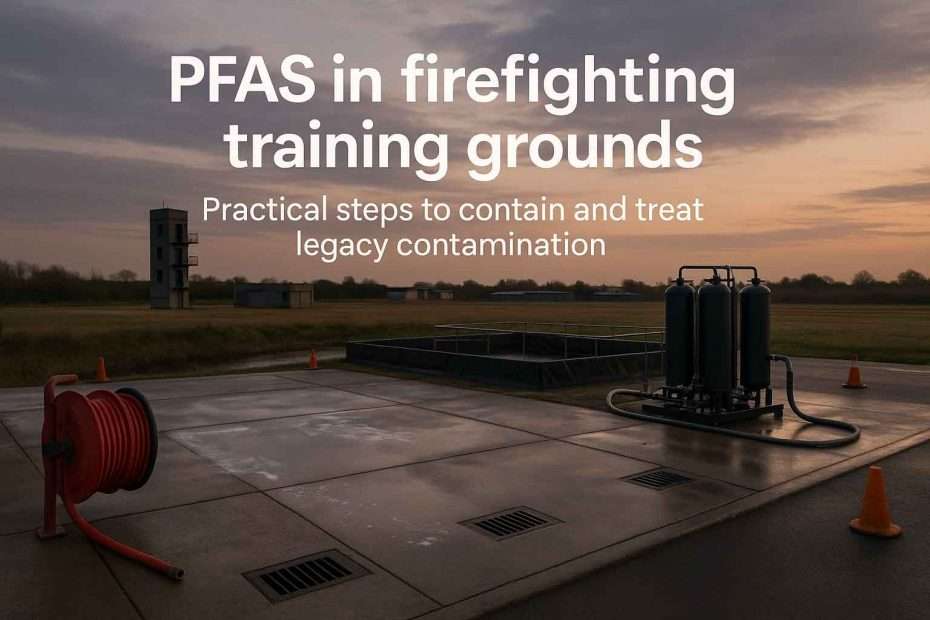
PFAS in firefighting training grounds
Practical steps to contain and treat legacy contamination
Summary: Firefighting training with aqueous film-forming foams (AFFF) has left many UK sites with per- and polyfluoroalkyl substances (PFAS), often called “forever chemicals.” This article explains, in plain language, how PFAS from historical training have spread, the practical steps site owners can take right now to contain and reduce exposure, and how enzymatic pretreatment can make proven downstream PFAS capture and destruction methods more effective and affordable. It provides a simple, UK-focused roadmap and shows how Bioglobe’s organic, bespoke enzyme solutions help remediate contamination without harming local ecosystems.
PFAS have quietly become one of the most challenging environmental issues of our time. They resist heat, repel oil and water, and were widely used in firefighting foams for realistic training scenarios on airfields, industrial estates, ports, refineries, and firefighter training centres. Those same properties that made PFAS invaluable in emergencies now make them stubborn in the environment: they do not break down easily, can travel long distances in water, and can accumulate in living organisms.
At many training grounds, AFFF was applied repeatedly over years. Foam solution ran over concrete and asphalt pads, through gullies, into separators or sumps, and often into unlined ditches, lagoons, or soakaways. Some sites had gravel-filled trenches or permeable layers beneath pads that allowed liquids to infiltrate. Over time, PFAS migrated into nearby soils, sediments and groundwater, creating long-lived plumes. Today, a site might look tidy, with modern practices in place, but the historical legacy can still be moving slowly beneath the surface.
This article is intended for ordinary readers: site owners, facilities managers, community representatives, and anyone who wants a clear overview and practical next steps. It avoids jargon where possible and explains what can be done now, what to plan next, and how organic, enzyme-based pretreatment helps the whole clean-up process work better—without harming the ecosystem.
What PFAS are and why training grounds are a hotspot PFAS are a large family of man-made chemicals. The most well-known include PFOS and PFOA, though many other variants exist. They were used in AFFF because they form a thin film that quickly spreads over fuel, cutting off oxygen and suppressing vapours. In training scenarios, foams were deployed repeatedly so crews could learn real-world skills. Unfortunately, regular application meant large volumes of diluted foam entered the environment over decades.
Why are PFAS problematic? In simple terms:
- They are extremely persistent. The strong bonds in their chemical structure resist natural breakdown.
- They are mobile in water. Rainfall and drainage carry them through soils and into streams, ditches and aquifers.
- They can accumulate in people and wildlife. Over time, PFAS can build up, raising health concerns.
At training grounds, PFAS contamination tends to concentrate around:
- The training pad itself and any cracks or joints.
- Drainage channels, gullies, interceptors, sumps and separators.
- Unlined ditches, lagoons, soakaways and reedbeds used historically to manage water.
- Low-lying fields where water settles or infiltrates.
- Downgradient groundwater, where PFAS can form plumes that move slowly over years.
Risk pathways from historical AFFF use, in plain English PFAS can move along several routes. Understanding these helps you break the problem into manageable parts.
- Surface water When it rains, water runs off the training pad, collects in drains or gullies, and flows to ditches, swales, or nearby streams and ponds. If that water contains PFAS, the chemicals can spread beyond your site boundary unless intercepted.
- Groundwater Some training grounds have permeable ground or cracks that allow water to trickle downwards. PFAS can move with this water into deeper soils and, eventually, into aquifers. These underground plumes are hard to see and can migrate off site over time.
- Soil and dust In dry conditions, contaminated soils can produce dust. While PFAS are more of a water issue, disturbed dusty soils and sediments can still move PFAS around locally and create exposure risks for workers.
- Sediments Ditches and ponds that receive contaminated water often build up sediments over years. These sediments can act like a “secondary source,” slowly releasing PFAS back into water long after the original foam use has stopped.
- Pipework and assets Old pipe runs, sumps, interceptors and separators may hold PFAS-laden residues or sludges. When disturbed or when water levels fluctuate, PFAS can be released again.
- Food chain Where PFAS reach water bodies, they can accumulate in fish and aquatic life. If livestock graze on affected land, PFAS may enter animal tissues. Over time, PFAS can make their way into the broader food chain.
Why ordinary site actions sometimes make things worse It’s natural to want to “clean” a site by power-washing, flushing drains, or digging out ditches. But without containment, these actions can mobilise PFAS and move them further into the environment. That’s why a cautious, stepwise approach is best: contain first, then treat.
Interim containment and sorption options you can deploy now Many valuable actions are simple, affordable and permissible as early steps. They reduce exposure and stop further spread while a longer-term plan is developed.
- Good housekeeping at the pad
- Keep training areas clean and dry when not in use. Avoid hosing foam residues into open ground.
- Seal obvious cracks, joints and drains where water can escape into soil.
- Install small lip bunds or edge barriers to prevent runoff leaving the hardstand.
- Control the water
- Intercept drainage from the training area into lined sumps or temporary tanks.
- Temporarily disconnect or bypass soakaways that discharge to the ground.
- During heavy rainfall, use additional modular tanks to capture first flushes.
- Sorption “polishing”
- Fit portable filtration units using suitable media such as high-quality activated carbon or PFAS-selective ion exchange resins. These can be placed on a bypass line or at discharge points.
- Monitor the system and replace media when it approaches “breakthrough” (when PFAS starts to appear in the outlet).
- Sediment management
- Survey ditches, lagoons and reedbeds that have received runoff in the past.
- Carefully remove highly contaminated sediments and store or dispose of them appropriately. Disturb as little area as possible at any one time to limit mobilisation.
- Prevent erosion that could carry sediments further downstream.
- Exposure reduction
- Restrict livestock grazing, crop production or fishing in obviously impacted areas until testing confirms safety.
- Use simple signage and barriers to keep the public and pets away from contamination hotspots.
- Nature-based buffering (with caution)
- Vegetated swales, gentle bunds and reed fringes can slow water and trap sediments.
- Recognise these do not remove PFAS on their own; they simply help control hydraulics and reduce sediment movement while other treatment steps capture the PFAS.
What these steps achieve
- Immediate reduction in the spread of PFAS.
- Lowered risk to people and wildlife in the short term.
- A stable, controlled setup that allows accurate sampling and proper treatment planning.
- Time to pilot and optimise treatment trains, rather than rushing into a single large, inflexible system.
How enzymatic pretreatment helps PFAS treatment work better PFAS are very persistent. No honest adviser will claim that enzymes alone will “destroy PFAS” in every case. Instead, think of enzymes as powerful helpers that make the rest of the treatment work better, last longer and cost less. Here’s how.
- They reduce fouling of filters and media Real-world water from training grounds rarely contains PFAS alone. It often carries oils, greases, detergents, proteins, fibres, organic matter and fine solids. These substances clog and coat activated carbon or resins, forcing early replacement and driving up costs.
- Enzymes targeted at fats (lipases), proteins (proteases) and carbohydrates (amylases) can break down these co-contaminants into simpler, more manageable forms.
- With less grease and gunk, sorption media stay effective for longer, and maintenance intervals stretch out. That means fewer change-outs and lower operating costs.
- They improve contact and transfer PFAS can stick to soils, sludges and biofilms. Enzymatic blends, often working alongside gentle, eco-safe biosurfactants, can help release PFAS from these matrices, transferring them more efficiently into the water phase where they are much easier to capture in a controlled unit.
- This is especially useful when treating sediments or cleaning internal surfaces of pipes and sumps. Rather than spreading contamination, you’re deliberately moving it into a captured stream for treatment.
- They prepare the flow for final destruction Some technologies can break PFAS down, including high-temperature mineralisation, supercritical water oxidation, advanced electrochemical oxidation, non-thermal plasma, or UV-based systems with appropriate reagents. These processes work best when the water has a lower organic load and fewer interfering substances.
- Enzymes help “precondition” the water so downstream destruction systems are more efficient, reliable and, ultimately, smaller and less energy-intensive than they would be otherwise.
- They support nature-based elements without harming ecosystems Where reedbeds, wetlands or biofilters are part of the overall water management, enzyme dosing helps prevent grease and fibre clogging. That keeps hydraulics functioning and maintains oxygen levels, while PFAS are diverted to proper capture and destruction steps. Crucially, organic enzyme blends can be designed to be eco-safe and biodegradable.
Bioglobe’s role in an enzyme-enabled PFAS programme
- Analyse. Bioglobe begins with laboratory analysis of your site samples—waters, sludges, sediments, and soils as appropriate. This identifies the types and levels of PFAS and, critically, the co-contaminants that will foul filters or complicate treatment.
- Formulate. Based on the sample profile, Bioglobe designs a bespoke, organic enzyme blend. Every site is different; we tailor the formulation for your specific matrix and temperature/pH conditions. The blends are designed to be compatible with wildlife and plants.
- Pilot. We support on-site pilots that dose enzyme pretreatment ahead of the PFAS sorption step, measuring changes in filter life, breakthrough timing, maintenance needs, and overall PFAS capture performance.
- Optimise. With pilot data, we tune the dosing regime and help you select the right sorption media and destruction route for spent media or concentrated eluates.
- Implement safely. The final programme is practical, scalable, and documented so you can demonstrate performance to regulators and stakeholders—with an emphasis on ecosystem protection and transparency.
A simple UK roadmap for site owners Month 0–2: Diagnose
- Gather history. Review training records, foam types used, dates, volumes, and changes in practice.
- Walk the site. Inspect pads, drains, oil-water separators, sumps, lagoons, ditches, reedbeds, soakaways and any low-lying areas. Note staining, odours, sediment build-ups and wet spots.
- Sample smartly. Take representative samples of surface water, groundwater (if accessible), soils/sediments and sludges. Test for a suite of PFAS, plus co-contaminants such as oils and greases, detergents, COD, suspended solids and metals. Record weather and flow conditions.
Month 2–4: Contain and plan
- Install immediate controls. Divert drainage to lined tanks or sumps, temporarily disable soakaways, and add bunds or barriers to prevent runoff.
- Fit portable filtration. Use carbon or PFAS-selective resins in skid units to treat collected waters before discharge or transport.
- Lab formulation. Send composite samples to Bioglobe for analysis and bespoke enzyme design focused on your fouling profile.
Month 4–8: Pilot
- Dose enzyme pretreatment upstream of the filtration unit. Track:
- Influent and effluent PFAS levels.
- Carbon/resin life extension and breakthrough timing.
- Reductions in oils, greases and COD.
- Maintenance needs (backwashing, change-outs, blockages).
- If soils and sediments are major sources, consider a controlled soil-washing trial with enzyme-assisted elution to transfer PFAS into a manageable water stream.
Month 8–12: Optimise and select destruction
- Size the final system based on pilot results.
- Choose a destruction pathway for spent media or concentrated PFAS streams. Options include high-temperature mineralisation off site or an approved on-site technology where suitable.
- Prepare documentation for regulators, including sampling plans and performance data.
Ongoing: Monitor and communicate
- Keep measuring. Regularly sample to confirm that PFAS concentrations remain under control and that media are performing as expected.
- Maintain infrastructure. Inspect bunds, tanks, filters, and dosing systems. Keep records of change-outs and maintenance.
- Be open. Share results with stakeholders and the community where appropriate to build trust.
Frequently seen site scenarios and what to do
- Historic pad with open ditch to a farm drain
- Problem: When it rains, PFAS-laden water reaches a field drain and then a stream.
- Near-term actions: Install a small bund and intercept drain; pump to a lined tank. Fit a simple filtration skid before any discharge or transfer. Start enzyme pretreatment to reduce fouling and stabilise flow.
- Medium term: Survey ditch sediments; remove hotspots carefully. Consider a vegetated buffer to slow flows—while remembering PFAS still need capture.
- Old training ground with a reedbed “treatment” cell
- Problem: The reedbed controls flow but does not remove PFAS, and it may now store PFAS in sediments.
- Near-term actions: Sample inlet, reedbed and outlet; install pre-bed interception with filtration. Use enzyme dosing to prevent clogging and keep hydraulics efficient.
- Medium term: Plan for PFAS capture upstream of the reedbed. Manage or remove the most impacted sediments under controlled conditions.
- Interceptor and sumps with greasy sludges
- Problem: Sumps hold oily sludges that foul filters and slowly release PFAS.
- Near-term actions: Controlled clean-out, with captured liquids treated through enzyme pretreatment and sorption. Avoid flushing to soil.
- Medium term: Modify operations to prevent future build-up; consider enzyme maintenance dosing to keep lines and sumps clear.
- Groundwater plume suspected off site
- Problem: PFAS detected in monitoring wells moving away from the site boundary.
- Near-term actions: Enhance capture at source to cut plume feeding. Consider a small hydraulic control system or pumping of hotspot wells with above-ground treatment.
- Medium term: Evaluate permeability and geology to design a focused plume management plan. Avoid broad excavation unless justified; target hot zones.
Why “organic, enzyme-first” is good for ecosystems and budgets
- It works with nature, not against it. Enzymes are biodegradable, targeted and designed for eco-safety. They support, rather than suppress, beneficial microbes and plants.
- It cuts waste and energy. Extending sorbent life means fewer change-outs, less transport of heavy media, and lighter carbon footprints.
- It avoids harsh chemicals. You reduce the need for aggressive reagents that can harm downstream biology or leave unwanted residues.
- It enables right-sizing. With a cleaner influent, you can often use smaller, smarter destruction systems—lowering capital and running costs.
Plain-English guidelines for safe site practice
- Don’t hose contamination into the ground. Capture and contain first.
- Don’t rely on reedbeds alone to remove PFAS. They are flow controllers, not PFAS solutions.
- Don’t excavate blindly. You may spread PFAS in dust or move the problem around. Sample before you dig and keep disturbed areas small and controlled.
- Do protect workers. When handling contaminated sediments or sludges, use appropriate protective equipment and avoid creating aerosols or dust.
- Do keep records. Simple logs of weather, flows, sampling and maintenance make your life easier with regulators and contractors.
- Do start small and prove it. Pilots save money by showing what works on your site before you scale up.
How this looks over a year, step by step
- The first two months focus on fact-finding and stabilising the site. You’ll already reduce risk and stop spread.
- Months three to six demonstrate the value of enzyme pretreatment: fouling drops, media last longer, and your contractor spends less time swapping filters.
- Months seven to twelve let you right-size the final system and choose the best destruction option with real data in hand, not guesswork.
Community and stakeholder reassurance PFAS headlines can worry communities. A calm, transparent approach helps rebuild trust:
- Share the basics in plain language: where the PFAS were, how they moved, and what you’re doing.
- Show that you are containing first, not pushing contamination around.
- Explain why you’ve chosen enzyme pretreatment: to protect nature, reduce waste, and make proven capture and destruction methods work better.
- Commit to regular monitoring and updates. People appreciate consistent, factual communication.
Problem – Consequences – Solution Problem Historical firefighting training with AFFF often left PFAS in pads, drains, ditches, and groundwater. Even if foam use stopped years ago, PFAS may still be moving slowly through soils and waters, showing up in ditches, ponds or wells.
Consequences If not controlled, PFAS can spread off site, accumulate in wildlife and livestock, and raise concerns for local communities. Cleanup becomes harder and more expensive the longer contamination is left to move. Simple maintenance actions like power-washing or ditching can unintentionally worsen the problem.
Solution Contain first. Capture runoff in lined tanks, avoid soakaways, and install appropriate filtration with activated carbon or PFAS-selective resins. Manage sediments carefully. Then add Bioglobe’s organic enzyme pretreatment to break down greases, detergents and other foulants so your filters last longer and capture PFAS more effectively. This enzyme-first approach is safe for ecosystems, lowers costs, and makes downstream PFAS destruction methods perform better. Bioglobe can analyse your samples, design a bespoke enzyme blend, pilot it on site, and guide you through to full cleanup.
A closer look at enzyme-enabled soil and sediment strategies While many projects focus on water, soils and sediments are often the true source. Here are practical, eco-minded tactics that combine containment, enzymes, and sensible engineering:
- Targeted soil washing Where feasible, excavate only the worst “hotspots” under controlled conditions. Use an enzyme-assisted wash to mobilise PFAS into a closed-loop water phase, then treat that water with sorption and plan destruction for the concentrate or spent media. This minimises dust, reduces volume, and avoids wholesale removal of healthy soils.
- Gentle hydraulic management If ditches are essential for drainage, keep them stable. Enzymatic pretreatment upstream reduces greasy deposits and fibres that otherwise trap sediments and change flow paths. This helps maintain predictable hydraulics while your filters do the PFAS work.
- Sediment capping or selective removal For ponds or cells with high PFAS in sediments, consider partial removal of the most contaminated layers. Where removal is impractical, engineered capping can limit resuspension and slow release. Always pair with upstream capture to stop recontamination.
- Line and seal critical points Simple liners in sumps and key ditches, plus sealing of pad joints, can dramatically reduce infiltration. The less water moving through contaminated zones, the less PFAS migrates.
- Maintenance dosing Small, periodic enzyme doses can keep infrastructure clear and maintain stable performance—especially helpful through winter when temperatures and flows fluctuate.
Practical procurement notes for site owners
- Ask for a pilot by default. A short pilot often pays for itself by preventing overdesign and by revealing the right media and change-out intervals.
- Specify media accountability. Insist on data for carbon or resin life and breakthrough curves based on your pilot, not just generic brochures.
- Include whole-life costs. A cheaper filter with half the life is not cheaper. Consider replacement frequency, labour, waste handling, and transport.
- Make monitoring part of the contract. Sampling, field meters, and clear reporting keep everyone focused on outcomes.
Regulatory and compliance perspective in the UK Regulators increasingly expect practical, risk-based control measures coupled with transparent monitoring. An enzyme-enabled programme fits well with these expectations:
- It starts with containment and measurable source control.
- It uses recognised capture steps (carbon, resins) with defensible performance data.
- It selects destruction routes that are established or well-piloted for PFAS wastes.
- It prioritises ecosystem protection by avoiding harsh chemical additions and by supporting nature-based hydraulics where appropriate.
Health and safety: doing the basics well
- Plan tasks to avoid creating dust and aerosols.
- Use appropriate protective equipment during sediment handling and filter change-outs.
- Keep enzyme handling straightforward—closed containers, basic PPE, and sensible hygiene.
- Train staff on sampling to avoid cross-contamination and get reliable results.
What success looks like after a year
- The site no longer discharges PFAS-laden water unchecked.
- Filtration media last significantly longer thanks to enzyme pretreatment.
- Sediments in key ditches or cells have been managed without widespread disturbance.
- PFAS in downstream samples trend downward, and community concerns ease.
- A realistic, right-sized final system is in place, with clear plans for media handling and ultimate destruction.
Why Bioglobe
- Organic and ecosystem-friendly. Our enzyme blends are designed to be biodegradable and safe for wildlife and plants.
- Bespoke, not off-the-shelf. Every site has a different mixture of co-contaminants and conditions. Our lab in Cyprus formulates to your exact needs, then we tune on site.
- Practical and proven thinking. We focus on containment, pilots, and data-led optimisation. The goal is steady, reliable progress—no silver bullets, just good science and good engineering.
- End-to-end support. From sample analysis and pilot design to monitoring plans and operational guidance, we help you move from problem to proof, then to permanent solutions.
FAQs
- Are enzymes enough to remove PFAS on their own? No. PFAS are extremely persistent, and most real-world clean-ups rely on capture (such as activated carbon or PFAS-selective resins) followed by an approved destruction step for the concentrates or spent media. Enzymes make these stages work better by breaking down the greases, detergents and organics that clog filters and shorten their life. Think of enzymes as the enabler that reduces cost, improves reliability, and protects the ecosystem in the process.
- What can we do immediately at a training ground while planning full remediation? You can act right away to reduce risk: intercept and store runoff from pads, avoid soakaways, fit portable filtration to treat captured water, and manage sediments carefully. Small bunds and sealing of cracks help a lot. Then plan an enzyme-enabled pilot upstream of the filtration so you can extend media life and improve PFAS capture while collecting data for a long-term plan.
- Will this harm wildlife or plants? Bioglobe’s formulations are organic and designed to be eco-safe. They do not sterilise soils or harm beneficial organisms. Instead, they help restore natural processes and reduce reliance on aggressive chemicals. By focusing on containment and treatment rather than dispersal, you protect nearby habitats, streams and ponds.
- How long until we see results? Some benefits appear quickly. Containment and filtration can reduce off-site movement within weeks. The advantages of enzyme pretreatment—longer media life, fewer blockages, and better PFAS capture—typically become clear over one to three months of operation, as you compare maintenance and breakthrough to your baseline.
- What does Bioglobe actually do on a PFAS site? We analyse your samples to understand the PFAS and the co-contaminants that cause fouling. We then create a bespoke, organic enzyme blend for your conditions. We help you pilot dosing upstream of capture units, monitor performance, and optimise the setup. Finally, we help you choose a practical destruction route for spent media or concentrates and provide a monitoring framework so you can demonstrate progress to regulators and the community.
Closing thoughts PFAS at firefighting training grounds is a solvable problem when approached calmly and systematically. Contain first so you stop spread. Capture PFAS with proven media. Use enzyme pretreatment to make everything run cleaner, longer, and more affordably—without damaging the very ecosystems you are trying to protect. Build your solution step by step with small pilots and clear data. Over a year, the combination of common sense and modern, organic biotechnology can turn a persistent legacy into a managed, shrinking risk.
Bioglobe stands ready to help you diagnose, design and deliver an enzyme-enabled remediation programme that fits your site, your budget and your duty of care to people and nature alike.
Bioglobe offer Organic Enzyme pollution remediation for major oil-spills, oceans and coastal waters, marinas and inland water, sewage and nitrate remediation and agriculture and brown-field sites, throughout the UK and Europe.
We have created our own Enzyme based bioremediation in our own laboratory in Cyprus and we are able to create bespoke variants for maximum efficacy.
Our team are able to identify the pollution, we then assess the problem, conduct site tests and send samples to our lab where we can create a bespoke variant, we then conduct a pilot test and proceed from there.
Our Enzyme solutions are available around the world, remediation pollution organically without any harm to the ecosystem.
For further information:
BioGlobe LTD (UK),
Phone: +44(0) 116 4736303| Email: info@bioglobe.co.uk