

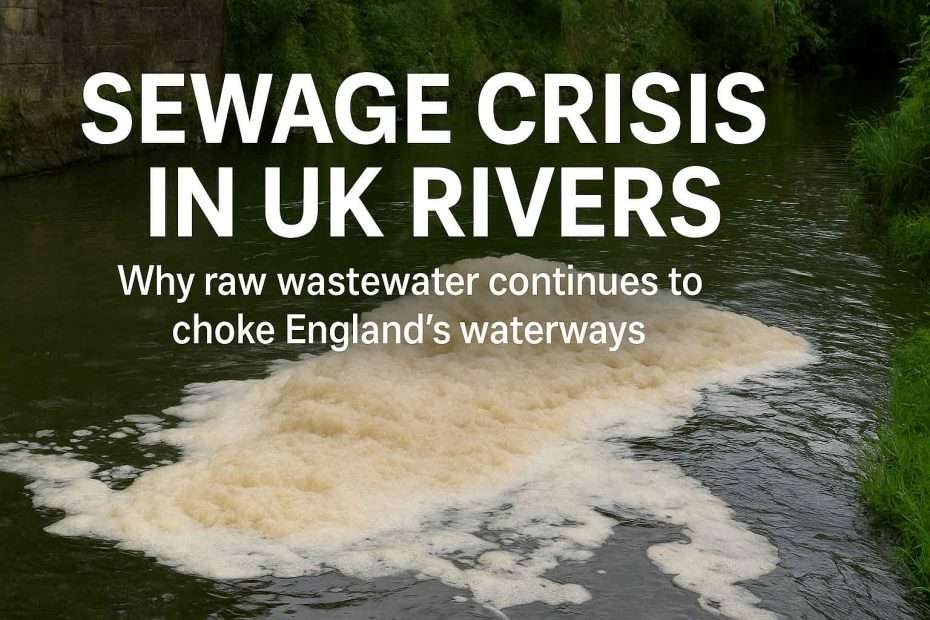
Sewage Crisis in UK Rivers
Why raw wastewater continues to choke England’s waterways
Summary
In recent years, water companies in England have discharged raw sewage into rivers and coastal waters for millions of hours, sparking public outrage and deep environmental concern. Ageing infrastructure, under-investment and increasing pressure from climate change have contributed to this crisis. While major upgrades to the sewer network will take years, there is growing interest in complementary, nature-based technologies. BioGlobe’s organic enzyme bioremediation offers precisely such a tool — capable of breaking down pollutants safely and effectively without harming aquatic ecosystems. In this article, we examine the scale of the problem, its impacts, government and industry responses, and how enzyme-based remediation could play a vital role in restoring cleaner, healthier waterways.
The Problem: Sewage Pollution in UK Rivers
A National Crisis of Duration and Scale
In 2024 alone, water companies in England discharged raw, untreated sewage into rivers and the coast for a staggering 3.61 million hours. (The Guardian) Although the number of separate spill events dropped slightly compared to 2023, the total duration of sewage discharge actually increased. (GOV.UK)
Storm overflow points — where sewage is mixed with rainwater — are central to the crisis. England has more than 14,000 such overflows, many of which are operating far more frequently than they should. (The Guardian) The average number of spills per overflow was 31.8 in 2024, according to the Environment Agency. (GOV.UK) Despite legally permitted “exceptional circumstances,” many of these overflows are now being used regularly. (The Guardian)
Among the worst offenders, Thames Water reported its raw sewage discharges rose by 50 percent in 2024 compared to the previous year, reaching nearly 300,000 hours. (The Guardian) This reflects not just wet weather, but deeper systemic problems: decades of underinvestment, mounting debts, and ageing Victorian-era infrastructure that is struggling to cope. (The Guardian)
Regional Hotspots and Rivers Under Threat
The problem isn’t evenly distributed. Some regions, rivers and overflows are being hit much harder than others. (The Guardian) For example:
- The River Irwell and its tributary, the Croal, near Manchester and Salford, have seen extremely high spill frequencies — more than 12,000 spills in 2023 in that catchment area. (The Guardian)
- The River Darwen, also in the North West, saw over 3,000 sewage overflows in 2023 — equating to around 83 spills per mile of river. (The Guardian)
- In the south, the River Avon, flowing through Bath and Bristol, also makes this “worst-spill” list. (The Guardian)
Meanwhile, coastal waters and lakes are not immune. Bodies such as Windermere, England’s largest natural lake, have been plagued by elevated nutrient and bacterial levels tied to sewage discharges. (BioGlobe)
Infrastructure Under Strain
To understand why so much sewage is being released, one must look at the underlying infrastructure. Much of England’s sewer system was built in the Victorian era, designed to carry both rainwater and sewage in the same pipes. When heavy rain overwhelms the system, excess flow is routed through storm overflows into rivers — a safety valve, but one that is now being used routinely. (The Guardian)
Water companies, many of which are privately owned, face monumental challenges: they need to modernise tens of thousands of overflows, monitor and control discharges, and balance their financial books — all while dealing with climate change, increased rainfall, and public anger.
Regulatory Pressure and Public Scrutiny
The Environment Agency’s 2024 data reveals that although more than 2,500 storm overflow points are slated for upgrades, many “high-frequency” overflows remain untouched. (GOV.UK) In fact, an analysis found that over half of the worst offenders (those that spill repeatedly) reported no meaningful repairs in 2024. (The Guardian)
Public outrage has grown. Campaigners, citizen scientists and local communities are calling for urgent action. Rivers once considered natural jewels are now described as “toxic chemical soups.” (The Independent) Moreover, the scale of the problem is increasingly being framed not just as an environmental issue, but as a national emergency. (The Guardian)
Consequences: How Sewage Spills Harm People and Nature
The crisis of sewage pollution in England is not just about ugly headlines or dirty rivers — it has profound and wide-ranging implications.
Ecological Damage
Raw sewage is a complex mix of organic matter (proteins, fats, carbohydrates), bacteria, nutrients (especially nitrogen and phosphorus), and potentially harmful chemicals. When released into rivers:
- Oxygen Depletion: Organic matter fuels biological oxygen demand (BOD), meaning microbes consume oxygen rapidly to break down the waste. This can suffocate fish and other aquatic life.
- Nutrient Overload: Nutrients like phosphorus and nitrogen can lead to eutrophication — triggering algal blooms that block sunlight, reduce oxygen levels, and upset the ecological balance.
- Pathogens: Untreated sewage carries harmful microbes, including E. coli and other bacterial indicators, which pose direct risks to wildlife and humans.
- Chemical Pollutants: Pharmaceuticals, microplastics and personal care chemicals may also be present, which aren’t always fully removed by conventional treatment processes.
Together, these effects impair water quality, damage biodiversity, and reduce the resilience of river ecosystems.
Public Health Risks
Sewage-polluted waterways pose serious risks to human health and wellbeing:
- Swimming: Wild swimming in rivers or coastal waters that have been contaminated can expose people to harmful bacteria, increasing the risk of infections, skin illnesses, or gastrointestinal diseases.
- Drinking water: Although treated drinking water typically comes from carefully managed sources, the presence of sewage in connected catchments raises alarm about the efficacy and safety margins of treatment works — especially those under strain.
- Recreation and Livelihood: Polluted rivers can no longer support thriving recreational or commercial fisheries, reducing tourism, harming jobs and damaging the social fabric of river communities.
Reputational and Trust Damage
The repeated scandals over raw sewage discharges have eroded public trust in water utilities. When residents learn that their local river has been repeatedly used as a conduit for untreated waste, confidence in the water companies’ commitment to environmental stewardship declines. That distrust also extends to regulators, who are increasingly seen as too lenient or too slow.
Financial and Regulatory Burdens
Fixing this crisis comes at a cost:
- Massive investment needs: The Water Industry National Environment Programme (WINEP) sets out thousands of actions — including upgrading over 2,500 storm overflows — with billions of pounds earmarked for the work. (GOV.UK)
- Fines and penalties: Water companies may face regulatory penalties for illegal or excessive discharges.
- Bill payer impact: To fund improvements, water companies are raising bills — a cost passed on to consumers, many of whom feel they’re paying for decades of mismanagement.
- Delayed action: Even with pledges in place, upgrades take years. During that time, pollution continues, and nature continues to suffer.
The Current Response: What Is Being Done — and Why It May Not Be Enough
Government and Regulator Moves
The government, through the Environment Agency, is pushing for stronger regulation and more transparency. According to the 2024 spill data, water companies have committed to upgrading storm overflows, and there will be more monitoring: thousands of sites are slated to receive event duration (spill) monitors. (GOV.UK)
Under WINEP, water companies are required to take tens of thousands of environmental actions over five years, backed by multi-billion-pound investments. (GOV.UK) The reported £22.1 billion fund for environmental improvements will go in part to reduce rainfall reaching overflow points via nature-based solutions. (GOV.UK)
Politically, the government has announced a target to halve sewage pollution by 2030 — a major promise that has grabbed headlines and been welcomed by campaigners.
Industry Challenges
Despite these pledges, progress has been slower than many hoped:
- Some of the worst offending overflows saw no meaningful repairs in 2024. (The Guardian)
- The financial burden is enormous: water companies operate under tight margins, growing debt, and increasing regulatory and public scrutiny.
- The infrastructure challenge is vast: upgrading sewer networks, retrofitting overflow points, and installing real-time monitors is complex and time-consuming.
- The industry is also under pressure to justify costs to customers. While investments are being made, many customers question whether they will see tangible change in their lifetimes.
The Solution: How BioGlobe’s Organic Enzyme Remediation Can Help
At this point, it’s tempting to think: “Is there anything that can make an immediate impact while the water companies catch up with infrastructure?” This is where BioGlobe’s enzyme-based, organic bioremediation offers a compelling, complementary approach — not a replacement for physical upgrades, but a powerful tool in the interim.
What Is Enzyme Bioremediation?
BioGlobe specialises in organic enzyme solutions: proteins that act as biological catalysts to speed up the breakdown of pollutants in contaminated environments. (BioGlobe) These enzymes can be tailored for different applications — including sewage — because BioGlobe analyses pollutant samples in its laboratories and develops bespoke formulations. (BioGlobe)
The key enzymes often used include:
- Proteases: to degrade proteins
- Lipases: to break down fats and oils
- Cellulases: to act on fibrous, plant-derived organic matter
- Other specialist enzymes: depending on the types of pollutants (e.g., hydrogels with laccases) (BioGlobe)
Some BioGlobe formulations are deployed in enzyme-assembled hydrogels — polymeric networks that stabilise the enzyme, protect it from harsh conditions, and allow it to act efficiently and sustainably. (BioGlobe)
How Enzymes Tackle Sewage Pollution
Here’s how enzyme remediation could make a real difference in polluted river systems:
- Targeted breakdown of organic pollutants
Enzymes can directly attack the major organic constituents of sewage (proteins, fats, sugars), breaking them down into simpler compounds. These simpler compounds are then far easier for natural microbes to consume, accelerating the cleanup. - Reduction in sludge and BOD
Because enzymes reduce the load of complex organic matter, they help reduce biological oxygen demand (BOD) and chemical oxygen demand (COD). That means less oxygen depletion and a healthier aquatic environment. - Nutrient control
By breaking down nutrient-rich organic matter more efficiently, enzymes can help reduce the risk of eutrophication (over-fertilisation of waterways that leads to algal blooms). - Pathogen mitigation
While enzymes don’t directly “kill” pathogens in the same way disinfectants do, by reducing the organic “food” that pathogens thrive on, they can lower bacterial loads and help stabilise microbial communities. - Safe for ecosystems
BioGlobe emphasises that its enzyme solutions are biotic, fully biodegradable, and non-toxic. After they perform their function, they break down into amino acids — natural building blocks that are reused in the ecosystem. (BioGlobe) This makes them safe even in waters supporting fish, aquatic plants and wildlife. - Supporting natural microbe recovery
Once enzymes have done the heavy lifting, native aquatic microbes can more easily complete the degradation process. This synergy between enzymes and microbes enhances long-term recovery and resilience.
Deployment Approaches: Flexible and Scalable
BioGlobe offers several deployment strategies depending on the site context:
- Hydrogel modules: These are floating or submerged devices containing immobilised enzymes. They can be placed at inflow points (e.g., where sewage enters a river) to treat polluted water in situ. (BioGlobe)
- Enzyme cartridges: These can be installed in sewer outfalls or overflow points to treat wastewater at source, before it disperses. (BioGlobe)
- Hybrid solutions: Combining hydrogels with aeration or biochar strips could trap and treat pollutants as water flows through, reducing nutrient concentrations downstream and limiting algal blooms.
Advantages Over Traditional Methods
Compared to conventional chemical or physical treatments, enzyme remediation offers several strengths:
- Milder operating conditions: Enzymes work under ambient temperatures and neutral pH, so they don’t require energy-intensive heating or harsh chemicals. (BioGlobe)
- Lower risk of harmful by-products: Unlike oxidants or disinfectants, enzymes don’t produce toxic secondary compounds.
- Reusability: Enzymes immobilised in hydrogels can remain active for longer, reducing the frequency of re-application. (BioGlobe)
- Eco-aligned: Because the process and by-products are natural, enzyme remediation aligns strongly with environmental protection goals and regulatory priorities.
- Community and regulatory appeal: The visible results (e.g., clearer water, fewer algal blooms) can build trust with local communities; meanwhile, regulators may support enzyme-based pilots as nature-based, decentralised interventions. In fact, BioGlobe has highlighted the potential to link citizen science with enzyme deployments. (BioGlobe)
Case Study: Windermere and Enzyme Solutions
BioGlobe has already envisioned how its technology could make a real-world impact. One of the most striking examples is Windermere, England’s largest lake, where high levels of phosphorus and bacterial contamination have been tied to sewage discharges. (BioGlobe)
In this context, BioGlobe proposes:
- Floating hydrogel modules to reduce nutrient concentrations and limit algal blooms. (BioGlobe)
- Enzyme cartridges at inflow points to treat sewage as it enters the lake. (BioGlobe)
- Monitoring frameworks (e.g., BOD, COD, phosphorus, E. coli) to track progress. (BioGlobe)
These interventions could deliver rapid, visible improvements while long-term infrastructure upgrades are underway.
How BioGlobe’s Approach Complements Infrastructure Upgrades
It is essential to stress that enzyme remediation is not a magic bullet — it does not replace the need for major investment in sewer networks, treatment works and monitoring systems. But it functions as a bridge, one that helps manage pollution today even as larger-scale infrastructure projects progress.
Here’s how it complements existing efforts:
- Immediate action
While building new sewage tunnels, upgrading treatment works, or replacing overflows takes years, enzyme treatments can be applied now to mitigate ongoing pollution. - Targeted intervention
Enzyme systems can be deployed at “hot spots” — rivers, lakes or overflows where sewage impact is worst. This helps maximise environmental benefits where they are needed most. - Cost efficiency
Large infrastructure works are hugely expensive. Enzyme bioremediation, although not free, represents a relatively modest cost in comparison, especially when delivering immediate ecological wins. - Supporting regulatory goals
With regulators pushing for reductions in sewage pollution, and with increased monitoring (e.g., more sensors, more transparency), enzyme-based projects demonstrate to both the public and regulators that water companies are not simply waiting for long-term fixes — they are proactively restoring water quality. - Community engagement
Local communities caring for their rivers can be directly involved. Enzyme deployments can go hand in hand with citizen-science water quality monitoring, creating real-time feedback loops and strengthening public trust. BioGlobe has experience and interest in coupling its remediation projects with community-driven data. (BioGlobe)
Challenges and Considerations
No solution is without its obstacles, and enzyme remediation is no exception. To make a meaningful and sustainable impact, BioGlobe’s approach must navigate several practical challenges:
- Stability and Robustness
Enzymes are proteins and can degrade or denature under extreme conditions (e.g., very high or low pH, temperature, inhibitors). Immobilisation (via hydrogels) helps, but the designs must be carefully tailored for each site. (BioGlobe) - Scalability
Some rivers or catchments are large, with high flows and variable pollution loads. Scaling up enzyme applications to treat significant volumes may require many devices (hydrogels, cartridges) and careful logistical planning. - Cost and Funding
Although cheaper than large infrastructure projects, enzyme systems still demand capital, recurring maintenance, and monitoring. Funding will need to be secured — potentially through restoration funds, regulatory support, or environmental levies. - Integration
Enzyme remediation should not be a siloed technology — it needs to be integrated with other interventions: sewer upgrades, nature-based solutions (wetlands, buffer strips), monitoring and regulation. - Measuring Impact
Quantitative, credible measurement is critical. Projects must define clear performance metrics (such as BOD/COD reduction, nutrient decline, E. coli counts, biodiversity recovery), establish baselines, and monitor over time. Trust from regulators and communities depends on being transparent and rigorous. - Long-Term Maintenance
Enzyme systems will require maintenance, replacement, or replenishment. Planning for long-term deployment means budgeting for these needs and ensuring that responsibility does not fall through the cracks.
A Vision for the Future: Cleaner Rivers, Healthier Communities
Imagine a future in which every river and lake in England — from the Irwell near Manchester to Windermere in the Lake District — shows clear signs of ecological recovery. One where algal blooms are less common, oxygen levels are stable, and wildlife returns. Local people swim and fish with confidence, knowing their waterways are protected.
In this future:
- BioGlobe’s enzyme modules float at inflow points, quietly—but powerfully — digesting organic pollutants before they spread downstream.
- Communities monitor water quality themselves, collaborating with scientists, using open dashboards that show improvements week by week.
- Regulators incentivise enzyme-based pilot projects as part of a layered, nature-based approach to water quality restoration.
- Water companies pair enzyme interventions with longer-term infrastructure investments, reducing reliance on overflows while they rebuild pipes, treatment works, and buffer zones.
- Education and awareness campaigns teach people about biological remediation — helping ordinary citizens understand that nature-based science can heal.
This is not a utopia, nor is it a quick fix. But it is a pragmatic, scientifically grounded, and ecologically sensitive approach. BioGlobe’s organic enzyme bioremediation offers a powerful tool — a bridge between today’s polluted reality and the cleaner, more resilient waterways of tomorrow.
Why BioGlobe Stands Out
Here are some of the key reasons why BioGlobe’s approach is uniquely suited to help in the UK’s sewage crisis:
- Custom Formulations: Because BioGlobe analyses real pollution samples, it can design enzyme blends tailored to each situation.
- Biodegradable & Safe: Its enzymes are plant-based or organic, break down into amino acids, and pose no long-term risk to fish or wildlife. (BioGlobe)
- Proven Technology: Use of proteases, lipases and immobilised enzyme hydrogels shows strong scientific foundations. (BioGlobe)
- Flexible Deployment: Multiple deployment methods (hydrogels, cartridges) mean BioGlobe can adapt to rivers, lakes, and sewer outflows.
- Community Engagement: BioGlobe supports citizen-science monitoring, making remediation a collaborative process. (BioGlobe)
- Regulatory Alignment: Enzyme remediation aligns with the UK government’s push for innovative, nature-based environmental solutions.
What Needs to Happen for Enzyme Remediation to Scale in the UK
To fully realise the potential of enzyme-based remediation — especially in the context of the sewage crisis — several things must align:
- Pilot Projects
- Local authorities, environmental NGOs, water companies and regulators should co-fund pilot deployments in critical river catchments or high-risk overflow sites.
- Demonstration projects should include robust scientific monitoring and transparent reporting.
- These pilots can build the evidence base, show cost-efficiency, and win community support.
- Funding Mechanisms
- Restoration funds from fines levied on polluters could be allocated to enzyme remediation.
- Government grants or innovation funds could support early adopters.
- Water companies might include enzyme remediation in their environmental spend as part of their compliance strategies.
- Regulatory Support and Incentives
- Regulators such as the Environment Agency and Ofwat should encourage enzyme-based projects via policy frameworks.
- Enzyme deployments could count toward environmental improvement targets.
- Real-time monitoring requirements (e.g., spill sensors) should be paired with active remediation programmes, not just passive reporting.
- Community Education and Participation
- Citizen-science platforms should be expanded so that people living near rivers can report water quality, support remediation projects, and track progress.
- Public outreach can demystify enzymes, explain how they work, and help communities understand why remediation matters.
- Research & Development
- Continued R&D is needed to improve enzyme stability, extend lifetimes, and reduce costs.
- Exploration of multi-enzyme systems, smarter deployment (e.g., drones, automated rafts), and hybrid solutions (enzymes + plants or microbes) could further enhance impact.
- Partnerships between academic institutions, BioGlobe, water companies, and governmental bodies will accelerate innovation.
Conclusion
The sewage crisis in England’s rivers is a deeply troubling symptom of decades of underinvestment, climate pressure, and neglect. Millions of hours of raw sewage continue to flow into waterways, damaging ecosystems, threatening public health, and undermining trust in the institutions charged with protecting our environment.
Yet amid this dark picture, there is real hope: BioGlobe’s organic enzyme bioremediation offers a green, science-based, and scalable approach to helping rivers recover. While it is not a replacement for the massive infrastructure upgrades that the country desperately needs, enzyme remediation provides a powerful interim tool — one that is effective, environmentally safe, and community-friendly.
By breaking down organic pollutants, supporting natural microbes, reducing oxygen demand, and curbing nutrient loads, enzyme systems can help buy time and reduce the environmental burden on our rivers. Enzyme modules, strategically deployed, monitored closely, and maintained responsibly, can form a bridge between the polluted present and a cleaner, more resilient future.
But for that future to become reality, concerted action is required: pilots, funding, regulatory support, public engagement and ongoing innovation. With the right commitment, enzyme remediation could become a cornerstone of Britain’s water restoration strategy — a way not just to stop the sewage, but to restore the natural vitality of our rivers, lakes and coasts.
At BioGlobe, we are ready to play our part. Our lab can analyse real-world pollutant samples, design bespoke enzyme formulations, deploy them in rivers or lakes, and work with communities and regulators to monitor success. Together, we can turn the tide on sewage pollution — not just with promises, but with results.
FAQs
- What exactly are the enzymes that BioGlobe uses, and how do they break down sewage?
BioGlobe uses enzymes like proteases, lipases and cellulases, tailored to break down proteins, fats and fibrous organic matter. These catalysts accelerate the decomposition of complex pollutants into simpler, non-toxic compounds, which native aquatic microbes can then consume more easily. - Is there any risk that using enzymes will harm wildlife — such as fish or aquatic plants?
No. BioGlobe’s enzyme solutions are organic and biodegradable. After they complete their task, they degrade into amino acids — natural and harmless building blocks. The approach is designed to be ecosystem-friendly, preserving fish and plant life rather than harming it. - How long does it take for enzyme remediation to improve water quality?
It depends on several factors: pollutant concentration, water flow, enzyme formulation, and deployment method. But generally, enzyme action begins quickly once applied, and noticeable improvements (e.g., reductions in BOD, nutrient levels, or microbial indicators) can emerge within weeks or months — especially when paired with good monitoring. - Will implementing BioGlobe’s enzyme systems be expensive for water companies?
While there is a cost to design, deploy, and monitor enzyme systems, they are often more cost-effective in the short and medium term than large-scale infrastructure upgrades. For many “hot spot” overflows or polluted sites, enzymes may offer a high-impact, lower-cost intervention while bigger works are underway. - Can enzyme remediation replace traditional infrastructure improvements, like fixing sewer pipes or expanding treatment works?
No — enzyme remediation is best understood as complementary, not a substitute. While it helps reduce pollution in the short to medium term, long-term solutions still require overhaul of sewer networks, better overflow controls and investment in treatment plants. Enzymes help fill the gap while those long-term projects proceed.
Bioglobe offer Organic Enzyme pollution remediation for major oil-spills, oceans and coastal waters, marinas and inland water, sewage and nitrate remediation and agriculture and brown-field sites, throughout the UK and Europe.
We have created our own Enzyme based bioremediation in our own laboratory in Cyprus and we are able to create bespoke variants for maximum efficacy.
Our team are able to identify the pollution, we then assess the problem, conduct site tests and send samples to our lab where we can create a bespoke variant, we then conduct a pilot test and proceed from there.
Our Enzyme solutions are available around the world, remediation pollution organically without any harm to the ecosystem.
For further information:
BioGlobe LTD (UK),
Phone: +44(0) 116 4736303| Email: info@bioglobe.co.uk