

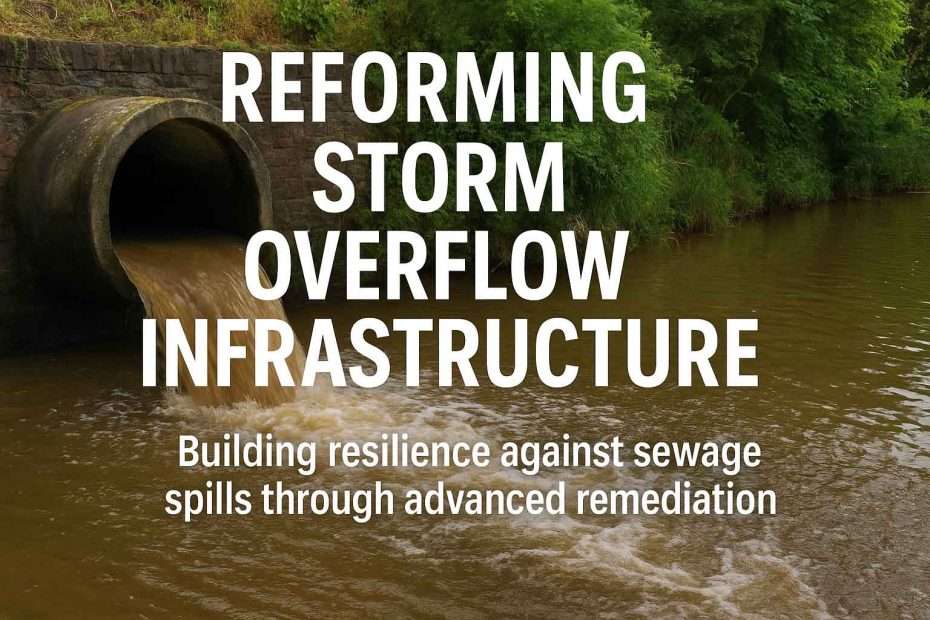
Reforming Storm Overflow Infrastructure
Building resilience against sewage spills through advanced remediation
Introduction
Across the United Kingdom, storm overflows have become one of the most urgent and widely discussed sources of water pollution. These systems, originally designed as emergency relief valves for combined sewers, now release untreated sewage into rivers, lakes, and coastal waters far more frequently than most people realise. As climate change drives more intense rainfall and population growth places additional pressure on ageing sewer networks, water companies are struggling to keep pace. The result: millions of hours of sewage discharges every year, declining ecological health, and rising public frustration.
At the heart of this challenge is a simple structural fact—much of the UK’s wastewater infrastructure is old, undersized, and not built for modern environmental expectations. The scale of investment required to fix the problem is enormous, making government planning and technological innovation absolutely essential. While major infrastructure projects are underway, they will take years to complete, and the country cannot afford to sit idle while rivers suffer.
This is where modern, nature-based remediation approaches offer real hope. BioGlobe, through its organic enzyme bioremediation solutions, provides a safe, highly effective, and environmentally gentle method for treating sewage pollution both within sewer networks and at discharge points. By integrating enzyme technology into refurbished or newly constructed overflow infrastructure, water companies can significantly reduce the impact of spills—without adding more chemicals or harming the delicate ecosystems already under strain.
This article examines the storm overflow problem in depth, explains the consequences of failing to modernise our sewer systems, and presents BioGlobe’s organic enzyme remediation as a powerful part of a cleaner, more resilient future for Britain’s waterways.
Problem
A Sewer System Built for a Different Era
Many of the sewer networks in the UK were laid over a century ago. In many towns and cities, a single pipe carries both wastewater and rainwater—a combined sewer system. This arrangement worked adequately when rainfall was predictable and populations were smaller. Today, however, the situation is very different.
Climate change has altered rainfall patterns dramatically. Sudden downpours, prolonged wet periods, and extreme weather events mean huge volumes of water can enter the sewer system within a matter of minutes. When these networks become overloaded, they cannot rely solely on conventional processing capacity. To prevent sewage backing up into homes and streets, water companies divert excess flow into storm overflows.
While the principle is understandable—no one wants sewage flooding their living room—this solution is now causing more harm than good. Frequency of spills has increased sharply. Far from being used only in emergencies, storm overflows have become a frequent operating mechanism.
The Normalisation of Sewage Spills
Not long ago, most people assumed that sewage entering rivers was a rare incident caused by extraordinary circumstances. Today, the reality is widely known: discharges happen daily across the country. Water monitoring technology and growing media attention have exposed the sheer scale of the issue.
Monitoring has improved, public expectations have changed, and environmental standards have tightened. However, the infrastructure remains largely outdated, meaning that storm overflow discharges continue to be an entrenched problem. Many overflows operate far beyond what engineers originally intended, and government bodies continue to publish sobering data on the number and duration of spills.
Underinvestment and Delayed Modernisation
The cost of modernising the entire sewer network is immense—estimates often stretch into tens of billions of pounds. Large-scale upgrades require political commitment, regulatory pressure, and long-term investment cycles. For years, upgrades lagged behind what was needed.
Only recently have ambitious plans begun to take shape:
- Large tunnels and storage systems designed to capture overflow.
- Expansion of treatment capacity at wastewater plants.
- Better monitoring and prediction tools for managing peak flow.
- Legislative frameworks that set requirements for spill reduction.
Nevertheless, infrastructure projects take time. Even with increased investment, meaningful change will not happen overnight.
Pollution Load Within Overflow Discharges
The wastewater released during storm events contains a complex mixture of pollutants:
- Human waste, including pathogens and microbial contaminants.
- Organic material that increases biochemical oxygen demand.
- Nutrients such as nitrogen and phosphorus that trigger algal blooms.
- Household chemicals and residues.
- Microplastics and fats, oils, and grease (FOG).
- Solids and sediments that accumulate within sewer networks.
This pollution does not simply “wash away”. It settles into riverbeds, builds in sediment layers, and degrades water quality long after the overflow event has ended.
Regulatory and Enforcement Challenges
Regulatory bodies have introduced increasingly detailed rules around monitoring, reporting, and reducing sewage discharges. However, enforcement has often been uneven. Water companies face complex organisational pressures, large operational areas, and conflicting financial priorities. While fines and public scrutiny have increased, the gap between expectations and performance remains substantial.
Public trust has been damaged—and with good reason. People expect clean rivers, not diluted sewage.
Consequences
The storm overflow crisis affects everyone—but its consequences are often hidden from view. Understanding these impacts helps explain why reforming infrastructure is so important and why supplementary treatments like BioGlobe’s enzymatic remediation are crucial to protecting ecosystems.
1. Environmental Degradation
When untreated sewage enters rivers, the immediate effect is a spike in organic pollution. Microorganisms consume this material, using up dissolved oxygen in the water. Declining oxygen levels can:
- Kill fish and aquatic invertebrates.
- Disrupt breeding cycles of sensitive species.
- Reduce biodiversity across entire river stretches.
- Trigger algal blooms that further suffocate aquatic life.
Some rivers recover slowly, but frequent discharges prevent natural regeneration.
Additionally, fats and oils congeal into deposits that clog habitats and sediment surfaces. Chemical detergents and household products introduce toxins that linger in the environment. Microplastics, abundant in wastewater, accumulate in river beds where they enter the food chain and affect larger animals.
2. Public Health Risks
People who swim, paddle, row, fish, or engage with water-based recreation are exposed to pathogens including bacteria, viruses, and parasites. This can lead to:
- Gastrointestinal illnesses.
- Skin, eye, and ear infections.
- More serious complications for vulnerable individuals.
Even those who do not directly enter the water may be indirectly exposed through contaminated fish, pets entering rivers, or floodwater spread.
3. Impact on Local Communities
Storm overflow issues contribute to wider social and economic impacts:
- Decline in local tourism when beaches or river areas receive pollution warnings.
- Reduced appeal of riverfront walking routes and leisure spaces.
- Falling community pride and rising frustration with utilities and government agencies.
- Business interruptions for companies reliant on clean water environments.
Communities often feel powerless against a large-scale problem that requires national solutions.
4. Loss of Trust in Water Companies
News stories about sewage spills, fines, and infrastructure failures have caused widespread loss of confidence. Many people believe companies have prioritised short-term financial gains over long-term environmental resilience.
Trust is further eroded when sewage spills appear to increase despite public awareness and political attention. Transparency has improved, but the public increasingly demands not just monitoring—but action.
5. Rising Financial Pressures
Infrastructure reform is expensive. The cost is ultimately borne by a combination of:
- Water company investment.
- Government funding.
- Customer bills.
While long-term improvements will benefit everyone, customers understandably question why they should pay more when the current system is not working. Without alternative remediation strategies, costs could climb even higher.
6. Long-Term Ecological Harm
Unchecked sewage discharge not only harms river life today but also has lasting effects that may take decades to reverse. Sediments can hold pollutants for years. Chemicals can accumulate in wildlife. Biodiversity loss can become permanent if habitats collapse.
A growing number of British rivers now struggle to meet even basic ecological standards. Without integrated solutions—both infrastructure upgrades and supplementary remediation—many of these waterways may not recover.
Solution
Modernising storm overflow infrastructure is essential. But even when the network is improved, extreme weather events will still cause occasional failures. Therefore, the country needs a layered approach that includes:
- Engineering upgrades
- Better monitoring
- Nature-based remediation
- Responsible planning
This is where BioGlobe’s Organic Enzyme Remediation plays a vital role.
BioGlobe provides a safe, proven, and ecologically harmonious method of treating the pollution associated with storm overflows. This is not a replacement for infrastructure investment—it is a complementary solution that can significantly reduce harm while large-scale upgrades are underway, and can continue to enhance system resilience even after improvements are complete.
1. What BioGlobe’s Enzyme Technology Does
BioGlobe has developed advanced organic enzyme blends that accelerate natural biological processes. Instead of relying on harsh chemicals, these solutions use enzymes—biological catalysts—that break down specific pollutants found in sewage.
Types of enzymes used include:
- Proteases – break down proteins in human waste.
- Lipases – digest fats, oils, and grease.
- Cellulases – break down plant-based organic matter.
- Amylases – break down carbohydrates.
These processes convert harmful organic pollutants into harmless, biodegradable by-products such as water, carbon dioxide, and simple nutrients.
Importantly, BioGlobe’s enzymes:
- Are completely organic.
- Do not introduce toxins or synthetic chemicals.
- Decompose naturally after completing their task.
- Do not harm aquatic plants or animals.
The solution mirrors the way nature cleans water—only faster and more efficiently.
2. Targeted Remediation Through Bespoke Blends
Every storm overflow behaves differently. Factors include:
- Pollution load
- Flow rates
- Local infrastructure shape
- Temperature
- Pre-existing microbial populations
BioGlobe addresses this complexity by analysing samples in its Cyprus laboratory, where enzyme blends are customised for each case. This bespoke approach ensures maximum treatment effectiveness and avoids the inefficiencies of one-size-fits-all chemical treatments.
3. Integration with Upgraded Infrastructure
As water companies invest in:
- Larger storage tanks
- Improved treatment capacity
- Smarter monitoring systems
- Overflow redesign
- Sustainable drainage systems
BioGlobe’s enzyme solutions can be integrated directly into these systems. For instance:
Dosing within storage tanks
Enzymes can be added to stormwater tanks to break down sewage during storage, reducing the pollution level of any necessary discharge.
Pipeline and sewer conditioning
Enzymes prevent build-up of fats, oils, and grease that constrict flow and contribute to overflow events. They keep pipelines cleaner and more efficient.
Lagoon and settlement basin treatment
Where water is held for pre-discharge settling, enzymes work to reduce organic load and odour, improving environmental outcomes.
Post-discharge intervention
Enzyme treatments can be deployed at sites with vulnerable ecosystems, reducing long-term damage and supporting natural restoration.
4. Zero Ecological Impact
Unlike chemical disinfectants or aggressive industrial agents, BioGlobe’s enzymes:
- Do not kill beneficial microbes.
- Leave no toxic residues.
- Do not alter pH levels in harmful ways.
- Do not accumulate in the food chain.
After performing their function, the enzymes simply degrade, leaving behind nothing harmful. This is crucial for rivers already under stress from multiple pollution sources.
5. Quick Wins During Long-Term Infrastructure Upgrades
Large engineering projects can take years before tangible benefits are felt. Enzyme remediation provides immediate help:
- Reducing pollution impact at overflow points
- Lowering organic load before environmental release
- Improving odour control
- Reducing blockages that contribute to overflows
- Enhancing microbial balance within sewer networks
These benefits work in tandem with long-term investment plans, helping bridge the gap between policy and environmental reality.
6. Alignment with Regulatory Frameworks
Environmental policy cycles such as AMP8 have set clear expectations for pollution reduction. BioGlobe’s solution supports compliance by:
- Improving water quality outcomes
- Making discharges less harmful
- Supporting ecological targets
- Providing measurable pollution reduction
- Enabling water companies to demonstrate proactive improvement
Nature-based remediation is increasingly encouraged by regulators, who recognise that technology must be part of the toolkit for cleaner rivers.
Building a Resilient Future
Modernising storm overflow infrastructure requires commitment from government, water companies and technology providers. The public also plays a role, through water use habits, volunteering, and advocacy.
BioGlobe’s organic enzyme remediation represents a forward-thinking, environmentally conscious step in this national effort. The approach reflects a broader shift in environmental engineering towards solutions that work with nature rather than against it.
A resilient future for Britain’s waterways includes:
- Strong regulation
- Major infrastructure investment
- Smart monitoring and prediction systems
- Sustainable urban drainage
- Public engagement
- And crucially, organic remediation technologies that can reduce pollution safely and effectively
Storm overflows may always exist in some form—but their impact does not have to be harmful. By integrating BioGlobe’s enzyme solutions into modern systems, water companies can dramatically reduce ecological damage without introducing new risks.
Conclusion
The UK’s storm overflow system is at a turning point. The public demands action, ecosystems require urgent protection, and government plans are being rolled out at a scale not seen for decades. Upgrading the network will take time, money, and engineering expertise, but the need for immediate mitigation is clear.
BioGlobe’s organic enzyme remediation offers a powerful, science-backed method for reducing the harm caused by sewage spills, both during the transition to improved infrastructure and beyond. It is safe, natural, and effective—and crucially, it supports a future where British rivers and coastlines are cleaner, healthier, and more resilient.
Storm overflows were never designed to operate as frequently as they do today. Reforming this system is essential, but doing so responsibly means combining engineering with biology. With bespoke enzyme solutions, BioGlobe is ready to help water companies protect ecosystems, achieve regulatory compliance, and restore public trust. A cleaner water future is achievable—and organic remediation will be a key part of delivering it.
FAQs
1. What is a storm overflow and why does it discharge sewage?
A storm overflow is a relief point in a combined sewer system. When heavy rain overwhelms the network, the overflow releases diluted sewage into waterways to prevent flooding in homes and streets.
2. Why can’t we simply eliminate storm overflows?
Storm overflows are built into historic sewer systems. Removing them entirely would require complete reconstruction of sewer networks, costing enormous sums and taking decades. Reducing their use is the realistic goal.
3. How is BioGlobe’s enzyme remediation different from chemical treatment?
Unlike chemical disinfectants, BioGlobe’s enzymes are organic and biodegradable. They break down pollution naturally without harming aquatic life or leaving toxic residues.
4. Can enzyme remediation be used everywhere?
Yes. Because BioGlobe creates bespoke enzyme blends tailored to local conditions, treatments can be applied in storage tanks, sewer lines, settlement basins, and natural water bodies.
5. Does enzyme remediation replace infrastructure upgrades?
No. It complements them. Enzymes reduce immediate harm from spills and improve water quality, while long-term infrastructure investment addresses the root structural problems.
Bioglobe offer Organic Enzyme pollution remediation for major oil-spills, oceans and coastal waters, marinas and inland water, sewage and nitrate remediation and agriculture and brown-field sites, throughout the UK and Europe.
We have created our own Enzyme based bioremediation in our own laboratory in Cyprus and we are able to create bespoke variants for maximum efficacy.
Our team are able to identify the pollution, we then assess the problem, conduct site tests and send samples to our lab where we can create a bespoke variant, we then conduct a pilot test and proceed from there.
Our Enzyme solutions are available around the world, remediation pollution organically without any harm to the ecosystem.
For further information:
BioGlobe LTD (UK),
Phone: +44(0) 116 4736303| Email: info@bioglobe.co.uk