

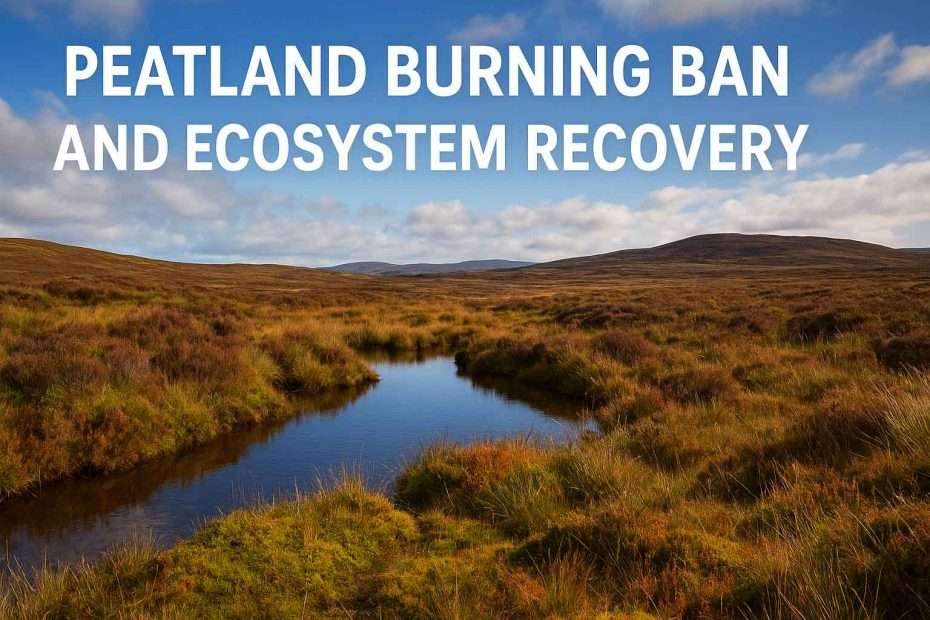
Peatland Burning Ban and Ecosystem Recovery
How restoring peatlands can cut carbon and clean the air
Summary
England has introduced a ban on burning deep peat to reduce carbon emissions, revive damaged ecosystems, and protect air quality. This article explains why peatlands matter, the environmental harm caused by burning, and how bioremediation — including Bioglobe’s organic enzyme solutions — can support peatland restoration and long-term climate resilience.
Introduction
Across England’s uplands and lowlands, peatlands form some of the most remarkable, yet most fragile, ecosystems in the country. They are vast stores of carbon, ancient archives of environmental history, and essential habitats for rare wildlife. When healthy and hydrated, peatlands quietly perform functions that benefit us all: holding back floodwaters, filtering air, supporting biodiversity, nurturing plant communities, and locking away greenhouse gases.
But for decades, many of these peatlands have been drained, dried, and routinely burned, usually in the name of land management. Burning is sometimes intended to encourage new heather growth for grouse shooting estates, or to manage vegetation load. Yet the scientific evidence is clear: burning deep peat degrades the soil, harms wildlife, releases stored carbon, and contributes to poor air quality.
The recent ban on burning deep peat in England marks a significant turning point in how these precious landscapes are protected. But a ban alone does not reverse the damage already done. Vast areas of peatland remain degraded, polluted, or ecologically unstable. True restoration requires active intervention — thoughtful, science-based, nature-positive solutions applied with care and long-term commitment.
This is where Bioglobe enters the picture. With a laboratory in Cyprus specialising in organic enzyme bioremediation and a commitment to environmentally safe solutions, Bioglobe is uniquely equipped to support the regeneration of damaged peatlands. Their methods focus on working with natural processes, enhancing microbial activity, detoxifying soils, and restoring ecological balance without introducing harmful chemicals or heavy disturbance.
This article explores the full context of peatland burning, the ecological and public health impacts, and the role of cutting-edge bioremediation in bringing these landscapes back to life. It is written for ordinary readers who want to understand what the burning ban means, why peatlands are vital, and how organic solutions can contribute to a healthier environment.
1. The Importance of Peatlands
What are peatlands?
Peatlands are waterlogged landscapes composed of partially decomposed plant material, built up over thousands of years. This slow decomposition happens because the waterlogged conditions prevent plant matter from breaking down fully. Instead, it accumulates as layers of peat.
Although peatlands cover only a small portion of the UK’s land area, they store more carbon than all the forests of the UK and France combined. Every centimetre of peat represents decades — sometimes centuries — of carbon accumulation. When peat dries out or burns, that carbon is released back into the atmosphere.
Peatlands as carbon sinks
Healthy peatlands are one of the most efficient carbon-storing ecosystems on Earth. Unlike forests, where carbon is stored in living biomass, peatlands store it in the soil itself. When water is retained, the carbon remains locked in place indefinitely.
A single square metre of peat can store as much as the annual emissions of a typical car. Across England, millions of tonnes of carbon lie beneath our feet in peat layers, quietly stabilising the climate.
Biodiversity and habitat value
Peatlands are unique ecosystems supporting species such as:
- sphagnum mosses
- short-eared owls
- curlews
- adders
- sundews (carnivorous plants)
- bog rosemary
- dragonflies and damselflies
- rare insects and amphibians
These species depend on stable, wet peatland environments. Burning disrupts the plant and microbial communities that sustain them.
Water storage and flood protection
Peatlands act like giant sponges. When saturated, they absorb rainfall and slowly release it, reducing flood risk downstream. When degraded, water runs off quickly, contributing to flash flooding and soil erosion.
Cultural and archaeological value
Peat preserves organic materials that would decay elsewhere — artefacts, wooden structures, even preserved human remains. These deposits offer insights into prehistoric climate, vegetation, and human activity.
2. Why Was Burning Done, and Why Is It Being Banned?
For generations, controlled burning (often called “muirburn”) has been carried out across upland Britain to stimulate the growth of young heather shoots favoured by red grouse. The practice was defended on grounds of tradition, estate management, and perceived ecological benefits.
However, scientific research increasingly shows that burning on deep peat is harmful:
- It lowers the moisture content of the peat.
- It destroys sphagnum moss, the key builder of peat layers.
- It increases erosion and runoff.
- It releases particulates and carbon into the air.
- It impairs water quality by releasing dissolved organic matter.
- It damages habitats for rare species.
As a result, England has introduced a ban on burning peat deeper than 30 cm. Scotland and Wales have taken similar steps.
The burning ban reflects a clear shift in national priorities: climate action, biodiversity protection, and air quality now outweigh the historically narrow interests of grouse moor management.
But banning future burning does not solve the damage already caused. Many peatlands remain degraded, hydrologically unstable, and polluted. Restoration is both necessary and urgent.
3. Problem
Even with the ban in place, England faces several pressing problems related to peatland degradation.
Drying and oxidation of peat
Decades of burning have dried out the upper peat layers. Once peat is dry, oxygen enters the soil and triggers microbial decomposition. This process releases carbon dioxide and sometimes methane, accelerating climate change.
Loss of sphagnum mosses
Sphagnum mosses are the engines of peat growth. They retain water, acidify the environment, and build new peat. Burning destroys these mosses and allows hardier but less peat-forming plants like heather to dominate.
Altered soil chemistry
Burning can leave behind residues, ash, and degraded organic matter. This affects:
- nutrient balance
- pH levels
- microbial activity
- availability of carbon compounds
These changes hinder natural regeneration.
Air pollution from historic burning
Even though burning is restricted, the particulates and carbon released in the past have long-lasting effects on local air quality and public health.
Habitat fragmentation
Large, continuous peatlands have been broken into degraded patches, reducing habitat connectivity for wildlife.
Water quality issues
Burned peat releases dissolved organic carbon into streams and rivers, increasing water treatment costs and affecting aquatic biodiversity.
4. Consequences
The degradation of peatlands has far-reaching implications for people, wildlife, and the climate.
1. Increased carbon emissions
Instead of storing carbon, degraded peatlands emit it. In some areas, damaged peat releases more carbon each year than a small town. This undermines national climate targets.
2. Air pollution
Burning peat produces fine particulate matter and gases that affect respiratory health. Vulnerable people — children, older adults, and those with asthma — suffer the most.
3. Loss of wildlife
Species that rely on wet habitats decline rapidly when peatlands dry out. Ground-nesting birds lose safe breeding grounds. Amphibians and insects disappear. Plants adapted to bog conditions struggle to survive.
4. Increased flood risk
Dry peat cannot absorb water effectively. Heavy rainfall runs quickly into rivers, overwhelming natural limits and increasing flood frequency and severity.
5. Soil erosion
Without stable moss layers, peat is washed away, thinning the soil and exposing deeper layers that are even more carbon-rich — creating a destructive feedback loop.
6. Reduced water quality
Peat particles washed into rivers darken the water and increase the cost of filtration for drinking water supplies.
7. Long-term ecological instability
Once burned, peatlands can take centuries to recover naturally. Without active intervention, many may never return to their original state.
5. Solution: How Bioglobe’s Organic Enzyme Bioremediation Can Help
Restoring peatlands requires more than blocking drainage ditches or planting mosses. The soil itself must be repaired, detoxified, and biologically rebalanced. Bioglobe’s organic enzyme bioremediation offers a powerful, environmentally friendly approach to accelerate peatland recovery.
Bioglobe’s approach is based on three principles:
- Work with nature, not against it.
Enzymes are natural catalysts already used by microbes and plants. Bioglobe’s solutions simply enhance natural processes without introducing chemicals or synthetic additives. - Repair the soil at a molecular level.
The soil’s chemistry, structure, and microbial communities must be restored before vegetation can thrive. - Ensure no ecological harm.
All enzyme blends are organic, biodegradable, and tailored to the site’s needs, leaving no toxic residues.
Stage 1: Scientific Site Analysis
Bioglobe begins with a detailed assessment of the peatland:
- sampling peat layers
- identifying pollutants
- understanding pH, moisture, and organic matter composition
- measuring microbial diversity
- assessing hydrological condition
- mapping vegetation cover
This analysis allows Bioglobe to identify the specific challenges facing each site.
Stage 2: Designing a Bespoke Enzyme Blend
Different peatlands face different challenges. Some are contaminated by atmospheric pollutants, others by agricultural runoff, while some suffer mainly from organic degradation caused by burning.
Bioglobe formulates enzyme blends that target:
- degraded organic residues
- oxidised carbon compounds
- unwanted chemical pollutants
- imbalance in microbial communities
Common enzyme groups used include:
- laccases for breaking down complex organic residues
- peroxidases for stabilising carbon compounds
- cellulases and hemicellulases to help rebuild natural soil structure
- hydrolases for detoxifying contaminants
- enzymes that enhance beneficial microbial activity
These formulations are engineered to work in waterlogged, acidic environments typical of peatlands.
Stage 3: Gentle, In-situ Application
Enzymes are applied directly to the peat through methods such as:
- spraying
- injection
- ground surface distribution
- slow-release gel formulations
Critically, this does not require disturbing the peat or using heavy machinery.
The enzymes begin working immediately, accelerating natural decomposition and rebuilding processes.
Stage 4: Restoring Microbial Balance
Healthy peat depends on a diverse community of microbes. Burning disrupts this balance. Bioglobe’s enzymes help restore microbial populations by:
- breaking down toxic residues that inhibit microbes
- making nutrients available
- stabilising pH
- encouraging beneficial bacteria and fungi
- reducing conditions that favour pathogenic or harmful microbes
Microbial recovery is essential for long-term ecosystem stability.
Stage 5: Supporting Water Retention and Soil Structure
As the enzymes break down damaged compounds and restore natural chemistry, the peat begins to regain its sponge-like structure. This helps:
- retain water
- encourage the return of sphagnum mosses
- rebuild peat layers
- reduce erosion
- stabilise the landscape
Stage 6: Working Alongside Rewetting and Replanting Projects
Enzyme bioremediation complements — rather than replaces — other restoration efforts:
- rewetting programmes
- blocking old drainage channels
- planting mosses and wetland plants
- reseeding native grasses and shrubs
- installing natural barriers or living walls to regulate water flow
Bioglobe’s approach ensures these interventions succeed by creating a stable soil foundation.
Stage 7: Long-term Monitoring
Peatland recovery can take years, but Bioglobe maintains ongoing assessment:
- soil sampling
- microbial analysis
- carbon-storage measurement
- vegetation surveys
- hydrology tracking
This ensures restoration continues smoothly and enzyme formulations can be adjusted if needed.
6. Why Bioglobe’s Approach Is Safe for the Environment
Bioglobe’s organic enzyme technology is fundamentally different from chemical treatments that risk ecological side effects.
100% biodegradable
Enzymes naturally break down over time into harmless amino acids.
Non-toxic to plants, animals, and microbes
They support native species rather than replacing or suppressing them.
No residue accumulation
Unlike chemicals, enzymes do not build up in the soil.
Non-disruptive to soil structure
Application is gentle and does not require digging or mechanical disturbance.
Tailored to each site
This ensures ecosystems are supported rather than shocked with generalised treatments.
7. How Peatland Restoration Benefits Everyone
Cleaner air
As peatlands recover and stop releasing particulates, local air quality improves, especially in rural communities.
Lower flood risk
Hydrated peatlands absorb water during storms, protecting downstream towns and farmland.
Stronger climate action
Restored peatlands become carbon sinks once again, helping meet national climate goals.
Protected wildlife
Birds, insects, amphibians, and specialised plants thrive when their habitats are restored.
Healthier landscapes and tourism opportunities
Peatland restoration enhances natural beauty, promoting hiking, birdwatching, and ecotourism.
Reduced water treatment costs
Cleaner peat runoff means less purification is needed for drinking water.
8. Conclusion
The ban on burning deep peat in England marks a historic and necessary step towards protecting one of the nation’s most valuable ecosystems. But banning harmful practices is only the beginning. True restoration requires active, science-based, environmentally safe methods that work with nature rather than against it.
Bioglobe’s organic enzyme bioremediation offers exactly that. By repairing soil chemistry, supporting microbial recovery, detoxifying residues, and restoring water retention, Bioglobe helps peatlands return to their natural state faster and more reliably than passive regeneration alone.
Healthy peatlands mean cleaner air, safer communities, richer biodiversity, and stronger climate protection. By embracing innovative and sustainable technologies, we can ensure that these extraordinary landscapes are preserved and restored for generations to come.
Frequently Asked Questions (FAQs)
1. Why are peatlands so important?
Peatlands store large amounts of carbon, help regulate water flow, support rare wildlife, and improve air quality. They are one of the most effective natural climate stabilisers.
2. Why is burning peat harmful?
Burning dries out the soil, destroys mosses, releases stored carbon, worsens air pollution, and damages habitats. The ban aims to protect ecosystems and cut emissions.
3. How does Bioglobe’s enzyme bioremediation work?
Bioglobe creates bespoke organic enzyme blends that detoxify soils, restore microbes, stabilise peat structure, and assist natural regeneration without harming the environment.
4. Is enzyme bioremediation safe for wildlife and plants?
Yes. Enzymes are natural proteins that biodegrade fully. They do not leave residues or introduce toxins, and they support — rather than replace — native species.
5. How long does peatland restoration take?
It varies depending on the degree of degradation. With interventions such as rewetting and enzyme bioremediation, recovery can begin within months, though full ecological restoration may take years.
Bioglobe offer Organic Enzyme pollution remediation for major oil-spills, oceans and coastal waters, marinas and inland water, sewage and nitrate remediation and agriculture and brown-field sites, throughout the UK and Europe.
We have created our own Enzyme based bioremediation in our own laboratory in Cyprus and we are able to create bespoke variants for maximum efficacy.
Our team are able to identify the pollution, we then assess the problem, conduct site tests and send samples to our lab where we can create a bespoke variant, we then conduct a pilot test and proceed from there.
Our Enzyme solutions are available around the world, remediation pollution organically without any harm to the ecosystem.
For further information:
BioGlobe LTD (UK),
Phone: +44(0) 116 4736303| Email: info@bioglobe.co.uk