

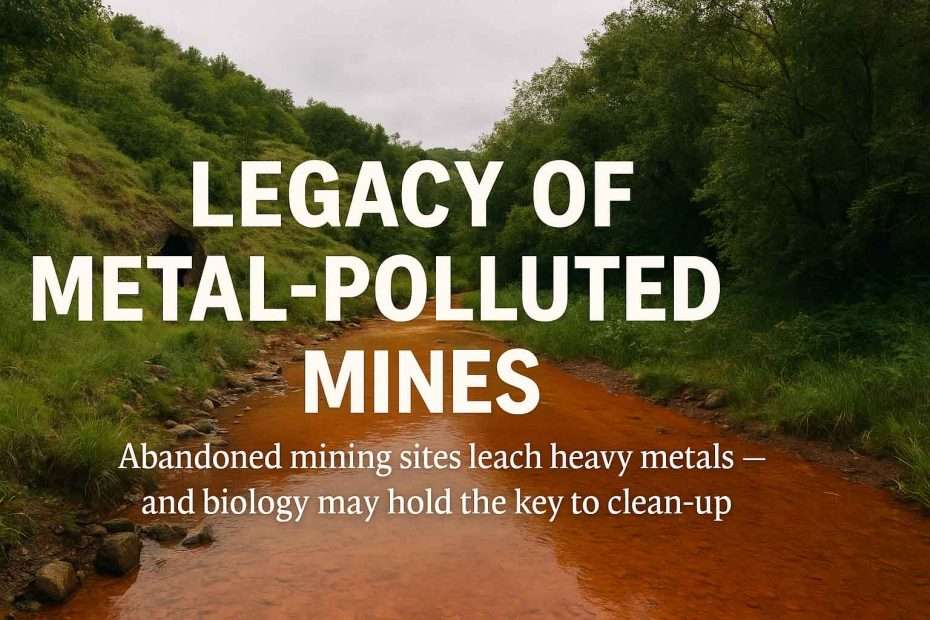
Legacy of Metal-Polluted Mines
Abandoned mining sites leach heavy metals — and biology may hold the key to clean-up
Summary
Across Wales and other historically mined regions of the UK, abandoned metal mines continue to leak hundreds of tonnes of heavy metals into rivers, soils and floodplains every year. Lead, zinc, cadmium, copper, arsenic and other pollutants persist long after mining ends, slowly poisoning waterways and ecosystems. Traditional engineered remediation is costly and often disruptive, and many affected sites are remote, difficult to access or environmentally sensitive. This article explores the scale of the issue, the environmental risks of historic mining, the limitations of conventional approaches, and how biological remediation — including enzyme-based and microbial methods — may offer a sustainable, low-impact and cost-effective path to restoring contaminated areas. Finally, we show how BioGlobe’s organic enzyme technology can support long-term ecosystem recovery without harming the environment.
Introduction
The story of metal mining in the UK is long and complex, stretching back thousands of years. In Wales, Cornwall, the Pennines, and parts of Scotland, mining has been a defining industry. Communities were built around pits and adits, fortunes made and lost, and the landscape reshaped by centuries of human activity.
But when the last miners left and the engines stopped, something else remained: pollution. Heavy metals do not rot away, evaporate, or break down naturally. They linger — in rock, soil, groundwater and river sediments — long after the last piece of ore has been hauled away.
Even today, abandoned mines quietly leak contaminated water, turning streams orange, killing fish, stressing ecosystems, and posing long-term risks to downstream communities. The legacy of historic mining is one of the UK’s most persistent environmental challenges — largely invisible, yet incredibly difficult to resolve.
Despite decades of engineering studies, pilot projects and environmental management schemes, much of the contamination remains unaddressed. Meanwhile, the scale of pollution is enormous: hundreds of kilometres of rivers affected, thousands of abandoned mine entries, and many millions of tonnes of spoil that continue to leach metals into the environment every time it rains.
But there is growing hope. Advances in biological remediation — enzymes, microbes, beneficial fungi, and plant-based systems — are offering a new way to approach mine pollution. These methods work with nature, not against it. They avoid disruptive excavation and chemical treatments. And importantly, they can deliver sustainable improvements that help return ecosystems to long-term health.
This article explains the problem in everyday language, reviews the environmental consequences, and explores why organic enzyme remediation developed by BioGlobe may be part of the solution.
Problem
A legacy of abandoned mines
Across Wales and many parts of the UK, thousands of disused mine workings sit scattered across hillsides, valleys and forests. Some date back only a few decades; others are centuries old. They include lead mines, zinc mines, silver mines, copper mines and mixed-metal workings. Many were small family-run ventures; others were major industrial sites.
When these mines were abandoned, there was no structured clean-up system. Waste rock — often containing high concentrations of metals — was piled into spoil heaps. Underground tunnels were left open. Drainage systems collapsed. Water began seeping through fractured rock, dissolving metals as it moved.
Many mines also contain sulphide minerals, such as pyrite. When exposed to air and water, these minerals oxidise, creating acidic water that can dissolve even more heavy metals — a process known as acid mine drainage.
In the UK’s rainy climate, the problem compounds. Every storm washes metals off spoil heaps, through old shafts, and into nearby streams. The result is a slow but continuous leak of pollution into rivers and soils.
Scale of contamination
Environmental authorities estimate that more than a thousand abandoned mines in Wales alone release significant amounts of heavy metals into the environment each year. Hundreds of tonnes of metals — including lead, zinc, cadmium, copper and iron — seep into rivers annually. Entire river catchments are affected.
Many rivers flowing through former mining regions fail to meet ecological quality standards. In some areas, river sediments contain metal concentrations dozens of times higher than natural background levels. Floodplains accumulate pollutants over decades, and heavy metals become embedded in soil, entering food chains through plants, livestock and wildlife.
The contamination is not uniform: each site has its own chemical profile, influenced by geology, the type of ore mined, local rainfall, soil conditions and water chemistry. This variety makes the problem even harder to address using standard engineering approaches.
Why heavy metals are particularly difficult pollutants
Unlike organic contaminants such as oil or sewage — which can degrade naturally — heavy metals are elemental substances. They do not disappear. They do not break down. They simply move.
Metals can:
- Dissolve in water and travel downstream
- Settle in sediments and later be released during floods
- Bind to organic matter and accumulate in soils
- Enter plant tissue or marine life
- Persist for centuries
The enduring nature of metal pollution means that even if a mine closed hundreds of years ago, its environmental impact may still be active today.
Why traditional remediation is challenging
Conventional remediation often involves large-scale engineering solutions:
- Excavation and removal of contaminated soil
- Construction of water treatment facilities
- Pumping and purifying mine drainage
- Stabilising spoil heaps with concrete or barriers
- Re-routing watercourses
These approaches can be effective in some contexts but have significant drawbacks:
- High cost — often millions of pounds per site
- Ongoing maintenance — particularly for treatment plants requiring constant energy and chemical inputs
- Landscape disruption — heavy machinery, excavation and disturbance of habitats
- Limited scalability — impossible to apply to thousands of affected sites
- Risk of secondary pollution — especially when chemicals or flocculants are used
Given the vast number of abandoned sites and the complexity of each one, fully engineered remediation is simply not feasible everywhere. Many mine sites therefore remain untreated, and pollution continues.
Consequences
Environmental damage
The most immediate consequence of metal pollution is ecological decline. Rivers contaminated with heavy metals often support far fewer fish, insects and aquatic plants. Toxic metals can interfere with gill function in fish, inhibit photosynthesis in algae, and reduce the growth and reproduction of freshwater invertebrates — the very creatures that form the foundation of aquatic food webs.
Some rivers downstream of abandoned mines have been described as “ecologically dead zones” — barren streambeds where few organisms can survive.
Sediments become long-term sinks for pollution. When heavy metals accumulate in riverbeds or floodplains, they can remain trapped for decades. However, during high flows or storms, these sediments can be destabilised, re-releasing metals into the water column.
Soil contamination
Heavy metals do not remain in water alone. Floodwaters deposit contaminated sediments onto fields, riverbanks and gardens. Over time, soils absorb metals, making them difficult to remove. This can affect:
- Agricultural productivity
- Soil microorganisms
- Plant health
- Earthworm populations
- Overall soil fertility
In some areas, even domestic soil in properties downstream of former mining regions contains elevated metal levels.
Threats to human health
Although most people are not directly exposed to old mine workings, heavy metals can enter human systems through:
- Contaminated crops
- Eggs from free-range hens
- Meat and milk from livestock grazing polluted fields
- Fish caught in contaminated rivers
- Dust particles carried on the wind
- Drinking water from private wells near polluted streams
Lead, cadmium, arsenic and mercury are among the most harmful metals, associated with neurological issues, kidney damage, developmental problems in children, and long-term risks such as cancer.
Impact on communities and landscapes
Beyond physical health, there are wider consequences:
- Rivers become unsafe for recreation
- Property values fall in polluted areas
- Tourism declines in affected regions
- Landscapes become scarred and visibly degraded
- Biodiversity loss affects local ecosystems
- Communities bear the stigma of environmental neglect
Heavy metal pollution is often invisible or misunderstood, but those who live near contaminated sites may feel abandoned or forgotten.
Economic repercussions
The cost of doing nothing is high:
- Loss of fisheries and angling revenue
- Reduced agricultural output
- Increased costs for water treatment
- Decline in tourism
- Expense of future clean-ups that become more difficult the longer they are delayed
Addressing pollution proactively is not just environmentally responsible — it is economically sensible too.
Solution
While heavy metal pollution is notoriously persistent, modern science is opening new possibilities. Biological remediation — also known as bioremediation — harnesses natural processes to detoxify environments in a more sustainable, low-impact way.
BioGlobe specialises in one of the most exciting aspects of this field: organic enzyme remediation.
Below we outline how biological processes work, and how BioGlobe’s approach is uniquely suited to dealing with contamination from abandoned metal mines.
How biological remediation works
Bioremediation uses natural organisms or biological molecules to transform, immobilise or extract pollutants. For heavy metals, biological processes do not destroy the metals, but they can change their form or behaviour in ways that make them less harmful.
Key biological mechanisms include:
1. Biosorption
Microbes, enzymes or plant materials bind metal ions onto their surfaces using functional groups such as amino, sulphydryl, phosphate or carboxyl groups. This immobilises metals and prevents them from dissolving in water.
2. Bioaccumulation
Certain plants and microbes absorb metals into their cells. Over time, they concentrate and store metals, allowing contaminated soils to slowly detoxify.
3. Bioprecipitation
Biological processes convert dissolved metals into solid forms that precipitate out of water and are less bioavailable.
4. Biotransformation
Microbial enzymes can convert metals from more toxic to less toxic states, or alter their solubility.
5. Complexation
Enzymes and organic molecules form complexes with metals, reducing their mobility.
6. pH modification
Some biological processes can stabilise local pH, reducing the acidic conditions that dissolve metals in the first place.
Why biological remediation is ideal for abandoned mines
Bioremediation has several major advantages compared with traditional engineering:
Gentle on the landscape
Biological methods can be applied without excavation, heavy machinery or major disruption.
Cost-effective
They require minimal infrastructure and can be scaled up across multiple sites.
Environmentally friendly
They avoid chemical additives, synthetic treatments or energy-intensive processing.
Sustainable
Processes are self-sustaining once established, supporting long-term ecological recovery.
Safe
No harmful by-products are produced, making the method suitable for rivers, farmlands and wildlife habitats.
Adaptable
Remediation can be tailored to local conditions, making it effective across diverse mine sites.
BioGlobe’s Organic Enzyme Remediation: A Natural Fit
BioGlobe has developed a unique organic enzyme remediation technology, created in our laboratory in Cyprus and applied successfully in a range of scenarios — from oil spills and wastewater pollution to brownfield land rehabilitation and heavy metal contamination.
Our approach is particularly well suited to abandoned mine pollution for the following reasons:
1. Fully organic and biodegradable
Our remediation agents are enzyme-based formulations derived from natural, plant-origin biomolecules. They are:
- Non-toxic
- Biodegradable
- Safe for aquatic and terrestrial life
- Non-disruptive to soil microbiomes
- Free from harsh chemicals
Once they have completed their function, our enzymes break down naturally into amino acids, which return harmlessly to the environment.
2. Bespoke formulations for maximum efficacy
Each contaminated site is different. Soil chemistry, pH, mineral composition, hydrology and vegetation all influence how metals behave.
BioGlobe analyses pollutants in our laboratory and creates bespoke enzyme variants designed specifically for each site. This ensures:
- Optimal binding or stabilisation of metals
- Maximum effectiveness
- Minimal application costs
- Compatibility with the local environment
- Sustainable results
This tailored approach is particularly useful for complex mine sites with mixed-metal contamination.
3. Compatibility with microbial and plant-based systems
BioGlobe’s enzyme solutions integrate seamlessly with:
- Beneficial microbial communities
- Mycorrhizal fungi
- Phytoremediation plants
- Wetland systems
- Soil regeneration programmes
Rather than replacing natural remediation, our technology enhances and accelerates it.
4. In situ remediation
Our treatments can be applied directly to:
- Polluted soils
- Spoil heaps
- Riverbanks
- Sediments
- Standing water
- Flowing streams
This eliminates the need for excavation, transportation or offsite disposal.
5. Zero harm to ecosystems
Because our solutions are organic, they can be applied in:
- Wildlife habitats
- SSSIs (Sites of Special Scientific Interest)
- Agricultural fields
- Rivers supporting fish and invertebrates
- Forest environments
- Areas near livestock or human settlements
The treatment itself does not create new ecological risks — a major advantage compared with some engineered solutions.
What remediation looks like in practice
Step 1: Site assessment
BioGlobe collects samples of soil, water and sediments. These are analysed in our lab to determine:
- Metal types and concentrations
- pH levels
- Organic matter
- Soil properties
- Hydrological behaviour
Step 2: Enzyme formulation
Based on the results, our scientists develop a bespoke enzyme blend optimised for the site.
Step 3: Application
The enzymes are applied using:
- Surface spraying
- Soil injection
- Mixing into sediments
- Controlled dosing in streams
- Integration into wetland or reedbed systems
Step 4: Biological activity
The enzymes work by:
- Binding metal ions
- Stabilising them in less mobile forms
- Reducing leaching
- Supporting beneficial microbial activity
- Enhancing natural ecosystem recovery
Step 5: Monitoring
We monitor the site over time to ensure continued improvement and adjust the treatment if necessary.
This final step is often brief because our solutions are stable, predictable and environmentally harmonious.
How ordinary people are affected
Metal pollution may seem like a distant problem, relevant only to specialists or environmental agencies. But its impacts reach everyday life:
- It affects rivers where families fish, paddle or swim.
- It creeps into soils where children play.
- It influences the health of gardens and home-grown produce.
- It undermines the beauty of local landscapes.
- It can reduce biodiversity enjoyed by local walkers, birdwatchers and dog owners.
- It affects farming communities who rely on clean land.
- It influences the long-term wellbeing of rural towns and villages.
Tackling mine pollution is not just about environmental science — it is about protecting community life and restoring natural spaces for everyone.
Why BioGlobe’s approach matters
BioGlobe provides a solution that is:
- Organic
- Safe
- Environmentally neutral
- Scientifically advanced
- Customisable
- Suitable for long-term restoration
- Designed for complex contaminants
Our organic enzyme remediation offers a practical way forward for abandoned mine sites — a way that aligns with nature, protects ecosystems, and supports sustainable recovery.
Heavy metals may be persistent, but with the right biological tools, their impact can be contained, stabilised and significantly reduced.
Conclusion
The legacy of metal-polluted mines is one of the UK’s most complex and long-lasting environmental challenges. Traditional engineering approaches, while useful in some contexts, cannot solve this problem alone. The scale, remoteness and sensitivity of many sites demand alternative solutions.
Bioremediation — using nature’s own tools — offers a promising path. Enzymes, microbes, plants and natural biochemical processes can stabilise metals, reduce their movement, and support ecological recovery without harming the environment.
BioGlobe’s organic enzyme technology represents a significant step forward in making biological remediation practical, scalable and effective for abandoned mine contamination.
By working with local authorities, landowners, community groups and environmental agencies, BioGlobe is prepared to help restore contaminated landscapes, revitalise ecosystems and protect future generations from the toxic legacy of historic mining.
The land has suffered long enough. The tools to heal it are finally here.
FAQs
1. Why are abandoned mines still polluting today?
Because when mines close, water fills underground tunnels and dissolves metals from exposed rock. Rainfall also washes metals from spoil heaps. These processes continue indefinitely unless actively managed.
2. Are heavy metals dangerous to humans?
Yes. Metals like lead, arsenic and cadmium can cause neurological issues, kidney damage, developmental problems, and other long-term health effects. Even low-level exposure over time can be harmful.
3. Can contaminated soils ever be truly restored?
Yes. While metals cannot be destroyed, they can be immobilised, stabilised or removed using natural biological processes. Over time, soils can regain fertility and ecological health.
4. How is enzyme-based remediation different from chemical treatments?
Enzyme remediation uses natural, biodegradable proteins that bind or stabilise pollutants. There are no harsh chemicals, no toxic residues and no disruption to ecosystems. It is a safe, environmentally friendly alternative.
5. Is BioGlobe’s solution safe for wildlife and plants?
Absolutely. Our formulations are organic, biodegradable and designed to be completely safe for all forms of life. They enhance natural ecological processes rather than interfere with them.
Bioglobe offer Organic Enzyme pollution remediation for major oil-spills, oceans and coastal waters, marinas and inland water, sewage and nitrate remediation and agriculture and brown-field sites, throughout the UK and Europe.
We have created our own Enzyme based bioremediation in our own laboratory in Cyprus and we are able to create bespoke variants for maximum efficacy.
Our team are able to identify the pollution, we then assess the problem, conduct site tests and send samples to our lab where we can create a bespoke variant, we then conduct a pilot test and proceed from there.
Our Enzyme solutions are available around the world, remediation pollution organically without any harm to the ecosystem.
For further information:
BioGlobe LTD (UK),
Phone: +44(0) 116 4736303| Email: info@bioglobe.co.uk