

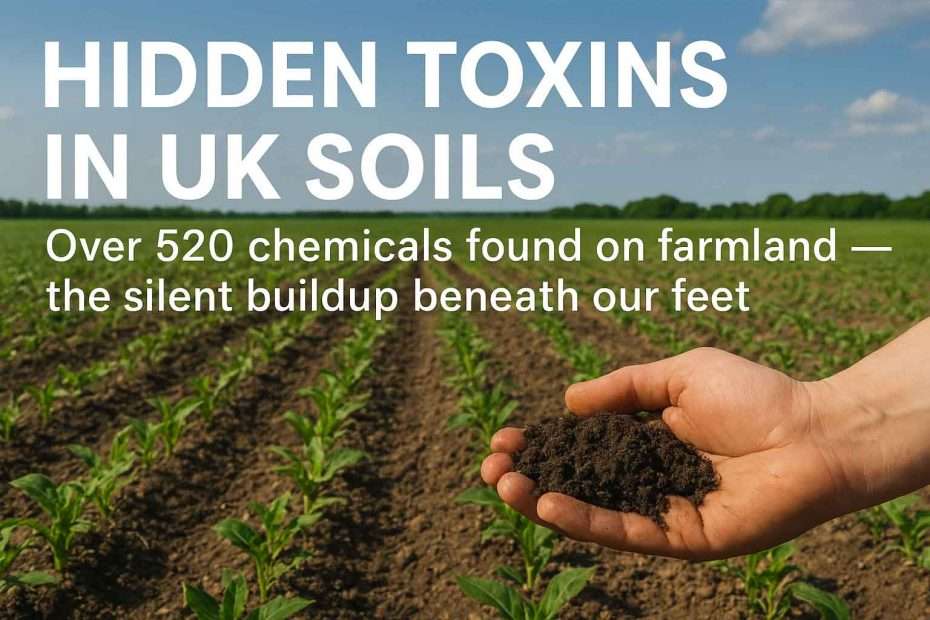
Hidden toxins in UK soils
Over 520 chemicals found on farmland — the silent buildup beneath our feet
Summary
A recent study revealed more than 520 different chemicals — including long-banned medical compounds — in English soils, largely due to the widespread use of treated sewage sludge (biosolids) as fertiliser. This article explains how this pollution occurs, what kinds of chemicals are accumulating (pharmaceuticals, flame-retardants, microplastics, PFAS, etc.), the risks for soil health, agriculture, and the food chain — and explores how biological remediation methods (e.g. enzyme treatments, phytoremediation) could help detoxify soils in a safer, more sustainable way.
Problem
- Treated sewage sludge — “biosolids” — is widely used on farmland in the UK as a cheap fertiliser and soil amendment. According to recent reporting, around 87% of the country’s treated sewage sludge is applied to agricultural soils. (The Guardian)
- A new study by University of Leeds found over 520 chemicals in English soils, many of them “emerging contaminants” including previously banned or little-known pharmaceutical compounds (e.g. certain anticonvulsants) that have persisted for decades. (The Guardian)
- Beyond pharmaceuticals, biosolids (and associated waste streams) carry a complex “cocktail” of pollutants: “forever chemicals” such as PFAS, flame-retardants, microplastics, persistent organic pollutants (POPs) such as PCBs or dioxins, and other long-lived industrial compounds. (The Guardian)
- Many of these contaminants are not regulated or routinely tested before sludge is applied to fields. The testing regime — dating from 1989 — typically looks only at heavy metals and a few pathogens, ignoring a vast array of emerging contaminants. (The Guardian)
- These substances accumulate over repeated applications. Microplastics, for example, were found to increase dramatically: in one study microplastic levels rose by as much as 1,450% after just four years of sewage-sludge spreading. (The Guardian)
In short: the soil beneath UK farmland is being treated — intentionally — as a dumping ground for a complex mix of persistent, poorly-monitored toxins.
Consequences
- Soil health degradation: The mixture of chemicals, microplastics, and persistent contaminants damages soil ecosystems. Soil biota — earthworms, fungi, microbes — can be harmed or disrupted by constant exposure. (James Hutton Institute)
- Disruption of soil biology & fertility: For example, research indicates that pharmaceuticals in biosolids can collapse beneficial soil fungal networks (mycorrhizae), reducing nutrient exchange and undermining plant health. (Fidra)
- Food chain contamination: Contaminants in soil can be taken up by plants, potentially entering the food chain and ending up in crops or livestock products. There is also concern about antibiotics or pharmaceutical residues contributing to antibiotic-resistance genes in soil bacteria. (Fidra)
- Environmental persistence & cumulative risk: Many of the chemicals are extremely persistent (PFAS, POPs, microplastics) and bioaccumulate; as more sludge is applied over time, contaminant levels can increase, compounding risk. (James Hutton Institute)
- Biodiversity loss & ecosystem imbalance: Soil is one of the richest reservoirs of biodiversity on Earth. Polluting soils undermines their capacity to support microbes, invertebrates, and plant life — threatening broader ecosystem health and resilience. (Fidra)
- Public and food safety concerns: Though evidence is still emerging, the potential for contaminated soil to impact food safety and human health is serious — especially given the presence of “forever chemicals,” pharmaceutical residues, and microplastics in soils used for food production. (The Guardian)
Solution: Biological Remediation — Why and How
Given the scale and complexity of contamination, traditional remediation (e.g. excavation, removal, chemical treatment) is often impractical, costly, and potentially further damaging. That’s where biological remediation — harnessing biology to clean soil — offers a viable, sustainable path.
Here’s how biological remediation (such as with the solutions developed by BioGlobe) can help:
- Targeted, bespoke enzyme-based cleanup: BioGlobe offers “organic & enzyme remediation” — custom enzyme blends tailored to the pollutants present. (BioGlobe)
- Biodegradable and ecosystem-friendly: Their enzyme formulas are plant-based and break down into amino acids after use — they are harmless to plants, animals, and soil organisms, and don’t introduce additional pollutants. (BioGlobe)
- Versatility across contaminants and conditions: BioGlobe’s enzyme blends can address a wide range of pollutants, including complex organic compounds, under both aerobic and anaerobic conditions, making them suitable for various soils and contamination contexts. (BioGlobe)
- Reduced ecological footprint compared to chemical treatments: Since the remediation is organic, there’s no introduction of harsh chemicals, no persistent residues, and minimal disruption to soil ecology — making it a safer, more sustainable solution. (BioGlobe)
- Potential to restore soil health and resilience: By breaking down harmful compounds, enzymes can restore a healthier soil microbiome and structure — enabling soils to support crops, biodiversity, and long-term fertility — without adverse side-effects for ecosystem or human health.
In short: BioGlobe’s approach offers a promising, environmentally harmonious way to reverse decades of chemical accumulation in soils — turning polluted “wasteland” back into healthy, living soil.
Why This Matters for Ordinary People
Even if you don’t live on a farm — chances are you eat food grown on farmland, drink water from sources connected to rural catchments, or enjoy natural landscapes dependent on healthy soil. Soil pollution is not a remote issue: it affects food safety, biodiversity, climate resilience, and the long-term health of ecosystems upon which all life depends. Biological remediation represents a practical, sustainable way to tackle this hidden crisis.
FAQs
1. How did over 520 chemicals end up in UK soils?
Because treated sewage sludge (“biosolids”) — which often contains not just human waste but industrial effluent, pharmaceutical residues, PFAS, microplastics and other chemicals — is repeatedly spread as fertiliser on farmland. The sludge is insufficiently tested: regulations check only a narrow set of contaminants (mainly heavy metals), leaving hundreds of emerging or persistent toxins unmonitored. (The Guardian)
2. Why aren’t these pollutants removed during wastewater treatment?
Standard wastewater treatment (in the UK) — even when producing “tertiary treated” sludge — is not designed to remove many persistent organic chemicals, PFAS, microplastics, or pharmaceutical residues. Many of these substances survive the process and end up concentrated in the sludge. (The Guardian)
3. Can cooking or washing crops remove these pollutants before they reach our plates?
Not reliably. Many of the chemicals are absorbed into the soil and taken up by plants; some are persistent and stable. Washing or cooking may remove surface residues but cannot eliminate compounds embedded in plant tissue or soil. This is why preventing or remediating soil-level contamination is crucial.
4. Is biological remediation (like enzymes) safe for soil life, crops and wildlife?
Yes — when done properly. For example, BioGlobe’s enzyme-based solutions are plant-derived, biodegradable, and designed to break down contaminants without introducing harmful by-products. After detoxification, the enzymes degrade into harmless amino acids, making them safe for soil organisms, plants, animals, and water systems. (BioGlobe)
5. Will biological remediation cost a lot and is it realistic for widespread use?
While costs vary depending on the scale and contamination level of a site, biological remediation — especially enzyme-based — can be more cost-effective and less disruptive than traditional chemical or mechanical cleanup. Because the approach is scalable and the solutions can be tailored (bespoke enzyme blends), it is realistic for farmland, polluted allotments, industrial sites, and even large-scale agri-environmental remediation programmes.
Bioglobe offer Organic Enzyme pollution remediation for major oil-spills, oceans and coastal waters, marinas and inland water, sewage and nitrate remediation and agriculture and brown-field sites, throughout the UK and Europe.
We have created our own Enzyme based bioremediation in our own laboratory in Cyprus and we are able to create bespoke variants for maximum efficacy.
Our team are able to identify the pollution, we then assess the problem, conduct site tests and send samples to our lab where we can create a bespoke variant, we then conduct a pilot test and proceed from there.
Our Enzyme solutions are available around the world, remediation pollution organically without any harm to the ecosystem.
For further information:
BioGlobe LTD (UK),
Phone: +44(0) 116 4736303| Email: info@bioglobe.co.uk