

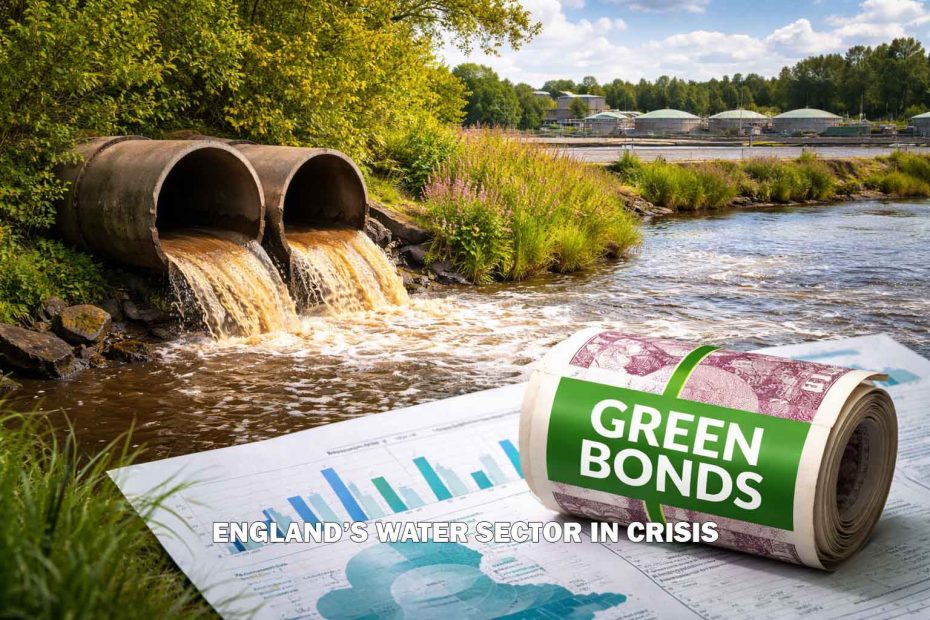
England’s Water Sector in crisis
Green Bonds and the Environmental Challenge: An In-Depth Analysis
In recent years, the English water industry has emerged as one of the most active corporate issuers of so-called “green bonds,” raising substantial capital on the basis that the funds will support environmentally beneficial projects. According to independent financial analysis, water companies in England have issued £10.5 billion in green bonds since 2017, representing around 19 per cent of all UK corporate green bond issuance over this period. When issuance by Thames Tideway, the developer of the London “super sewer,” is included, the sector’s share rises to 22 per cent of the UK total. This scale of issuance places the industry among the largest corporate participants in the UK’s green debt markets, alongside renewable energy developers and clean transport financiers.
Yet the juxtaposition of heavy green bond issuance with ongoing environmental challenges has provoked sustained criticism from campaign groups, analysts, regulators and politicians. At the heart of the controversy are questions over whether the proceeds of these green bonds are delivering genuine and additional environmental benefits — particularly in terms of reducing the most visible marker of failure for water firms in England: sewage pollution of rivers, streams and coastal waters.
This article provides a detailed assessment of the issues at stake, addressing:
- The nature and purpose of green bonds and sustainable finance
- How the English water industry has used green finance
- Environmental performance data for water companies
- Regulatory frameworks and enforcement in England and Wales
- Criticisms, allegations of “greenwashing,” and industry responses
- Broader financial and policy context, including planned investments and reforms
Understanding Green Bonds and Sustainable Finance
Green bonds are debt instruments whose proceeds are earmarked for projects with environmental benefits. This can include investments in renewable energy, energy efficiency, sustainable transport, climate adaptation, and water and wastewater management. Issuers receive capital from investors who accept typically lower yields in return for the expectation that their funds will support environmental and climate outcomes.
Green bond issuance is supposed to adhere to recognised standards such as the International Capital Market Association (ICMA) Green Bond Principles, which require that proceeds are allocated to eligible categories, that there is transparent reporting on use of proceeds, and that impacts are disclosed. A critical element of credibility is additionality — meaning that the financed activities go beyond what the issuer would have undertaken anyway as part of business as usual or legal obligations.
In practice, however, the boundary between genuinely additional environmental investment and the refinancing of existing obligations can be blurred. Critics of green finance point to cases where proceeds from green bonds simply help companies refinance existing debt or fund activities that regulators already require them to perform, raising questions about the environmental value created by such instruments.
Green finance — including green bonds, sustainability-linked loans and other labelled instruments — has grown rapidly as global capital markets respond to climate change, biodiversity loss and investor demand for Environmental, Social and Governance (ESG) investment strategies. In the UK, the water industry has been one of the most significant adopters of labelled environmental debt.
Water Companies in England: Extent of Green Bond Issuance
Analysis of Bloomberg and other financial data reveals that since the first green bond issued by a UK water company in 2017, the sector has accumulated more than £10.5 billion in green bond issuance. Anglian Water is the largest issuer in the sector, with approximately £3.5 billion raised, followed by Thames Water, with £3.1 billion. Both firms rank among the top tier of corporate green bond issuers in the UK overall, with Anglian Water ranked third and Thames Water sixth in terms of total issuance since 2017.
Although the earliest issuance focused on specific capital projects, more recent frameworks allow water firms to incorporate a broader set of activities, including general sustainable finance and refinancing under a “Sustainable Financing Framework”. For example, Thames Water’s framework extends beyond traditional green bonds to include sustainability and social bonds that align with its Environmental, Social and Governance priorities. These frameworks are typically assessed by independent reviewers to certify alignment with global standards.
Anglian Water has also outlined its use of green finance proceeds in impact reports and investor documentation, confirming that funds are allocated to projects tied to climate adaptation and environmentally sustainable water management — including water recycling services, monitoring of pollutants, and increasing the capacity of treatment works to manage storm events.
The Thames Tideway Tunnel, commonly known as the “super sewer”, has separately issued green and blue bonds — where blue bonds are a subsector of green bonds specifically targeting marine and aquatic ecosystem outcomes. The Tideway project, designed to intercept combined sewer overflows and reduce sewage pollution into the tidal River Thames, has been a pioneering infrastructure project for environmentally linked finance.
Despite these developments, critics have argued that some allocation practices and reporting approaches may fall short of delivering measurable, additional environmental outcomes.
Environmental Performance of Water Firms: Regulatory Data
A central criticism levelled against the use of green bonds by English water companies is the persistent record of environmental pollution, especially untreated or partially treated sewage discharges into rivers and coastal waters. Water and sewerage companies in England are legally required to protect water quality and meet defined environmental performance standards. However, regulatory data shows ongoing challenges.
The Environment Agency’s Environmental Performance Assessment for 2023 revealed that serious pollution incidents remain high, with 47 such incidents recorded — only a slight change from recent years. Out of these incidents:
- Thames Water, Southern Water and Anglian Water accounted for the majority of serious pollution occurrences.
- Four companies performed significantly below target (“red” status) for this environmental performance metric, including Anglian Water, Southern Water, Thames Water and Yorkshire Water.
- Only a subset of companies achieved performance better than target, demonstrating that compliance and performance levels vary markedly across the sector.
Other regulatory assessments into 2024 indicated that the overall environmental performance of water companies was at its lowest recorded level in the decade-long history of the Environment Agency’s rating exercise. Serious pollution incidents reportedly rose by approximately 60 per cent, underscoring the scale of challenges facing operational performance, infrastructure resilience and sewer network management.
These performance data points form the backdrop against which sceptics question the linkage between green bond financing and actual improvements in water quality and environmental outcomes.
Pollution Incidents: Scale, Causes and Trends
Sewage pollution incidents arise largely from infrastructure limitations, storm overflow discharges, faults in treatment works, and overloaded sewer networks. Regulatory reporting reveals that a significant proportion of serious pollution incidents originate from foul sewers, sewage treatment works and rising mains — together representing 87 per cent of incidents in the latest reporting year.
Although companies and regulators attribute many overflows to extreme weather events and climate change pressures (such as exceptionally wet winters and summers that overwhelm combined sewer systems), there is broad consensus that long-term investment in infrastructure renewal and capacity enhancements is necessary to reduce discharges.
Environmental campaigners have also highlighted cumulative pollution metrics over multiple years, citing data that public waterways were subjected to prolonged periods of sewage dumping, sometimes hundreds of thousands of hours annually, endangering biodiversity, recreational waters and ecosystem health.
The scale of these pollution events has fuelled public dissatisfaction and reinforced arguments that the environmental performance of the water sector does not align with the environmental narratives often deployed in green bond marketing materials.
Criticisms of Green Bond Use in the Water Sector
Environmental campaign groups, such as River Action, have characterised the widespread issuance of green bonds by water firms as “corporate greenwash on steroids”, on the grounds that the environmental improvements ostensibly financed by these instruments are not evident in regulatory performance metrics and pollution statistics. According to this view, issuing billions in green debt while failing to deliver measurable improvements in river health and sewage management undermines the credibility of green finance itself and erodes public trust.
Independent investigations have also suggested that green bond proceeds have, in several cases, been used to refinance existing obligations or fund activities that companies are already legally required to undertake. This raises concerns about the additionality and environmental integrity of the green bond frameworks adopted. Critics argue that if the funds are not genuinely supporting new or enhanced environmental programmes beyond regulatory requirements, the environmental value proposition is weakened.
Some media and analyst commentary has also pointed out that environmental performance disclosures from certain water companies have lapsed; for instance, Thames Water reportedly had not published green bond impact reports for two consecutive years, contravening industry expectations for transparency despite not being a statutory obligation.
Industry and Regulator Responses
Water companies and industry bodies have responded that green finance plays an essential role in funding long-term infrastructure and environmental programmes. For example, Anglian Water states that investment through green bonds and sustainable finance underpins environmental improvement initiatives, including carbon emission reductions, climate adaptation projects and targeted water quality protection measures. The company has acknowledged that pollution remains a challenge, but contends that performance should be assessed across a broader set of environmental metrics rather than focusing solely on pollution incidents.
Thames Water, for its part, has reiterated its commitment to fulfilling reporting obligations for green bond impact, noting that Covid-19, operational pressures, and external market conditions have impacted timelines for certain disclosures. The company maintains that its sustainable financing framework is designed to ensure that proceeds are linked to projects with strategic environmental and social value, such as reducing leaks and improving wastewater treatment capacity.
Industry bodies have also underscored the substantial long-term investment needs facing the water sector. Through regulatory review cycles and investment planning processes such as Ofwat’s Price Review 2024 (PR24) and programmes like the Water Industry National Environment Programme (WINEP), water companies are required to commit to thousands of targeted environmental actions over multi-year periods, backed by tens of billions of pounds in planned investment.
Notably, the Environment Agency confirmed that water companies had pledged £22.1 billion in targeted environmental commitments under WINEP to address legal requirements and environmental challenges over the coming five years, four times the investment secured in the previous price review cycle. This includes actions aimed at habitat restoration, pollution prevention, and infrastructure upgrades.
Regulatory and Policy Context
The English water industry operates within a complex regulatory framework involving multiple bodies:
- Ofwat (the Water Services Regulation Authority) is responsible for economic regulation, price controls, and performance incentives.
- The Environment Agency oversees environmental protection, monitors pollution incidents, and publishes performance assessments.
- Natural England advises on biodiversity, landscape and protected species impacts.
Under current legal regimes, companies must comply with environmental permits governing discharges, treatment standards, and infrastructure operations. Regulatory enforcement can include fines, compliance notices, and in extreme cases, criminal prosecution for serious breaches. Recent high-profile enforcement actions and legal challenges have underscored the seriousness of non-compliance, even as companies dispute certain allegations or maintain that changing weather patterns exacerbate infrastructure strains.
Regulatory ratings systems — such as the Environment Agency’s star-based environmental performance assessment — influence public perceptions and regulatory pressure. The most recent ratings showed many companies falling short of expectations, leading the regulator to call for a fundamental cultural shift within the sector to improve environmental outcomes.
Furthermore, environmental scientists and commentators have criticised the communication strategies of water companies, suggesting that some firms use rhetorical devices similar to other major polluting sectors to downplay environmental harm. This includes framing sewage discharges as “heavily diluted rainwater” or emphasising positive metrics while minimizing negative impacts — tactics some researchers liken to classic greenwashing strategies.
Financial Stability, Investment Needs and Sector Reform
While much criticism focuses on environmental performance, the financial structure and stability of water companies is also a point of contention. Some of the largest firms, particularly Thames Water, have struggled with high debt levels and financial stress. Historical analysis indicates that Thames Water accumulated large debts over decades, raising concerns about its ability to fund necessary infrastructure repairs and environmental improvements without support from customers, investors or government interventions.
High debt servicing costs can divert revenue away from capital investment in critical infrastructure, limiting the capacity to modernise aging sewer networks or expand treatment capacity. This situation has prompted discussions among policymakers and regulators about potential interventions, regulatory reform, and the balance between private ownership, public interest and long-term environmental sustainability.
Water companies have argued that regulatory changes are needed to create a more “investable sector” that can attract capital for large-scale infrastructure upgrades, including climate adaptation projects. They contend that sustainable finance, including green and sustainability bonds, can play a key role in meeting these investment needs — provided the regulatory and policy frameworks support credible environmental outcomes and investor confidence.
Public and Political Reaction
Public reaction to the water industry’s environmental performance and use of green finance has been intense. Politicians from various parties have criticised water companies for perceived failures to protect rivers and deliver on environmental commitments, with some calling for greater accountability, stricter enforcement, or even changes to industry ownership models.
The Liberal Democrat environment spokesman described what he termed the “great sewage swindle of the water industry,” arguing that water firms are exploiting environmental finance instruments while failing to reduce pollution at scale. Such rhetoric reflects broader scepticism among parts of the public and political spectrum about the effectiveness of voluntary or market-based environmental finance mechanisms when tied to firms with weak regulatory outcomes.
At the same time, households facing rising water bills — driven by investment needs, debt servicing and regulatory allowances — have expressed frustration that costs are increasing without clear evidence of environmental improvement.
Conclusion: Balancing Finance, Regulation and Environmental Outcomes
The debate over green bonds and environmental performance in the English water sector underscores a fundamental tension between financial instruments designed to signal sustainability and real-world environmental outcomes. On one hand, green finance provides a mechanism for raising capital at scale for long-term infrastructure and climate adaptation projects. On the other, persistent pollution, regulatory underperformance and allegations of greenwashing raise pressing questions about accountability, transparency and whether green bonds are truly delivering additional environmental benefit.
The available evidence suggests that significant investment is planned and underway across the sector, supported by regulatory mandates and green finance. However, the disjunction between rising green bond issuance and continued environmental performance challenges both water companies and policymakers to strengthen reporting standards, ensure that capital deployment results in verifiable ecological improvements, and align financial incentives with long-term sustainability goals.
Addressing these issues will require concerted efforts from industry leaders, regulators, investors and civil society alike. Transparent reporting frameworks, robust independent impact assessments, and a clear demonstration of additional environmental benefit will be essential if green finance is to fulfil its promise of supporting a genuinely sustainable water sector in England and Wales.
Below are five professionally framed FAQs suitable for inclusion at the end of the article. They are written in UK English and aligned with the tone and substance of the analysis.
Frequently Asked Questions
1. What are green bonds, and why do water companies issue them?
Green bonds are debt instruments where the funds raised are intended to finance projects with defined environmental benefits, such as improving water quality, upgrading wastewater treatment infrastructure, reducing carbon emissions, or enhancing climate resilience. Water companies issue green bonds to access capital at competitive rates while signalling their commitment to environmental sustainability. Investors are attracted by the combination of relatively stable returns and the expectation that their capital supports environmentally beneficial outcomes.
2. Why has the use of green bonds by England’s water companies become controversial?
The controversy arises from the contrast between the large volumes of green bonds issued and the water industry’s ongoing record of sewage pollution and environmental underperformance. Critics argue that issuing billions of pounds in green-labelled debt is inconsistent with continued pollution incidents, raising concerns that some green bonds may be used to finance routine operations or regulatory obligations rather than delivering genuinely additional environmental improvements.
3. Are water companies legally required to report on the environmental impact of green bonds?
There is currently no statutory requirement in the UK for companies to publish detailed impact reports on green bond proceeds. However, producing such reports is considered best practice under recognised market standards, such as the Green Bond Principles. Failure to publish timely and transparent impact reporting can undermine investor confidence and fuel accusations of greenwashing, even if it does not breach legal requirements.
4. Do green bonds directly reduce sewage pollution in rivers and coastal waters?
Green bonds can support investments that contribute to reducing sewage pollution, such as upgrading treatment works, expanding sewer capacity, or improving monitoring systems. However, they do not automatically result in improved environmental outcomes. The effectiveness of green bonds depends on how the funds are allocated, whether the projects go beyond existing regulatory requirements, and how rigorously environmental impacts are measured and enforced over time.
5. What changes could improve confidence in green finance within the water sector?
Greater confidence could be achieved through stronger and more consistent impact reporting, clearer evidence that green bond proceeds fund additional environmental improvements, and closer alignment between financial incentives and regulatory performance. Enhanced oversight by regulators, independent verification of environmental outcomes, and reforms that prioritise long-term infrastructure resilience over short-term financial returns would also help ensure that green finance delivers tangible benefits for rivers, ecosystems and public health.
Bioglobe offer Organic Enzyme pollution remediation for major oil-spills, oceans and coastal waters, marinas and inland water, sewage and nitrate remediation and agriculture and brown-field sites, throughout the UK and Europe.
We have created our own Enzyme based bioremediation in our own laboratory in Cyprus and we are able to create bespoke variants for maximum efficacy.
Our team are able to identify the pollution, we then assess the problem, conduct site tests and send samples to our lab where we can create a bespoke variant, we then conduct a pilot test and proceed from there.
Our Enzyme solutions are available around the world, remediation pollution organically without any harm to the ecosystem.
For further information:
BioGlobe LTD (UK),
Phone: +44(0) 116 4736303| Email: info@bioglobe.co.uk