

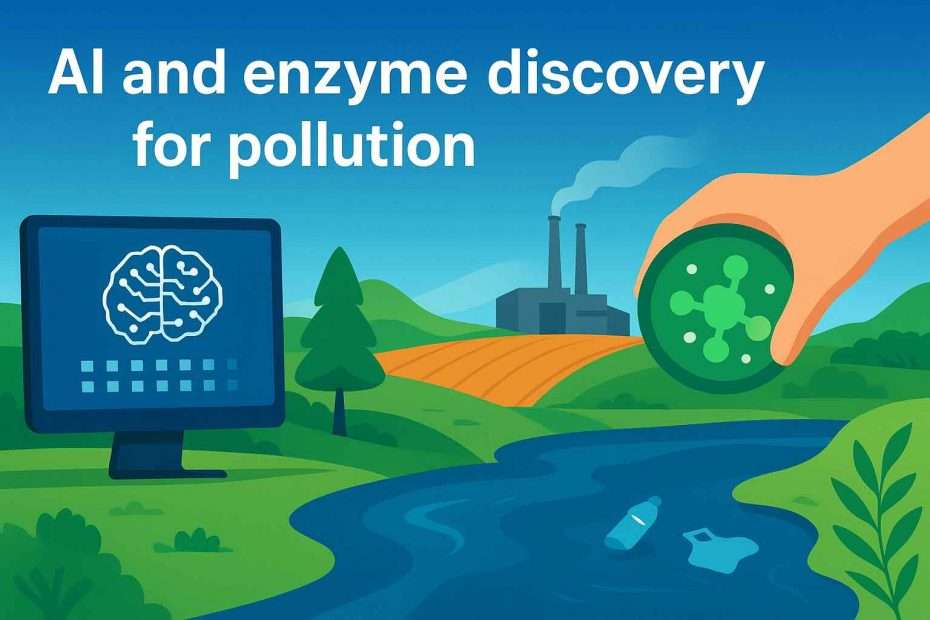
Ai and Enzyme Discovery for Pollution
Predicting pollutant-degrading enzymes using machine learning
Introduction
Across the world, pollution has become one of the most difficult environmental challenges of the twenty-first century. From chemical residues in soils and industrial contaminants in rivers to microplastics in coastal waters, the persistence of pollutants poses serious risks to human health, ecosystems, and the economy. Despite decades of technological innovation, traditional clean-up techniques often fall short: many are expensive, slow, disruptive, or potentially damaging to the environment in their own right.
BioGlobe, with its organic enzyme remediation solution developed in Cyprus and deployed throughout the UK, is part of a new movement toward nature-based environmental recovery. Instead of relying on harsh chemicals or mechanical excavation, BioGlobe uses entirely organic enzymes—proteins derived from natural sources—to break down pollutants safely and efficiently. These enzymes transform complex contaminants into harmless natural by-products, allowing ecosystems to restore themselves without ecological harm.
What is accelerating BioGlobe’s mission further is the integration of artificial intelligence—particularly machine learning and predictive modelling—into enzyme discovery and design. Through an internal AI framework (referred to here as XenoBug), BioGlobe aims to predict which enzymes will break down specific pollutants, design bespoke enzyme formulations for individual sites, and identify new enzyme candidates that have not previously been used for environmental clean-up.
The combination of AI and enzyme bioremediation is more than a technological upgrade. It represents a completely new approach to pollution management—one that is faster, more targeted, more adaptive, and fully aligned with natural ecological processes. Most importantly, it offers hope for communities across the UK where soil, waterways, and green spaces have been affected by industrial history, agricultural run-off, sewage discharge, or urban pollution.
This article takes readers inside that new frontier. It explains how AI predicts pollutant-degrading enzymes, how BioGlobe uses this capability to build bespoke remediation solutions, and why this matters for UK-specific environmental challenges. It is written for ordinary people who want to understand how modern science can help restore the land and waters around them—naturally, safely, and effectively.
Problem
Pollution is not a single issue. It is a complex and overlapping set of environmental pressures that affect soil, water, air, and the organisms that depend on them. Across the UK, pollution emerges from both historic and modern sources:
1. Soil Contamination
Many areas of the UK, especially former industrial regions, contain soil contaminated by heavy industrial heritage—chemical plants, fuel depots, waste facilities, and manufacturing sites. Even small-scale businesses such as garages, metal workshops, and agricultural storage yards can leave long-lasting pollutants behind.
Pollutants commonly found in soils include:
- Petroleum hydrocarbons
- Diesel and lubricants
- Pesticides and agrochemicals
- Solvents, detergents, or degreasers
- Organic waste residues
- Nutrient overloads (nitrates and phosphates)
These chemicals often bind tightly to soil particles, remain toxic for decades, and can seep into groundwater.
2. Water Pollution
Rivers, canals, lakes, marinas, and coastal waters across the UK have faced increasing pollution pressure from multiple sources:
- Agriculture, particularly nutrient run-off
- Industrial and commercial discharge
- Sewage overflows during heavy rainfall
- Accidental spills into water systems
- Microplastics and plastic debris
- Oil and diesel run-off from roads
- Anti-fouling chemicals in marinas
The UK’s ageing sewage infrastructure, combined with higher rainfall episodes, means untreated wastewater frequently enters rivers. Agricultural fertilisers, pesticides, and manure also wash into waterways, disrupting ecological balance.
3. Plastic and Microplastic Accumulation
Plastic pollution has quickly become one of the most urgent environmental issues. Plastics break down very slowly, gradually fragmenting into microplastics. These tiny fragments:
- Accumulate in rivers and oceans
- Enter the food chain
- Harm wildlife
- Persist for decades
Unlike many natural materials, plastics are resistant to microbial breakdown. Their chemical structure is specifically designed to endure.
4. Urban and Industrial Pollutants
Cities face unique challenges:
- Road run-off containing oil, tyre particles, and brake dust
- Heavy metals from industry
- Paint flakes, microfibres, household detergents
- Overflow from storm drains
- Anti-freeze, de-icing salts, or industrial cleaning agents
These enter both soil and water, often unnoticed but steadily accumulating.
5. Limitations of Traditional Remediation Methods
Conventional pollution remediation relies heavily on:
- Excavation and disposal (“dig and dump”)
- Mechanical filtration
- High-temperature incineration
- Chemical treatments
- Long-term natural attenuation
However, these methods often have serious drawbacks:
- They can be expensive and slow.
- They disrupt land, habitats, and wildlife.
- They may leave behind chemical residues.
- They are not always effective for complex or mixed pollutants.
- They struggle with emerging contaminants like microplastics.
Communities are increasingly seeking solutions that clean environments without damaging them further, or requiring major industrial intervention.
Consequences
When pollution is left unmanaged or inadequately addressed, the consequences compound over time. These effects are not abstract—they directly affect people’s health, local nature, and community wellbeing.
1. Damage to Ecosystems
Pollutants interfere with the natural balance of soil and water ecosystems:
- Toxic chemicals weaken or kill beneficial soil microbes.
- Aquatic plants, insects, and fish suffer from reduced oxygen levels.
- Nutrient overloads cause algal blooms, which suffocate fish and other wildlife.
- Persistent organic pollutants accumulate in the food chain.
A single pollutant can disrupt many parts of an ecosystem.
2. Risks to Human Health
Contaminated soil or water can expose people to:
- Carcinogenic compounds
- Hormone-disrupting chemicals
- Pathogens from untreated waste
- Heavy metals
- Hydrocarbons
Pollution also affects food production—when agricultural soil is compromised, pollutants can move into crops and livestock.
3. Loss of Biodiversity
Species diversity declines as pollutants:
- Stress wildlife
- Reduce available food
- Alter habitat conditions
- Drive sensitive species away
Over time, polluted environments may become “biological deserts”.
4. Economic and Social Costs
Pollution affects:
- Land values
- Tourism and recreation
- Agriculture
- Fishing industries
- Urban redevelopment
- Public health budgets
Contaminated sites often remain unused or abandoned due to the high cost of clean-up.
5. Long-Term Environmental Degradation
Many pollutants—especially plastics, hydrocarbons, pesticides, and industrial chemicals—do not degrade naturally within a reasonable timescale. Without intervention, they remain in the environment:
- Decades for hydrocarbons
- Centuries for plastics
- Indefinitely for certain industrial compounds
The longer pollution remains, the harder—and more expensive—it becomes to remove.
Solution
BioGlobe presents a science-driven yet ecological solution: organic enzyme bioremediation enhanced and accelerated by artificial intelligence.
This section explains how enzymes work, how AI predicts and designs new pollutant-degrading enzymes, and how the two combine into a transformative approach to environmental clean-up.
What Are Enzymes and Why Are They Ideal for Remediation?
Enzymes are natural proteins found in all living organisms. They act as catalysts—accelerating chemical reactions without being consumed in the process. In environmental contexts, enzymes can break down pollutants into harmless components such as:
- Water
- Carbon dioxide
- Simple organic molecules
- Nutrients that soil microbes can then consume
Because enzymes are natural and biodegradable, they do not damage soil, plants, fish, animals, or microbial communities. After completing their task, they simply break down themselves.
BioGlobe’s enzyme formulations are:
- Completely organic
- Non-toxic
- Environmentally safe
- Derived from natural biological sources
- Effective under typical environmental conditions
- Suitable for soil, water, and marine environments
Different enzymes target different pollutants. For example:
- Lipases break down oils and fats
- Hydrolases break down plastics and synthetic polymers
- Oxidoreductases break down organic chemicals
- Esterases break down pesticides
However, the earth contains millions of possible enzymes—many still undiscovered. Manually testing them all is impossible.
This is where AI becomes revolutionary.
How Artificial Intelligence Predicts Pollutant-Degrading Enzymes
AI—especially machine learning models—can analyse enormous biological datasets containing:
- Enzyme sequences
- Known enzyme functions
- Protein structures
- Reaction pathways
- Pollutant chemical profiles
- Environmental conditions
Through pattern recognition and predictive modelling, AI can:
1. Predict What a Given Enzyme Can Break Down
By analysing the structure or sequence of an enzyme, AI models can forecast:
- Which pollutants it may degrade
- Its reaction speed
- The conditions where it works best
- Whether it will remain stable in soil or water
- How effective it will be in the presence of competing substances
This replaces months of laboratory work with rapid digital analysis.
2. Discover New Enzymes in Existing Databases
Many enzymes remain “uncharacterised”—their functions have never been tested. AI can scan these unknown sequences and identify ones with strong potential for pollutant degradation.
3. Generate Completely New Enzymes
Advanced AI models—similar to those used in drug discovery—can design brand new enzyme sequences with:
- Enhanced stability
- Greater activity
- Specificity for stubborn pollutants
- Resistance to environmental inhibitors
- Compatibility with other enzymes in a blend
This opens possibilities for addressing pollutants that natural enzymes struggle with.
4. Optimise Enzymes for Real-World Conditions
Environmental conditions vary:
- Temperature
- pH
- Salinity
- Soil type
- Water chemistry
- Presence of oils or organic matter
AI can evaluate which enzymes perform best in each setting, allowing BioGlobe to create highly targeted solutions.
Introducing “XenoBug”: BioGlobe’s AI-Driven Enzyme Discovery Platform
While the name XenoBug is used here for explanation, the concept represents BioGlobe’s internal AI tools for enzyme discovery and formulation design.
XenoBug is designed to:
- Analyse pollutant samples from a site
- Identify the full chemical composition
- Predict which enzymes will break down each pollutant
- Optimise an enzyme cocktail specific to the site’s conditions
- Suggest new enzyme candidates for laboratory synthesis
- Simulate environmental performance before field application
This system dramatically accelerates the remediation process.
Why This Matters: AI + Enzymes = Custom Pollution Clean-Up
Traditional remediation usually relies on:
- Generic solutions
- Chemical treatments
- One-size-fits-all approaches
But pollution varies greatly from site to site. A marina polluted by diesel requires different enzymes to a farm affected by fertilisers. An industrial yard contaminated with solvents needs a different approach to a river suffering from microplastics.
AI-guided enzyme design enables BioGlobe to create:
Tailored enzyme blends
Each blend is adjusted for:
- Pollutant type
- Concentration levels
- Soil or water chemistry
- Microbial ecology
- Temperature and weather patterns
- Depth of contamination
Faster remediation
Because enzymes accelerate natural reactions, clean-up can be significantly quicker.
Non-disruptive application
No excavation, no relocation of soil, no harm to wildlife or habitats.
Better ecological outcomes
Enzymes restore balance rather than disrupt it.
Scalability
AI allows rapid design for:
- Rivers
- Lakes
- Large industrial sites
- Coastal zones
- Agricultural landscapes
Sustainability
All products are organic and biodegradable.
Applications Across the UK
The UK has many pollution challenges that are ideally suited to this approach. BioGlobe’s AI-enhanced enzyme solutions can address:
1. Agricultural Run-Off
Large quantities of fertilisers, pesticides, and livestock waste wash into:
- Streams
- Rivers
- Canals
- Lakes
Enzymes can break down:
- Nitrates
- Phosphates
- Pesticides
- Organic waste
AI allows rapid tuning for specific farming regions.
2. Industrial and Brownfield Sites
Legacy pollutants linger in soils for decades. Enzyme blends can target:
- Oils and hydrocarbons
- Solvents
- Detergents
- Chemical waste residues
Tailored enzyme treatments can clean land for safe redevelopment.
3. Rivers and Waterways
Many rivers suffer from:
- Sewage discharge
- Oils and fuels
- Nutrient loading
- Microplastics
AI-driven solutions can be adapted for flowing water, low-oxygen environments, and changing seasonal conditions.
4. Coastal and Marine Environments
Harbours and marinas contain:
- Fuel residues
- Anti-fouling chemicals
- Microplastics
- Boat cleaning detergents
Marine-safe enzymes present a non-toxic alternative for sensitive coastal habitats.
5. Urban Pollution
Cities experience complex mixtures of pollutants. Enzymes can help remove:
- Road oil
- Rubber particles
- Brake dust
- Chemical cleaners
- Overflow materials
The Future: AI as a Partner in Environmental Restoration
Artificial intelligence is not replacing natural processes—it is helping us understand and support them. By predicting which enzymes will be most effective, AI reduces the guesswork and accelerates environmental clean-up.
This future includes:
- Rapid response to pollution incidents
- Tailor-made environmental solutions
- Zero-harm organic remediation
- Restoration of ecosystems at scale
- Discovery of biodegradable alternatives to harsh chemicals
- A circular, nature-based approach to human impact
BioGlobe’s integration of AI into enzyme bioremediation marks a major step forward. It represents a shift from reactive clean-up to proactive ecological design.
In a world where pollution is increasing in complexity, this combination of natural science and cutting-edge technology offers a hopeful, sustainable path forward.
FAQs
1. How does AI identify which enzymes can break down pollutants?
AI analyses large datasets of known enzyme sequences and chemical structures. Through pattern recognition, it predicts which enzymes are likely to react with and break down specific pollutants, even if the enzyme has never been tested before.
2. Are BioGlobe’s enzyme solutions safe for wildlife and plants?
Yes. Enzymes are natural biological molecules. They are non-toxic, biodegradable, and leave no harmful by-products. They do not harm fish, birds, soil microbes, or plants.
3. Can enzyme bioremediation handle plastics and microplastics?
Yes. Advances in biotechnology have identified enzymes capable of degrading certain plastics. AI is helping speed up the discovery of even more effective plastic-degrading enzymes.
4. How long does enzyme remediation take?
The timeframe depends on pollutant concentration and environmental conditions. However, enzyme-based clean-up is generally faster than traditional methods because enzymes catalyse reactions rapidly.
5. Can this method be used on large-scale pollution such as rivers or industrial sites?
Absolutely. Enzyme solutions can be formulated as liquids, powders, hydrogels, or encapsulated systems—allowing them to be used in rivers, lakes, marinas, soils, and extensive industrial areas.
Bioglobe offer Organic Enzyme pollution remediation for major oil-spills, oceans and coastal waters, marinas and inland water, sewage and nitrate remediation and agriculture and brown-field sites, throughout the UK and Europe.
We have created our own Enzyme based bioremediation in our own laboratory in Cyprus and we are able to create bespoke variants for maximum efficacy.
Our team are able to identify the pollution, we then assess the problem, conduct site tests and send samples to our lab where we can create a bespoke variant, we then conduct a pilot test and proceed from there.
Our Enzyme solutions are available around the world, remediation pollution organically without any harm to the ecosystem.
For further information:
BioGlobe LTD (UK),
Phone: +44(0) 116 4736303| Email: info@bioglobe.co.uk