

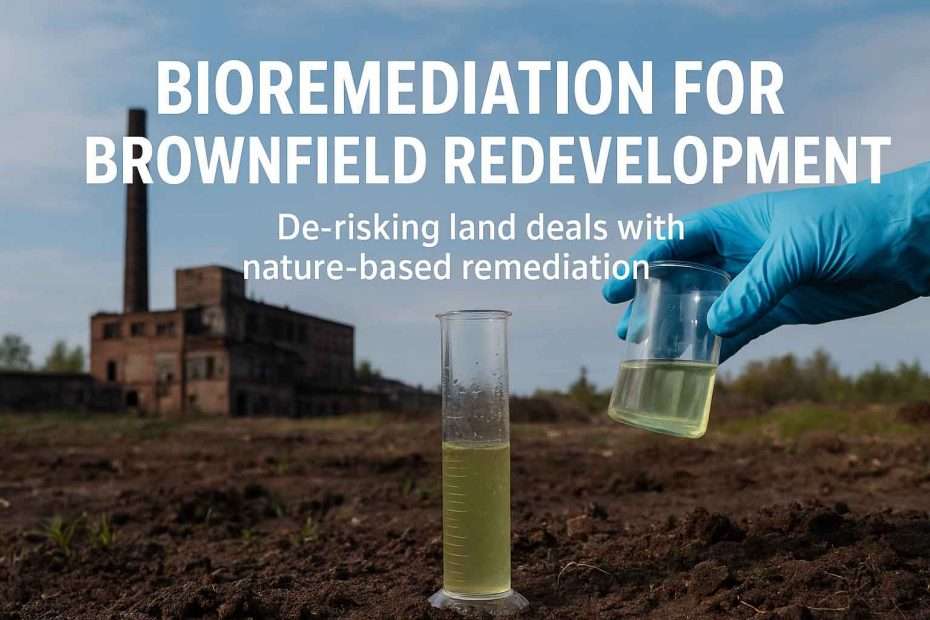
Bioremediation for Brownfield Redevelopment
De-risking land deals with nature-based remediation
Summary
For investors and developers, reclaiming and redeveloping brownfield land presents a major opportunity — but also carries risk. Contaminated soils, legacy hydrocarbons, solvents and heavy industrial residues can inflate costs, delay programmes and affect environmental, social and governance (ESG) credentials. In-situ biological methods offer a smarter alternative. By treating contamination on‐site with bespoke enzyme-based remediation, companies such as BioGlobe Ltd (UK) (operating via its lab in Cyprus and UK arm) are delivering faster, less disruptive clean-ups and enhancing the sustainability case for regeneration. This article explains how developers can use organic enzyme solutions to reduce risk, shorten timelines, improve ESG scores and navigate UK planning and regulator considerations.
Problem
Many brownfield sites — former industrial, chemical, manufacturing or petroleum sites — exhibit persistent contamination:
- Hydrocarbons (diesel, petrol, oils) in soil and groundwater.
- Solvents and chlorinated compounds from past manufacturing.
- Mixed residues that hamper redevelopment and escalate remediation costs.
- Limited options: traditional excavation, landfill disposal, thermal treatment or chemical remediation are expensive, disruptive and time-consuming.
The UK has thousands of such sites: redevelopment is recognised as crucial both to the housing delivery agenda and “levelling up” initiatives. (eic-uk.co.uk) But the uptake of brownfield redevelopment lags partly because of remediation cost, technical uncertainty, regulatory burdens and risk to investors. (MDPI)
Consequences
For investors or developers, the consequences of contaminated land can be substantial:
- Cost over-runs & schedule delays: Unexpected contamination may require deep excavation, off-site disposal or long treatment times, extending project timing and increasing cost.
- Regulatory and planning risk: Planning authorities and regulators (such as Environment Agency in England) are increasingly vigilant about land quality, remediation standards and long-term liability. The remediation strategy must be robust and defendable. (emerald.com)
- ESG/market perception: Sustainable investment criteria favour lower-impact remediation. A site developed without proper remediation may face reputational risks, higher borrowing costs or reduced appeal to occupiers who care about environmental credentials.
- Lost value: With formidable remediation risk, many brownfield sites are passed over in favour of greenfield sites despite limited land supply. (eic-uk.co.uk)
- Ecosystem damage & future cost: Using aggressive chemical or thermal remediation may restore the site but harm soil biology, biodiversity and future ecosystems — creating longer-term costs or reduced re-use potential.
Solution
Here’s how BioGlobe’s organic enzyme bioremediation offers a game-changing alternative for brownfield redevelopment — and how you as a developer or investor can benefit.
What’s the method?
- BioGlobe creates bespoke enzyme-based remediation solutions in its Cyprus laboratory, for use in the UK market via its UK arm. (BioGlobe)
- These formulas are organic, plant-based or protein-based (enzymes) which biodegrade safely after completing their remediation task. BioGlobe emphasise that the enzyme blends leave no harmful residues and can be used without harming ecosystem life, even aquatic environments. (BioGlobe)
- Unlike microbial remediation (which relies on live organisms) enzyme remediation works via stable catalysts that can degrade hydrocarbons, solvents and organic pollutants under a variety of conditions. (BioGlobe)
- For brownfield land, the process typically involves site sampling and pollutant analysis, design of a bespoke enzyme variant, pilot testing on site, then full application and ongoing monitoring. (BioGlobe)
What are the benefits for redevelopment?
- In-situ treatment means less excavation, less transport of contaminated soil, fewer landfill or off-site disposal costs — so lower cost and shorter schedule.
- Reduced disruption: By treating on‐site and using gentle biological means, there is less impact to surrounding land, fewer logistics, and easier community/authority consent.
- Improved ESG credentials: The method is organic, non-toxic, ecosystem-friendly — meaning your project can more easily make the sustainability case and may bolster planning/financing discussions.
- Regulator and planning alignment: In the UK context, the use of nature-based solutions and remediation methods that minimise disturbance are increasingly viewed favourably. For example, reviews of brownfield redevelopment note that bioremediation is “very important” as an alternative to excavation and removal. (emerald.com)
- Optimised land use: With lower remediation risk and cost, previously marginal sites become more viable, unlocking land that otherwise would remain undeveloped or under-utilised.
- Ecosystem regeneration: Because only benign enzyme catalysts are used, the soil biology and native ecosystem can recover faster, aiding landscaping, biodiversity improvement, and community acceptance.
How does BioGlobe support you through the process?
- Pollutant analysis: The first step is detailed site testing to identify the hydrocarbon, solvent or mixed pollution profile.
- Bespoke formulation: BioGlobe’s lab crafts a tailored enzyme blend specific to your site’s contamination mix and local conditions (soil type, moisture, aeration).
- Pilot application: A small-scale test is executed to confirm performance, monitor degradation, and refine the dose/application method.
- Full-scale deployment: The enzyme application is carried out across the site, often in situ, minimising excavation and transport.
- Monitoring & reporting: Ongoing sampling, data tracking and reporting help you demonstrate to regulators, planning authorities and financiers that remediation targets are met.
- Ecosystem-safe: The process is carried out without adverse effect to surrounding flora/fauna; enzymes themselves degrade naturally after working. (BioGlobe emphasise this on their website) (BioGlobe)
Planning and regulatory considerations in the UK
- Local plans and brownfield registers: The UK government has emphasised brownfield redevelopment as part of housing and regeneration strategies. (eic-uk.co.uk)
- Liability and remediation standards: Developers must satisfy regulators (e.g., the Environment Agency) that land is suitably remediated for its proposed use (residential, commercial, mixed). The use of proven, safe remediation solutions like enzyme-based can help de-risk the regulatory path.
- Sustainability criteria: Investors and planning authorities increasingly ask for demonstration of sustainable remediation methods (lower carbon footprint, minimal disruption). Enzyme remediation supports that.
- Timeline management: Because enzyme methods can shorten turnaround compared to large-scale excavation/transport, you can align remediation more closely with development schedules — improving financial returns and reducing holding cost.
- Monitoring & after-care: Even after redevelopment, a monitoring regime may be required. Using enzyme remediation with good monitoring supports long-term compliance and occupier reassurance.
Why this matters for you as an investor/developer
By choosing an enzyme-based bioremediation partner like BioGlobe, you can make a strong case that your land-deal is better de-risked:
- Spend less up-front on massive excavation/disposal.
- Get to planning consent and construction quicker.
- Present a strong ESG narrative to lenders, occupiers and stakeholders.
- Unlock sites that might otherwise be too risky due to contamination.
- Deliver a development with environmental integrity — good for community, good for brand, good for value.
Conclusion
Turning contaminated brownfield land into viable development sites is key to the UK’s regeneration and housing strategy. But the risk of legacy pollution has slowed many projects. Nature-based, enzyme-driven remediation offers a smarter alternative: gentler on the environment, faster to execute, and aligned with sustainability credentials. With its bespoke organic enzyme solutions designed, tested and monitored by BioGlobe, developers can proceed with greater confidence, reduce cost and time, and deliver projects with a strong ESG profile. In short: you don’t just remediate land — you regenerate opportunity.
FAQs
- What is enzyme-based bioremediation and how is it different from traditional methods?
It uses biological catalysts (enzymes) to break down pollution on-site, rather than relying on excavation or chemicals. Because the process is organic and tailored, it’s gentler, leaves no harmful residues, and preserves the ecosystem. (BioGlobe) - Which types of contamination can enzyme remediation handle?
Typical brownfield pollutants include hydrocarbons (oil, diesel), solvents and organic residues. BioGlobe’s bespoke enzyme formulations are designed to target these pollutants specifically on each site. (BioGlobe) - How does enzyme remediation help with planning regulator and ESG concerns?
Because the method is low-impact, ecosystem-safe and can reduce the need for large-scale excavation/transport, it aligns with sustainability goals. It also supports a robust remediation strategy for regulatory consent and improves ESG credentials for investors. - Can enzyme remediation reduce overall project timeline and cost for brownfield redevelopment?
Yes — by treating contamination in situ and minimising movement of soil and disposal costs, the method can shorten remediation time and reduce logistics costs, thereby improving schedule and budget certainty. - What does the process look like if engaging BioGlobe for a contaminated brownfield site?
First: pollutant identification and site sampling. Second: laboratory formulation of a bespoke enzyme variant. Third: pilot application on-site to verify performance. Fourth: full-scale deployment. Finally: monitoring and reporting to confirm remediation objectives are met and ecosystem recovery is progressing. (BioGlobe)
Bioglobe offer Organic Enzyme pollution remediation for major oil-spills, oceans and coastal waters, marinas and inland water, sewage and nitrate remediation and agriculture and brown-field sites, throughout the UK and Europe.
We have created our own Enzyme based bioremediation in our own laboratory in Cyprus and we are able to create bespoke variants for maximum efficacy.
Our team are able to identify the pollution, we then assess the problem, conduct site tests and send samples to our lab where we can create a bespoke variant, we then conduct a pilot test and proceed from there.
Our Enzyme solutions are available around the world, remediation pollution organically without any harm to the ecosystem.
For further information:
BioGlobe LTD (UK),
Phone: +44(0) 116 4736303| Email: info@bioglobe.co.uk