

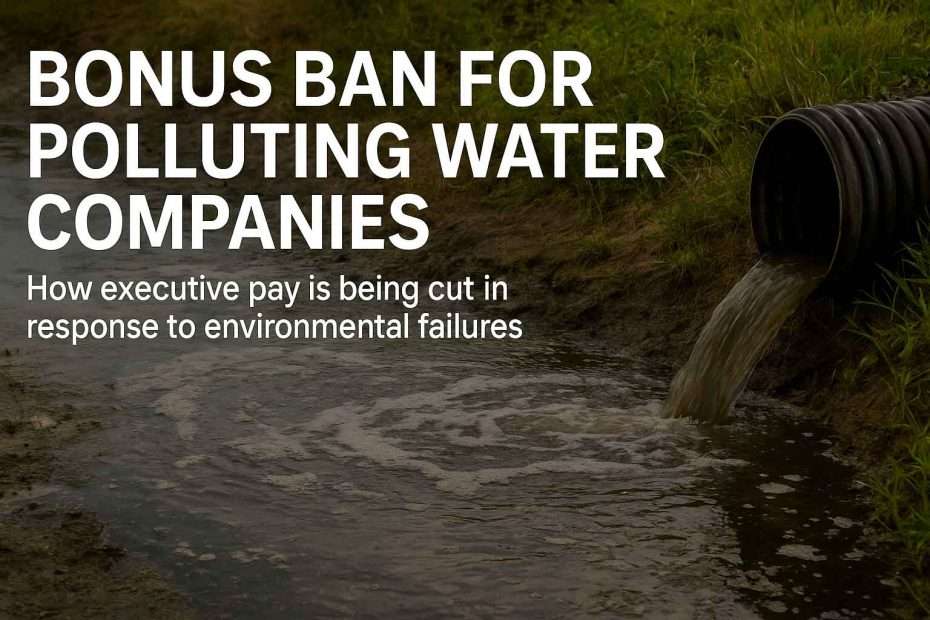
Bonus Ban for Polluting Water Companies
How executive pay is being cut in response to environmental failures
Introduction
For years, the people of the United Kingdom have watched rivers turn murkier, coastlines close to swimmers, and sewage spills become disturbingly ordinary news. What was once an occasional environmental accident has, in many regions, become a predictable pattern of mismanagement from water companies entrusted with protecting public health and the natural environment. Against a backdrop of repeated sewage discharges, rising public anger, and widespread frustration, the UK Government has introduced a bold new measure: a ban on bonuses for senior executives at several major water companies responsible for repeated pollution incidents.
This policy shift marks a turning point in the long-running debate over water industry accountability. It signals that environmental breaches will no longer be brushed aside as an unfortunate cost of doing business, and that leadership must finally face consequences when their companies fail to meet acceptable standards. But the story does not end with punishment. If anything, the ban raises a more important question: what practical steps can water companies take to fix the problem at its root?
This is where BioGlobe and our fully organic, enzyme-based bioremediation solutions come into the picture. Pollution can be managed, reversed, and prevented — not through harsh chemicals or temporary Band-Aid measures, but through natural, scientifically developed enzymatic processes that break down contaminants safely and effectively, without causing collateral damage to the ecosystem.
This article explores the context of the bonus ban, why it matters, what it reveals about the condition of the UK’s waterways, and how organic enzyme bioremediation offers a powerful, nature-based solution that aligns ecological restoration with corporate responsibility. It is written for ordinary people who want to understand what is happening, why it is happening, and what can realistically be done to remediate pollution sustainably.
Part 1 — Understanding the Problem
The State of UK Water Pollution
In recent years, wastewater contamination has become one of the most hotly discussed environmental issues in the UK. Much of the public frustration stems from the sheer scale of sewage releases into natural water systems. These incidents occur when wastewater treatment infrastructure is overwhelmed, poorly maintained, or simply mismanaged. While certain emergency discharges are permitted under specific conditions, too many have occurred when conditions did not justify them.
Many communities have grown discouraged, feeling as though their concerns have not been taken seriously by the companies responsible for safeguarding water quality. From inland rivers to coastal bathing waters, various areas across England have suffered from increased levels of effluent, algal blooms triggered by excess nutrients, unpleasant odours, reduced biodiversity, and, in some cases, direct threats to human health.
These problems are not isolated. They represent a systemic issue in the water industry — one that has persisted despite years of warnings, fines, and public scrutiny.
Why the Bonus Ban Was Introduced
The Government’s decision to restrict bonus payments for senior executives was not made lightly. It followed a series of revelations showing that multiple water companies repeatedly failed to uphold acceptable environmental standards, while at the same time paying out sizeable bonuses to their executives. For many, this felt like a gross misalignment of priorities: pollution incidents increased, rivers deteriorated, and public outrage intensified — yet leaders at the top were still rewarded.
The bonus ban aims to do three things:
- Enforce accountability at a leadership level.
Executives must feel the consequences of environmental failures. If pollution persists, bonuses will be withheld. - Encourage genuine action rather than PR spin.
The intent is to push companies to focus on real solutions, not cosmetic ones. - Signal a cultural shift within the industry.
Environmental breaches will now directly affect the financial incentives of decision-makers.
While some executives argue that bonuses are necessary to attract talent, many ordinary people feel that protecting the nation’s water should come before executive compensation packages.
The Scale of Pollution Incidents
Sewage spills and untreated wastewater discharges have been documented in rivers, canals, and along coastal regions frequented by swimmers, boaters, and anglers. These spills often contain a mixture of organic matter, human waste, household chemicals, oils, and various pollutants that treatment plants are supposed to manage. When such contaminants enter natural waters, they disrupt ecosystems that depend on stable, clean conditions.
In many cases, water companies cite ageing infrastructure as the culprit. While infrastructure modernisation is indeed needed, critics rightly point out that companies have had years of profits and opportunities to invest, yet did not always prioritise upgrades over shareholder returns. This is part of why public patience has worn thin.
Part 2 — Consequences of Continued Water Pollution
To appreciate the importance of sustainable solutions, it’s vital to understand the real-world consequences caused by repeated sewage discharges and the failure to handle wastewater safely.
Environmental Damage
Perhaps the most immediate impact of water pollution is the harm it causes to wildlife and ecosystems. When sewage enters rivers and coastal waters, it introduces high levels of organic material. As this decomposes, it consumes oxygen in the water — oxygen that fish, plants, and aquatic invertebrates rely on. Low oxygen levels can suffocate aquatic life, leading to fish kills and the collapse of local biodiversity.
Additionally, excess nutrients found in wastewater — particularly nitrogen and phosphorous — promote the rapid growth of algae. These algal blooms block sunlight, limit photosynthesis, and further damage aquatic habitats. When algae die off, their decomposition consumes even more oxygen, exacerbating the problem.
In short, pollution creates a chain reaction of ecological decline.
Threats to Human Health
Sewage contains bacteria, viruses, and pathogens that can pose serious health risks. From gastrointestinal illnesses to skin infections, swimmers and water sports enthusiasts can be directly affected when discharges enter public waters. Even individuals who do not enter the water may face risks if contaminated water spreads to beaches or is aerosolised near coastal winds.
Communities relying on rivers for recreation, fishing, or local tourism face not only practical health dangers but also long-term economic consequences if visitors stay away.
Economic Impacts
Pollution is bad for business — but it’s also expensive to clean up. Water companies often face fines, reputational damage, and increased regulatory scrutiny. Tourism-based communities suffer financial losses when water quality drops. Angling clubs lose members when fish stocks die off. Local wildlife trusts must increase conservation efforts.
In many parts of the UK, rivers and coastlines are a core part of regional identity. Pollution doesn’t just harm nature — it undermines livelihoods.
Loss of Public Trust
Perhaps the most intangible yet significant consequence is the erosion of trust. When ordinary people read about sewage spills and executive bonuses in the same week, frustration turns into disbelief. This lack of trust has a ripple effect. People begin to question whether regulators are doing enough, whether companies are sincere about environmental stewardship, and whether water systems are being safely managed.
Rebuilding trust will require transparency, accountability, and meaningful action — particularly in the form of cleaner, safer waterways.
Part 3 — The Solution: How BioGlobe Can Help Remediate the Problem Naturally
Water companies now face a clear crossroads: continue with the same approaches that have failed for decades, or embrace modern, environmentally responsible technologies that can address pollution before it spreads.
BioGlobe’s Organic Enzyme Bioremediation provides a powerful solution that aligns with both ecological needs and public expectations.
Below is the required structure:
Problem
Repeated sewage discharges and inadequate wastewater management systems have allowed contaminants to enter UK rivers, lakes, and coastal waters. When pollution enters natural environments, it disrupts ecosystems, harms wildlife, damages public health, and triggers public outrage. Traditional chemical-based treatments often introduce new risks and may harm the very ecosystems they aim to protect.
Consequences
- Ecosystem degradation, including reduced oxygen levels, declining biodiversity, and habitat collapse.
- Health risks for swimmers, wildlife, and communities living near polluted waters.
- Loss of public trust in water companies and regulators.
- Economic harm to local tourism, fishing industries, and nature-based businesses.
- Financial penalties and increased regulatory scrutiny for water companies.
Solution: BioGlobe’s Organic Enzyme Remediation
BioGlobe offers a groundbreaking, nature-based remediation system built upon plant-derived organic enzymes. These enzymes break down pollutants safely, efficiently, and without introducing any toxic by-products.
1. Bespoke Enzyme Formulations
Every pollution incident is different. Pollutants vary by region, infrastructure, and source. At our laboratory in Cyprus, BioGlobe analyses samples from contaminated sites to identify the precise pollutant composition. Based on this data, we create custom enzyme blends that target the exact contaminants present.
This ensures maximum efficacy and minimal environmental impact.
2. Natural, Safe, and Effective Biodegradation
BioGlobe’s enzymes accelerate natural biochemical processes. They break down complex pollutants into simple, harmless by-products such as water, carbon dioxide, and amino acids.
This method:
- Does not harm wildlife
- Does not introduce chemical toxins
- Does not disrupt microbiological balance
- Works with nature rather than against it
Unlike some traditional remediation chemicals, our enzymes leave no harmful residues.
3. Suitable for Multiple Environments
Whether the contamination occurs in:
- Rivers
- Streams
- Lakes
- Canals
- Sewage lagoons
- Coastal areas
- Agricultural run-off zones
BioGlobe can adapt its enzyme delivery systems to the specific environment. Our formulations can be applied in liquid form, encapsulated for slow release, or incorporated into hydrogels for extended stability.
4. Rapid Deployment and Proven Results
Pollution spreads quickly — so rapid response is essential. BioGlobe’s enzyme formulations work fast, beginning pollutant breakdown almost immediately after deployment.
We also conduct pilot tests on-site to demonstrate effectiveness before scaling to full remediation.
5. A Holistic, Sustainable Approach
Our mission is not only to remediate pollution but to restore ecosystems. By reducing contaminants safely, we support healthier aquatic life, improved water clarity, and restored natural balance.
Our solutions align with growing public demand for green, sustainable remediation methods. They also support water companies in meeting new regulatory expectations, including those connected with the bonus ban.
Part 4 — Why Leadership Accountability Matters
The bonus ban is more than a political gesture — it is a shift in expectations. Executives are now required to take environmental protection seriously. This means investing in genuine, scientifically sound remediation strategies rather than short-term fixes.
BioGlobe provides a path that water companies can adopt immediately to demonstrate:
- Responsibility
- Commitment to improvement
- Alignment with government environmental policies
- Genuine ecological stewardship
This is not just about avoiding fines or scrutiny. It’s about rebuilding trust with the public — and nature.
Part 5 — Building a Cleaner Future
If water companies combine leadership accountability with modern remediation technologies, the UK’s polluted waters can recover. Rivers can return to safe, vibrant ecosystems. Coastal areas can remain open and healthy. Wildlife can thrive. People can enjoy clean water without fear or frustration.
BioGlobe stands ready to be part of this transformation.
Through organic, enzyme-based solutions, we offer a way to repair damage without causing further harm. We believe in working with nature — not against it — and we believe that sustainable remediation is the future of environmental restoration.
The bonus ban has opened a new chapter. Now the real work begins.
Frequently Asked Questions (FAQs)
1. Why did the government ban bonuses for water company executives?
Because several water companies repeatedly failed to meet environmental standards. Sewage pollution became widespread, yet senior executives continued receiving bonus payments. The ban introduces accountability.
2. Can pollution caused by sewage spills be safely cleaned?
Yes. While the damage can be significant, natural enzyme-based remediation can break down contaminants effectively and safely, without harming ecosystems.
3. What makes BioGlobe’s enzyme technology different?
Our enzymes are fully organic, plant-derived, and biodegradable. They break down pollutants into harmless by-products without introducing any chemicals that could damage wildlife or water systems.
4. Do BioGlobe’s enzymes work in saltwater as well as freshwater?
Yes. Our formulations can be designed for rivers, lakes, canals, estuaries, and coastal waters. We tailor each blend to match the specific environment and pollutants present.
5. How quickly does enzyme bioremediation work?
Enzymes begin acting immediately after application. The full remediation timeline depends on pollutant concentration, water flow, temperature, and environmental conditions, but enzyme treatment is generally faster and far safer than many traditional chemical methods.
Bioglobe offer Organic Enzyme pollution remediation for major oil-spills, oceans and coastal waters, marinas and inland water, sewage and nitrate remediation and agriculture and brown-field sites, throughout the UK and Europe.
We have created our own Enzyme based bioremediation in our own laboratory in Cyprus and we are able to create bespoke variants for maximum efficacy.
Our team are able to identify the pollution, we then assess the problem, conduct site tests and send samples to our lab where we can create a bespoke variant, we then conduct a pilot test and proceed from there.
Our Enzyme solutions are available around the world, remediation pollution organically without any harm to the ecosystem.
For further information:
BioGlobe LTD (UK),
Phone: +44(0) 116 4736303| Email: info@bioglobe.co.uk