

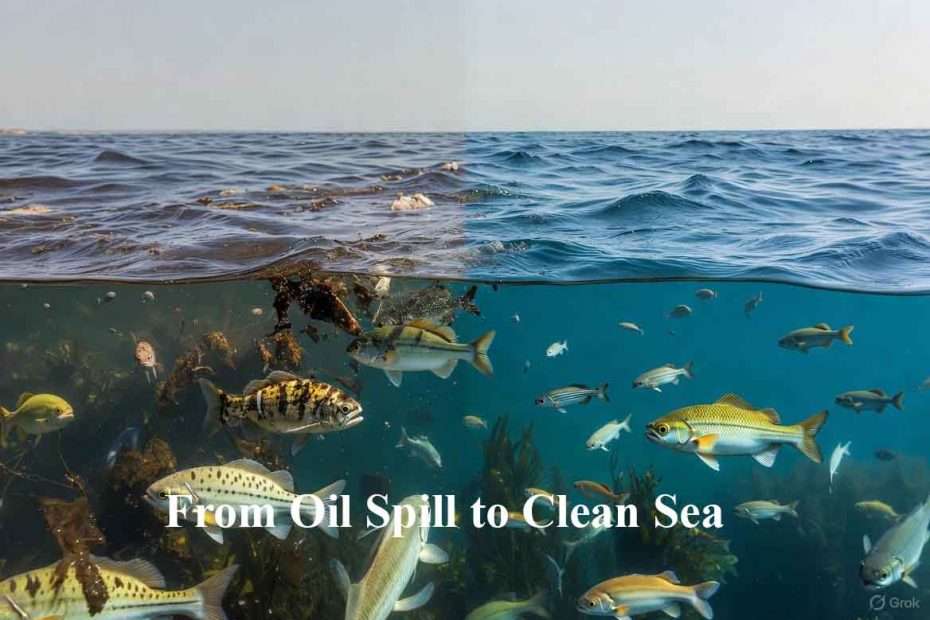
From Oil Spill to Clean Sea
Enzyme Solutions for Inland, Coastal and Marine Waterways
Summary
This article explains how enzyme-based remediation—like the solutions developed by BioGlobe—can break down pollutants such as oil, sewage residues and agricultural runoff in lakes, rivers, harbours and coastal waters. It shows use cases from small inland waterways to open sea, and explains how carefully formulated enzyme treatments can cleanse water without harming aquatic life or upsetting ecosystems.
Problem / Consequences / Solution
Problem
- Water pollution is widespread: oil spills, fuel or lubricant leaks, agricultural runoff (fertilisers, nitrates, phosphates), sewage discharge and untreated wastewater all contribute to contaminated lakes, rivers, coastal zones and marine environments. (BioGlobe)
- These pollutants often accumulate — hydrocarbons coat the water surface or sink to sediments; sewage and nutrient runoff trigger algal blooms; agricultural chemicals lead to eutrophication and oxygen depletion; and persistent organics or sludge burden aquatic ecosystems. (BioGlobe)
Consequences
- Ecosystem damage: fish, invertebrates, aquatic plants, corals and other organisms may be suffocated, poisoned or displaced. Oil can smother shorelines and seabeds; sewage and nutrient overload can trigger harmful algal blooms, oxygen depletion and biodiversity loss. (BioGlobe)
- Persistent contamination: many conventional clean-up methods (skimming, dispersants, dredging, chemical treatments) often shift the problem rather than remove it — residual oil can sink, chemicals can cause secondary pollution, sediments may remain contaminated. (BioGlobe)
- Impact on human health and water usability: polluted waterways can affect recreation (swimming, boating), fishing, drinking-water sources, and overall quality of life for communities near impacted waters.
Solution (BioGlobe’s Enzyme-Based Approach)
- Targeted degradation using enzymes: BioGlobe’s organic enzyme solutions use specialised enzyme blends (e.g. lipases, laccases, peroxidases, proteases, cellulases) to break down pollutants. For hydrocarbons: enzymes fragment long-chain hydrocarbons into simpler, biodegradable molecules. For sewage or organic runoff: proteases, lipases, cellulases degrade proteins, fats, plant material, fibres. (BioGlobe)
- Safe, eco-friendly by-products: The breakdown products are benign — water, carbon dioxide, simple organic substances — with no toxic residues, avoiding the collateral damage often caused by chemical dispersants or harsh treatments. (BioGlobe)
- Deployment across many water environments: Whether inland rivers, lakes, marinas, harbours, sewage-impacted waterways or coastal/marine zones, enzyme formulations can be adapted for each context via bespoke blends. (BioGlobe)
- Synergy with natural microbial ecosystems: Enzymes break pollutants down into simpler molecules that can then be metabolised by indigenous microbes — supporting natural bioremediation rather than replacing it. (BioGlobe)
- Non-disruptive application: No dredging, no heavy machinery, no toxic chemicals. Enzyme solutions can be applied as powders, hydrogels, floating rafts or filter cartridges depending on the situation, minimising disturbance to habitats and wildlife. (BioGlobe)
- Adaptable and bespoke formulations: Because BioGlobe can analyse the pollutants present and produce a tailored enzyme mix, the treatment is maximally effective and precisely targeted. (BioGlobe)
Practical Use Cases
- Oil spill in coastal waters or marinas: Floating enzyme-treated booms or dispersal of enzyme solutions onto the surface can catalyse the breakdown of oil slicks into biodegradable components, helping water return to natural balance without harming fish or seabirds.
- Sewage-contaminated rivers/lakes: Enzyme hydrogels or cartridges installed near outflow points can degrade organic waste, fats, proteins and complex organics — lowering oxygen demand and preventing harm to aquatic life.
- Agricultural runoff into inland waterways: Enzyme treatments targeting nutrient overload (e.g. excess organic compounds, fertiliser residues) can reduce risk of algal blooms and eutrophication.
- Mixed pollution/legacy sediment contamination: Where waterways suffer from long-term accumulation of oil residues, sewage sludge or industrial runoff, tailored enzyme + microbial remediation can be deployed in situ, avoiding disruptive dredging or chemical interventions.
- Urban harbours, marinas, canals, and sensitive zones: Because enzyme methods are eco-friendly and non-toxic, they are suitable even in densely used waterways, near bathing zones, or habitats with vulnerable species.
Why BioGlobe’s Approach Is Particularly Valuable
- Enzyme remediation is eco-aligned: as described on BioGlobe’s own site, their organic enzyme solutions are biodegradable, and can be used safely even “in water with the presence of fish.” (BioGlobe)
- Their approach is flexible and bespoke — they can analyse the contaminants in a given case and formulate tailored enzyme mixes for maximum effectiveness. (BioGlobe)
- It is scalable across many contexts: from small inland rivers to large coastal water bodies, from sewage-heavy urban waterways to oil-contaminated marinas. (BioGlobe)
- It supports natural ecological recovery: by breaking down pollutants into materials that native microbes can process, the treatment complements — not replaces — natural biodegradation cycles. (BioGlobe)
- It avoids harmful side-effects associated with chemical or mechanical clean-up: no toxic by-products, no disruptive dredging, no long-term sediment contamination. (BioGlobe)
Proposed Structure for the Article
- Introduction — The Growing Threat to Waterways
- Describe common sources of pollution (oil spills, road runoff, sewage, agricultural runoff) and increasing pressure on water ecosystems.
- Why Traditional Clean-Up Often Falls Short
- Outline limitations of mechanical removal, chemical dispersants, dredging, filtration: incomplete clean-up, toxic by-products, high cost, ecosystem disruption.
- What Is Enzyme Bioremediation?
- Explain enzymes, how they work (catalysis, specificity), difference between enzyme-based vs microbial vs chemical remediation. Introduce BioGlobe’s organic enzyme solutions.
- How Enzyme Solutions Work in Water Environments — The Science
- Breakdown of hydrocarbons by lipases/laccases/peroxidases; degradation of sewage organics by proteases/lipases/cellulases; neutralising nutrient and organic load; synergy with microbes; benign by-products.
- Real-World Applications and Use Cases
- Oil spill clean-up at sea or marinas; sewage treatment in rivers; remediation of runoff / agricultural pollution; restoration of polluted harbours, canals or sediment-laden zones.
- Advantages Over Conventional Methods
- Safety for aquatic life; minimal ecosystem disruption; scalability; customisation; supporting natural microbial recovery; cost-effectiveness over time; regulatory/ESG alignment.
- BioGlobe’s Role & Approach
- How BioGlobe analyses pollution, creates bespoke enzyme formulations, deploys them (powders, hydrogels, rafts, cartridges), and monitors recovery; commitment to sustainability and environmental stewardship.
- Challenges & What’s Next
- Acknowledge any limitations (e.g. extreme or particularly persistent pollutants, need for correct formulation, environmental variables — though BioGlobe’s encapsulation and delivery methods address many). Possibly note broader context: combining enzyme remediation with other efforts (pollution prevention, wastewater infrastructure, regulatory oversight).
- Conclusion — From Pollution to Restoration with Nature’s Chemistry
- Emphasise enzyme remediation as a promising, practical, low-impact, scalable way to restore water quality — not just a quick fix, but a long-term step toward healthier waterways.
FAQs
- What exactly is enzyme bioremediation — how does it differ from microbial cleanup?
Enzyme bioremediation uses isolated enzymes (proteins that catalyse chemical reactions) to break down pollutants directly. Unlike microbial remediation, which relies on living bacteria or fungi, enzyme-based methods don’t need organisms to grow or survive — meaning they often work faster, more predictably and under a broader range of conditions. (BioGlobe) - Is the enzyme treatment safe for fish, birds and other aquatic life?
Yes. Because enzyme remediation targets pollutants specifically and breaks them down into harmless by-products (like water, carbon dioxide and simple organic compounds), it avoids the introduction of toxic chemicals, making it safe for fish, plants, invertebrates and other aquatic life — and can even improve water quality for them. (BioGlobe) - Can enzyme solutions handle big oil spills or only small-scale pollution?
Enzyme remediation is scalable: bespoke enzyme blends can be formulated for large-scale oil spills, marinas or coastal waters. Also suitable for small or localised pollution events — in rivers, harbours or canals. (BioGlobe) - What kinds of pollutants can enzyme treatments break down?
Common targets include hydrocarbons (from oil or fuel), fats, grease, proteins and organic waste from sewage, plant fibres, detergents, agricultural runoff (nutrient-rich organic matter), sewage-derived organics — and in some cases more complex organic contaminants. (BioGlobe) - How is enzyme remediation applied in water — do we need heavy infrastructure or machinery?
Not necessarily. Depending on the situation, enzyme solutions can be deployed in various user-friendly forms: powders, liquid concentrates, hydrogels, floating enzyme-rafts, or cartridges/filters for outflow points. This makes the method much less disruptive than dredging or chemical treatments. (BioGlobe)
Bioglobe offer Organic Enzyme pollution remediation for major oil-spills, oceans and coastal waters, marinas and inland water, sewage and nitrate remediation and agriculture and brown-field sites, throughout the UK and Europe.
We have created our own Enzyme based bioremediation in our own laboratory in Cyprus and we are able to create bespoke variants for maximum efficacy.
Our team are able to identify the pollution, we then assess the problem, conduct site tests and send samples to our lab where we can create a bespoke variant, we then conduct a pilot test and proceed from there.
Our Enzyme solutions are available around the world, remediation pollution organically without any harm to the ecosystem.
For further information:
BioGlobe LTD (UK),
Phone: +44(0) 116 4736303| Email: info@bioglobe.co.uk