

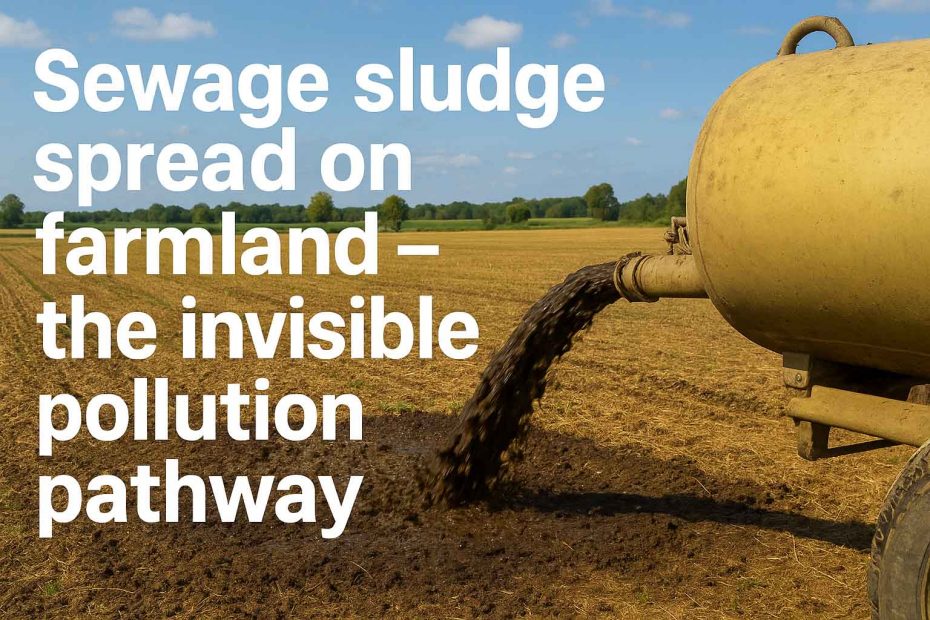
Sewage sludge spread on farmland – the invisible pollution pathway
Why sludge-derived contaminants are now a UK-wide environmental concern
Introduction
Across the UK, public awareness of water pollution has risen sharply in recent years. Images of sewage being discharged into rivers and seas have dominated headlines, sparking national outrage and calls for tighter regulation of water companies. Yet while most people now recognise the scale of the sewage-in-rivers issue, very few know what happens to the solid portion of our wastewater once it leaves the treatment works.
This little-discussed substance is sewage sludge – a by-product of wastewater treatment which, for decades, has been spread on farmland as a cheap, nutrient-rich fertiliser. It is often promoted as part of a sustainable, circular economy: recycling nutrients back into the soil, reducing reliance on chemical fertilisers, and helping farmers maintain organic matter.
But a growing body of evidence suggests that sewage sludge contains far more than nutrients. It often carries a complex mixture of PFAS (“forever chemicals”), microplastics, pharmaceutical residues, antibiotics, endocrine-disrupting compounds, flame retardants, industrial chemicals, heavy metals and more. Many of these are persistent, bioaccumulative, and capable of moving from soils into water or even the food chain.
Despite this, the regulatory framework governing sludge use is outdated, monitoring is limited, and public awareness is extremely low. The practice continues largely unquestioned, even though the UK applies millions of tonnes of sludge to farmland every year.
This article explains how sewage sludge ends up on fields, what contaminants it may contain, why the issue matters, and how modern, organic bioremediation – such as Bioglobe’s enzyme-based remediation solutions – could help clean up the problem safely and sustainably.
1. Understanding Sewage Sludge: From Treatment Works to Farmland
When wastewater from homes, businesses, hospitals and industry enters a sewage treatment plant, it undergoes a series of processes designed to remove solids, pathogens, and pollutants. The cleaned liquid portion is discharged into rivers or the sea. The remaining solids, however, do not disappear.
These solids are thickened, treated and stabilised to create sewage sludge, sometimes referred to as “biosolids”. Sludge was historically landfilled or incinerated, but as environmental standards improved and landfill space dwindled, a new solution emerged: apply it to farmland as a fertiliser.
Sludge contains nitrogen, phosphorus and organic matter – all valuable for crops. Therefore, water companies began to process and market it as a soil improver. Farmers benefited from a low- or no-cost nutrient source, and water companies found an inexpensive outlet for a waste product that would otherwise require costly disposal.
On the surface, this arrangement appears mutually beneficial. But what is increasingly clear is that sewage sludge also contains the chemical footprint of modern life – a footprint that conventional sewage treatment methods were never designed to remove.
2. What’s Really in Sewage Sludge? A Hidden Chemical Cocktail
Sewage sludge is formed from everything that goes down toilets, sinks, drains and industrial pipes. This includes:
- Domestic wastewater
- Industrial effluents
- Leachate from landfills
- Runoff containing urban pollutants
- Household chemicals
- Microplastics from washing clothes
- Pharmaceuticals excreted by humans
- Cleaning agents, personal care products and cosmetics
Most wastewater treatment plants are designed to remove pathogens and organic load, not synthetic chemicals. As a result, many pollutants become concentrated in the sludge.
Common contaminants found in UK sewage sludge include:
1. PFAS (“forever chemicals”)
PFAS are used in firefighting foams, waterproof fabrics, food packaging and non-stick cookware. They are incredibly persistent and have been linked to cancers, immune disruption, hormonal problems and fertility issues. Once PFAS enter the environment, they can linger for decades or even centuries.
2. Microplastics
Microplastics enter wastewater from clothing fibres, cosmetic products, degraded packaging and tyre particles. Treatment plants are effective at removing them from the liquid phase, but that simply means they become trapped in the sludge instead.
3. Pharmaceuticals and antibiotics
Modern life uses an enormous range of pharmaceuticals: painkillers, antidepressants, hormones, antibiotics, anti-inflammatory drugs and more. Many of these pass through the human body and into sewage systems. While some degrade naturally, many are stable enough to persist through treatment and accumulate in sludge.
4. Endocrine disruptors
These include bisphenols, phthalates, flame retardants and other chemicals that can interfere with hormones in animals and humans.
5. Heavy metals
Although some heavy metals are regulated, many industrial sites still discharge trace amounts. Metals such as cadmium, mercury, lead, zinc and copper can accumulate in soils where sludge is repeatedly applied.
6. Industrial chemicals
Dyes, solvents, surface-active agents, plasticisers, pesticides, and various manufacturing by-products are all commonly detected.
7. Landfill leachate-derived chemicals
Many water companies accept tanker loads of landfill leachate – the liquid that drains through waste in landfill sites. This liquid contains a concentrated mix of industrial chemicals, household toxins, solvents, oils, metals and persistent pollutants. When mixed with sewage and turned into sludge, these contaminants are transferred directly onto farmland.
In short, sewage sludge contains many substances that were never intended to be in soil, many of which can persist for years, accumulate over time, and move through ecosystems in ways that were once dismissed or misunderstood.
3. The Problem: How Sludge Becomes an Invisible Pollution Pathway
Outdated regulation
The UK’s framework for regulating sludge dates back to the late 1980s. It focuses mainly on pathogens and a small list of heavy metals, reflecting what was considered important at the time. Since then, thousands of new chemicals, pharmaceuticals and plastics have become commonplace in society. Yet regulation has barely changed.
Most sludge is not screened for:
- PFAS
- Microplastics
- Pharmaceutical residues
- Flame retardants
- Endocrine disruptors
- Antibiotic-resistant bacteria
- Industrial solvents
- Combination effects of mixed chemicals
This regulatory gap creates a situation in which sludge can legally be applied to farmland even if it contains dozens of potentially harmful substances that are simply not tested for.
Public unawareness
Unlike sewage spills into rivers, which are visible and emotive, sludge spreading is quiet and unobtrusive. Fields treated with sludge may look no different to fields fertilised with manure. The practice takes place away from towns and cities, and because the risks accumulate slowly over time, there is no single dramatic event to trigger public concern.
Misleading framing
Because sludge contains natural nutrients, it is often described as “recycling” or “resource recovery”. This positive language can obscure the fact that sludge is also a vehicle for chemical pollution. Some environmental advocates have raised concerns that sludge use effectively moves pollution from water into soil, creating a new, less visible contamination route.
Cumulative buildup
Unlike water, which constantly flows and dilutes, soils tend to accumulate persistent chemicals. A field receiving sludge every few years can experience a slow, steady increase in pollutants, even if each individual application meets regulatory norms.
This means the problem may take years to manifest – but once contamination becomes widespread, reversing it is extremely difficult.
4. Consequences: How Sludge-Derived Pollution Affects Soil, Water, Wildlife and People
Even though sewage sludge is applied under controlled conditions, there is growing concern that the long-term consequences may be far more significant than previously recognised.
Below are the key risks emerging from current research.
1. Soil contamination and degradation
Soils are living ecosystems containing fungi, bacteria, insects, earthworms and organic matter. These are essential for plant growth, carbon storage, nutrient cycling and biodiversity. When contaminants accumulate in soil, they can disrupt these natural systems.
Microplastics and soil structure
Microplastics can:
- interfere with soil aeration
- reduce water retention
- impair root growth
- damage earthworms and microbes
- alter soil chemistry
Fields repeatedly treated with sludge have been found to contain far higher microplastic levels than untreated soils.
PFAS and persistent chemicals
PFAS, flame retardants and other stable chemicals bind strongly to soil particles. They resist degradation, build up over time, and in some cases can migrate through soil into groundwater.
Pharmaceutical and hormone residues
Residues of hormones, antidepressants or anti-inflammatory drugs can affect soil organisms and disrupt microbial communities.
2. Water contamination
Contaminants in sludge-treated soils can enter waterways through:
- surface runoff after heavy rain
- erosion
- leaching into groundwater
- drainage channels and ditches
This introduces pollutants into rivers, streams, reservoirs and coastal areas.
Microplastics washed from fields have been detected in rivers and estuaries. PFAS are known to migrate through soil into groundwater over long timescales. Pharmaceuticals, antibiotics and endocrine disruptors can affect fish, amphibians and aquatic insects.
3. Food chain exposure
Although research is ongoing, studies suggest that some contaminants may enter the food chain via:
- uptake into crops
- livestock grazing on treated land
- accumulation in soils used for vegetable and fruit production
- contamination of drinking water sources
While the risk to consumers is still being studied, the precautionary principle suggests that allowing persistent, bioactive chemicals onto farmland is unwise.
4. Antibiotic resistance
Sludge frequently contains residual antibiotics from human medicine. Introducing these compounds into soils can create selective pressure for antibiotic-resistant bacteria. This presents a long-term public health concern.
5. Wildlife and biodiversity impacts
Pollutants in sludge can affect:
- soil invertebrates
- pollinators
- birds and small mammals
- aquatic species downstream
Biodiversity loss is rarely immediate but occurs gradually as soil and water quality decline.
6. Long-term legacy
Unlike spills or accidents, which can be cleaned up after the event, sludge pollution creates a long-term, cumulative burden. Once pollutants are embedded in soils across thousands of acres, remediation requires enormous resources and effort.
5. The Solution: How Organic Enzyme Bioremediation Can Break the Pollution Cycle
The scale and complexity of sludge-derived pollution requires innovative thinking. Traditional approaches – such as banning sludge, incinerating waste, or imposing strict new landfill controls – are expensive, energy-intensive and politically challenging.
A modern, environmentally responsible alternative is bio-based remediation, particularly enzyme-driven approaches that actively break down contaminants.
This is where Bioglobe’s organic Enzyme Bioremediation technology makes a meaningful difference.
Bioglobe: bespoke remediation based on pollutant analysis
Bioglobe operates a laboratory with the ability to:
- analyse pollutants present in wastewater, sludge, soil or runoff
- identify chemical signatures such as pharmaceuticals, PFAS-like compounds, microplastic-associated contaminants, pesticides, hydrocarbons and more
- design customised enzyme formulations tailored to the specific contamination profile
- deploy organic, biodegradable solutions that work with ecosystems – not against them
This allows each scenario to be approached scientifically and safely.
How enzyme-based bioremediation works
Enzymes are biological catalysts. They accelerate chemical reactions, enabling contaminants to be broken down into harmless or far less harmful components. Because they are:
- naturally derived
- biodegradable
- non-toxic
- highly specific
- effective at low concentrations
they are ideal for environmental cleanup.
Bioglobe’s formulations are specially designed to target pollutants commonly found in sludge and contaminated soils.
Applications include:
1. Treating sewage sludge before it reaches farmland
Enzyme blends can be added to sludge to reduce the load of organic contaminants before it is used as fertiliser. This decreases the long-term chemical burden on soils.
2. Remediating contaminated soils
For land already affected by years of sludge spreading, Bioglobe can apply enzyme-based treatments to break down pollutants within the soil matrix.
3. Cleaning water runoff
Enzymatic solutions applied in buffer zones or drainage areas can intercept contaminants before they flow into rivers or groundwater.
4. Restoring soil biology
By improving the quality of soil and reducing toxic load, enzymes help promote the recovery of earthworms, microbes and overall soil biodiversity.
5. Protecting food safety
Reducing contaminants in soils decreases the risk of uptake by crops and livestock, improving overall food security and long-term agricultural sustainability.
Why ecosystem-compatible solutions matter
Unlike chemical treatments, which may introduce new toxins, or incineration, which is energy-intensive and generates emissions, enzyme remediation:
- leaves no harmful residues
- complements natural processes
- restores ecosystems rather than damaging them
- offers a scalable, cost-effective alternative
- aligns with circular economy principles
- helps transition towards sustainable sludge management
Bioglobe’s approach is particularly powerful because it combines scientific analysis with custom-built solutions. This ensures every treatment is targeted, efficient and environmentally responsible.
6. Bringing the Public into the Conversation
Most people do not realise that farmland across the UK receives millions of tonnes of sewage sludge every year. Very few understand what modern sludge contains, how outdated the regulations are, or that soils may be accumulating a mixture of persistent chemicals that future generations will have to deal with.
Raising awareness is essential.
Ordinary people deserve to know:
- how their household waste is being used
- whether their food may be grown on sludge-treated soils
- what risks exist to water, wildlife and long-term farmland health
- what can be done to fix the issue
The goal is not to create fear, but to encourage informed public dialogue and responsible policy-making.
Sludge management must modernise. Regulation must catch up with science. Monitoring must be improved. And sustainable remediation techniques – particularly those that are organic, safe and ecosystem-compatible – must be adopted widely.
This is where organisations like Bioglobe can make a real difference, offering solutions that help farms, water companies and local authorities navigate the transition to safer, cleaner environmental practices.
7. Conclusion
Sewage sludge has been used on UK farmland for decades, originally seen as a smart way to recycle nutrients and reduce waste. But as our understanding of chemical pollution has evolved, it has become clear that sludge spreading is also an invisible pollution pathway – one that transfers contaminants from wastewater into soils, water systems and potentially the food chain.
The issue is not caused by farmers, and it is not caused solely by water companies. It stems from an outdated regulatory system, a flood of new chemical products entering everyday life, and a lack of modern remediation tools within the traditional wastewater framework.
Ignoring the problem is no longer an option. Soils are the foundation of farming, biodiversity and food production. Protecting them requires forward-thinking solutions.
Bioglobe’s organic Enzyme Bioremediation offers:
- bespoke pollutant analysis
- targeted degradation of contaminants
- ecosystem-safe remediation
- scalable implementation
- a path towards long-term sustainability
By integrating these approaches into sludge management and soil restoration, the UK can begin to address this hidden problem and safeguard farmland and water for the future.
FAQs
1. Why is sewage sludge used on farmland?
Because it contains nutrients such as nitrogen and phosphorus, water companies supply treated sludge to farmers as a low-cost fertiliser and soil improver. This reduces the need for chemical fertilisers and helps dispose of a waste product.
2. Why is sewage sludge now considered a pollution risk?
Modern sludge contains microplastics, PFAS, pharmaceuticals, industrial chemicals and other contaminants that traditional treatment processes were not designed to remove. These pollutants can accumulate in soil, affect water quality and potentially enter the food chain.
3. Can sludge pollution affect crops and food?
There is evidence that some contaminants may be taken up by crops or enter food systems indirectly via water or livestock. While more research is ongoing, the long-term risks are considered significant enough to warrant precaution and better regulation.
4. How does Bioglobe’s bioremediation help?
Bioglobe analyses the pollutants present in sludge or soil and creates a tailored enzyme solution that breaks down harmful compounds organically. This reduces contamination without damaging soil biology or creating new pollutants.
5. Is enzyme bioremediation safe for the environment?
Yes. Enzymes are natural, biodegradable catalysts. They work with existing soil ecosystems, break down pollutants rather than masking them, and leave no harmful residues. This makes them one of the most sustainable remediation options available today.
Bioglobe offer Organic Enzyme pollution remediation for major oil-spills, oceans and coastal waters, marinas and inland water, sewage and nitrate remediation and agriculture and brown-field sites, throughout the UK and Europe.
We have created our own Enzyme based bioremediation in our own laboratory in Cyprus and we are able to create bespoke variants for maximum efficacy.
Our team are able to identify the pollution, we then assess the problem, conduct site tests and send samples to our lab where we can create a bespoke variant, we then conduct a pilot test and proceed from there.
Our Enzyme solutions are available around the world, remediation pollution organically without any harm to the ecosystem.
For further information:
BioGlobe LTD (UK),
Phone: +44(0) 116 4736303| Email: info@bioglobe.co.uk