

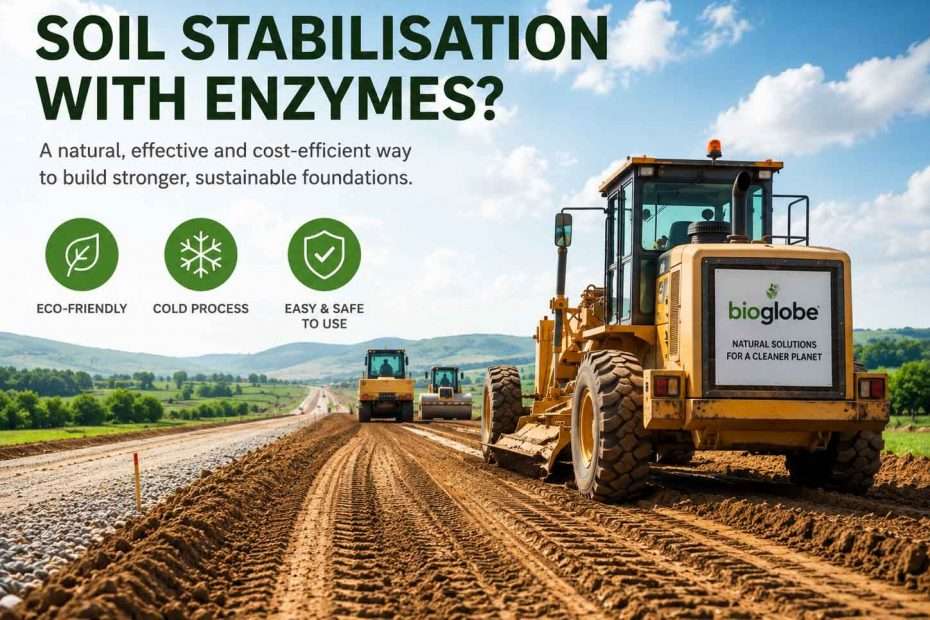
Soil Stabilisation with Enzymes
A Sustainable Future for Infrastructure Development
Modern infrastructure development faces a growing challenge: how to construct durable, cost-effective roads and foundations while reducing environmental impact. Traditional soil stabilisation methods, particularly those involving cement, lime, and bitumen, have long dominated the construction industry. However, these conventional approaches often come with high carbon emissions, extensive energy consumption, and rising material costs.
As governments, contractors, engineers, and developers increasingly prioritise sustainability, the construction sector is turning towards environmentally responsible technologies that deliver both performance and economic value. One of the most innovative solutions now transforming the industry is enzyme-based soil stabilisation.
At Bioglobe, we specialise in the production and distribution of advanced enzyme-based organic remediation solutions designed to improve environmental performance across a range of industrial and infrastructure applications. Our enzyme technologies provide sustainable alternatives to harmful chemical treatments while maintaining exceptional engineering performance.
Among these innovations, soil stabilisation enzymes are emerging as one of the most effective and environmentally friendly solutions available for road construction, dam infrastructure, industrial yards, agricultural access roads, and numerous other civil engineering projects.
This article explores how enzyme soil stabilisation works, why it is rapidly gaining international adoption, and how it delivers long-term environmental and economic benefits.
Understanding Soil Stabilisation
Soil stabilisation is the process of improving the engineering properties of soil to increase its load-bearing capacity, durability, and resistance to moisture. In many construction projects, naturally occurring soil lacks the strength or stability needed to support heavy traffic loads or structural foundations.
Historically, engineers have relied on methods such as:
- Cement stabilisation
- Lime stabilisation
- Bitumen treatment
- Mechanical compaction
- Aggregate replacement
While these methods can improve soil strength, they often involve significant environmental costs. Cement production alone accounts for approximately 8% of global CO₂ emissions, while bitumen heating produces pollution and consumes large quantities of energy.
Enzyme-based soil stabilisation offers a fundamentally different approach.
Instead of replacing soil or adding large volumes of industrial materials, enzymes improve the performance of the existing in-situ soil by altering its physical and chemical properties.
The result is a stronger, denser, more stable road base or foundation achieved with significantly lower environmental impact.
What Are Soil Stabilisation Enzymes?
Soil stabilisation enzymes are bio-catalytic formulations specifically developed to improve the physical and mechanical properties of soil.
These enzymes are completely natural, biodegradable, non-toxic, and non-corrosive. They are typically supplied as concentrated liquid formulations that are diluted with water and applied directly to the soil during the construction process.
The enzymes work by interacting with clay particles within the soil. Clay soils naturally contain negatively charged particles that attract water molecules, creating swelling, instability, and weak compaction performance.
Enzyme formulations alter the soil chemistry by reducing the affinity between clay particles and water. This allows the particles to bind more tightly together, resulting in:
- Increased density
- Reduced permeability
- Improved compaction
- Higher load-bearing strength
- Greater long-term durability
In practical terms, enzyme treatment transforms weak or unstable soils into highly durable construction layers suitable for roads, foundations, and industrial surfaces.
One of the most significant engineering benefits is the dramatic improvement in California Bearing Ratio (CBR), a key measurement of soil strength used in pavement design.
By increasing CBR values, enzyme stabilisation reduces or eliminates the need for imported aggregates, excessive cement, or deep excavation.
The Science Behind Enzyme Soil Stabilisation
Although the concept may appear simple, the science behind enzyme stabilisation is highly sophisticated.
A unique blend of carefully selected enzymes acts as a catalyst within the soil matrix. These enzymes improve workability, mixability, binding, and compaction efficiency.
When mixed with water and applied during soil preparation, the enzymes trigger chemical reactions that modify the electrochemical properties of clay particles.
This process creates several critical improvements:
1. Reduction in Water Affinity
Clay particles naturally attract and retain water. Excess moisture weakens the soil structure and reduces load-bearing capacity.
Enzymes reduce this attraction, helping soil particles pack tightly together with lower moisture sensitivity.
2. Improved Compaction
Because the soil particles bind more efficiently, contractors can achieve higher densities with less mechanical effort.
This means:
- Faster compaction
- Reduced fuel consumption
- Lower equipment wear
- Improved productivity on-site
3. Enhanced Soil Strength
The enzyme treatment creates a dense, tightly bound structure that significantly increases CBR and compressive strength.
This allows roads and foundations to withstand heavier loads with reduced maintenance requirements.
4. Reduced Permeability
Enzyme-treated soils become more resistant to water penetration.
This reduces:
- Erosion
- Pothole formation
- Water damage
- Seasonal weakening
The result is longer-lasting infrastructure with improved resilience under varying weather conditions.
Why Enzyme Soil Stabilisation Is Environmentally Superior
Environmental sustainability is one of the primary reasons why enzyme stabilisation is attracting global attention.
Traditional construction methods rely heavily on cement, lime, and bitumen — materials associated with high carbon emissions and energy-intensive production processes.
By contrast, enzyme stabilisation is a low-impact, eco-friendly solution.
Completely Natural and Biodegradable
Enzyme stabilisers are derived from natural biological processes and contain no harmful toxic compounds.
Unlike many chemical stabilisers, they do not contaminate groundwater or agricultural land.
Reduced Carbon Footprint
Cement production is one of the largest industrial contributors to greenhouse gas emissions.
Enzyme treatment drastically reduces or eliminates the need for cement in many soil stabilisation projects.
This results in:
- Lower embodied carbon
- Reduced transportation emissions
- Less energy consumption
- Reduced dependence on industrial materials
Elimination of Bitumen Heating Pollution
Bitumen-based road construction requires heating, which consumes energy and releases pollutants into the atmosphere.
Enzyme stabilisation uses a cold process, eliminating the pollution associated with heated bitumen applications.
Lower Material Consumption
Because enzyme treatment improves existing in-situ soil, projects require fewer imported aggregates and less excavation.
This minimises:
- Quarry extraction
- Truck transportation
- Fuel consumption
- Landscape disruption
Safe for Workers and Communities
Enzyme stabilisers are easy and safe to use.
Their non-toxic and non-corrosive nature reduces risks to construction workers and surrounding communities.
Comparing Enzyme Stabilisation with Cement Stabilisation
Cement stabilisation has long been a standard practice in road construction, but it presents several limitations.
Typically, cement-treated bases require between 4–8% cement by weight to achieve target strength values.
While effective in the short term, cement stabilisation often produces a brittle layer prone to cracking over time.
Additionally, the environmental impact of cement production is substantial.
Enzyme stabilisation offers a more flexible, sustainable alternative.
Lower Material Usage
Enzyme treatment typically requires only 1–2 litres per cubic metre of soil.
This significantly reduces the quantity of imported materials needed on-site.
Comparable or Higher CBR Performance
Enzyme-stabilised soils can achieve comparable or even superior California Bearing Ratio performance compared to cement-treated bases.
This makes them highly suitable for:
- Rural roads
- Industrial access roads
- Parking areas
- Agricultural routes
- Low and medium traffic roads
- Industrial flooring
Reduced Construction Costs
Projects using enzyme stabilisation often achieve cost savings of 30–50% per kilometre compared with cement stabilisation.
Savings are achieved through:
- Reduced material costs
- Lower transportation requirements
- Faster installation
- Lower fuel consumption
- Reduced equipment wear
Improved Flexibility
Unlike brittle cement layers, enzyme-treated soil retains a degree of flexibility.
This helps reduce cracking and improves long-term pavement durability.
Near-Zero CO₂ Footprint
The low material intensity and biological nature of enzyme stabilisers create a dramatically smaller carbon footprint.
This supports sustainability targets and environmentally responsible infrastructure development.
Which Soil Types Work Best?
Not all soils behave identically, and successful soil stabilisation depends on understanding local soil characteristics.
Enzyme stabilisation works particularly well on:
- Clay soils
- Silty-clay soils
- Medium plasticity soils
- Fine-grained soils
The ideal Plasticity Index (PI) range is typically between 10 and 35.
These soils respond well because clay particles are highly reactive to the electrochemical effects of the enzyme formulation.
Soils Less Suitable for Enzyme Treatment
Highly granular or sandy soils with a Plasticity Index below 8 may require additional binders or alternative stabilisation systems.
In such cases, technical evaluation becomes essential.
Importance of Soil Testing
Before specifying dosage rates, professional technical teams conduct detailed soil analysis, including:
- Atterberg limits
- Sieve analysis
- Modified Proctor tests
- Moisture-density relationships
- CBR testing
These tests ensure the correct enzyme dosage and construction methodology are selected for optimal performance.
At Bioglobe, we recognise that every project is unique. Proper soil assessment is critical to delivering reliable long-term results.
Applications of Enzyme Soil Stabilisation
The versatility of enzyme stabilisation makes it suitable for a broad range of civil engineering and infrastructure projects.
Road Construction
One of the most common applications is road base stabilisation.
Enzyme treatment creates strong, durable road layers capable of handling traffic loads while reducing maintenance costs.
Applications include:
- Rural roads
- Secondary roads
- Farm roads
- Forestry access roads
- Mining roads
- Industrial access routes
Dams and Embankments
Stabilised soils improve erosion resistance and structural integrity in dam and embankment construction.
The reduced permeability also helps control water infiltration.
Industrial Yards and Hardstands
Heavy industrial areas require stable surfaces capable of supporting equipment and vehicle traffic.
Enzyme-treated soil provides a durable and cost-effective alternative to extensive concrete paving.
Agricultural Infrastructure
Agricultural roads and pathways often suffer from seasonal deterioration.
Enzyme stabilisation improves durability while remaining environmentally safe for farmland and groundwater.
Parking Areas and Logistics Facilities
Warehouses, distribution centres, and parking facilities benefit from improved ground stability with reduced construction costs.
Low-Cost Infrastructure Development
In developing regions, enzyme stabilisation provides an affordable solution for improving road connectivity and transportation infrastructure.
The ability to use local soil significantly reduces project costs.
Construction Process for Enzyme Stabilisation
One of the major advantages of enzyme soil stabilisation is its simplicity and efficiency.
The process generally follows these stages:
1. Site Evaluation and Soil Testing
Engineers analyse soil properties and determine the appropriate dosage and treatment method.
2. Surface Preparation
The construction area is graded and scarified to the required depth.
3. Enzyme Dilution
The enzyme concentrate is diluted with water according to project specifications.
4. Application
The diluted solution is sprayed evenly across the prepared soil.
5. Mixing
The soil and enzyme solution are mixed thoroughly using graders or rotavators.
6. Compaction
The treated soil is compacted using rollers.
Because the enzymes improve compaction efficiency, higher densities are achieved with less mechanical effort.
7. Curing
The stabilised layer is allowed to cure, during which the chemical bonding process strengthens the soil structure.
The cold-process nature of enzyme stabilisation simplifies implementation while reducing energy usage and environmental impact.
Longevity and Performance
One of the most important questions asked by engineers and project managers is how long enzyme-stabilised roads and foundations will last.
Field performance has demonstrated excellent durability.
Properly constructed enzyme-treated soil bases have shown service lives exceeding 5–8 years in:
- Rural roads
- Agricultural roads
- Industrial yards
- Parking areas
- Access routes
In many cases, the performance lifespan can be even longer depending on:
- Traffic loading
- Drainage conditions
- Construction quality
- Maintenance practices
- Climate conditions
Importantly, the treatment creates permanent changes within the soil matrix.
The enzymes do not simply “wash out” after rainfall.
Once curing is complete, the stabilised structure remains durable under normal environmental conditions.
Economic Advantages for Contractors and Developers
Infrastructure budgets are under increasing pressure worldwide.
Enzyme stabilisation delivers substantial financial advantages without compromising engineering performance.
Lower Project Costs
Typical cost savings range between 30–50% compared with cement-treated bases.
Savings are generated through:
- Reduced cement usage
- Less imported aggregate
- Lower fuel consumption
- Reduced hauling distances
- Faster construction timelines
Reduced Maintenance
Improved resistance to moisture and erosion lowers long-term maintenance requirements.
This is especially valuable for rural and low-volume roads where maintenance budgets are limited.
Faster Project Completion
Simplified construction processes improve productivity and reduce project delays.
Better Use of Local Materials
Using existing in-situ soil eliminates the need for expensive material replacement.
This also reduces transportation logistics and associated environmental costs.
The Growing Global Demand for Sustainable Construction
Governments and industries around the world are under increasing pressure to reduce carbon emissions and improve sustainability.
Infrastructure projects are being evaluated not only on performance and cost but also on environmental impact.
Enzyme soil stabilisation aligns perfectly with modern sustainability goals because it:
- Reduces embodied carbon
- Minimises industrial material usage
- Conserves natural resources
- Lowers transportation emissions
- Improves construction efficiency
- Supports circular construction principles
As climate policies become stricter and environmental standards evolve, demand for eco-friendly infrastructure technologies will continue to grow.
Biological stabilisation technologies are well positioned to become a core part of future infrastructure development.
Why Bioglobe Supports Enzyme-Based Remediation Solutions
At Bioglobe, sustainability and environmental responsibility are at the centre of our mission.
We develop and distribute advanced organic and enzyme-based remediation technologies that help industries reduce pollution, improve operational efficiency, and minimise environmental harm.
Our approach is based on several core principles:
Sustainable Innovation
We believe industrial progress should not come at the expense of environmental health.
Our enzyme technologies provide high-performance alternatives to harmful chemical systems.
Environmental Responsibility
Biodegradable, non-toxic formulations help protect ecosystems, groundwater, and communities.
Cost-Effective Solutions
Environmental sustainability should also make economic sense.
Enzyme stabilisation reduces costs while improving infrastructure performance.
Practical Engineering Performance
Our technologies are designed not only for environmental compliance but also for real-world engineering effectiveness.
Strong, durable infrastructure remains essential for economic development.
Frequently Asked Questions
Are soil stabilisation enzymes environmentally safe?
Yes. Enzyme-based stabilisers are non-toxic, biodegradable, and environmentally safe when properly applied.
They do not leach harmful heavy metals and do not significantly alter soil pH.
This makes them suitable for use near groundwater sources and agricultural land.
Can enzyme stabilisation replace cement completely?
In many projects, yes.
However, the suitability depends on:
- Soil type
- Load requirements
- Climate conditions
- Project design specifications
Technical soil testing is always recommended before final design.
How much enzyme is required?
Typical applications require approximately 1–2 litres of concentrated enzyme product per cubic metre of soil.
Exact dosage depends on soil characteristics and target engineering performance.
Is the process complicated?
No.
Enzyme stabilisation is relatively simple to implement using standard road construction equipment and procedures.
How quickly can roads be opened to traffic?
This depends on curing conditions and project specifications, but enzyme-treated roads can often be placed into service rapidly following proper compaction and curing.
Does enzyme treatment work in wet climates?
Yes.
In fact, reduced permeability and improved moisture resistance make enzyme stabilisation highly beneficial in regions exposed to rainfall and seasonal moisture variation.
The Future of Soil Stabilisation
The future of infrastructure development will increasingly depend on technologies that combine performance, affordability, and environmental responsibility.
Enzyme soil stabilisation represents a major advancement in sustainable civil engineering.
By improving the performance of existing soils using biodegradable biological formulations, the industry can reduce dependence on carbon-intensive construction materials while lowering project costs.
As governments and developers seek greener infrastructure solutions, enzyme technologies are expected to play a larger role in:
- Road construction
- Rural development
- Mining infrastructure
- Industrial projects
- Agricultural access networks
- Climate-resilient infrastructure
The benefits are clear:
- Lower emissions
- Reduced environmental damage
- Improved cost efficiency
- Strong long-term performance
- Safer construction processes
Conclusion
Soil stabilisation with enzymes is transforming the way infrastructure projects are designed and delivered.
Unlike traditional stabilisation methods that rely heavily on cement, bitumen, or chemical additives, enzyme-based stabilisation offers a sustainable, biodegradable, and highly effective alternative.
By altering the physical and chemical properties of soil, enzyme formulations dramatically improve compaction, increase strength, reduce permeability, and enhance long-term durability.
The technology provides substantial environmental advantages through lower carbon emissions, reduced material usage, and elimination of pollution associated with heated bitumen and heavy industrial processing.
At the same time, contractors and developers benefit from lower project costs, faster construction timelines, and reduced maintenance requirements.
For governments, engineers, and industries seeking practical solutions that align with modern sustainability goals, enzyme soil stabilisation represents a forward-thinking approach to infrastructure development.
At Bioglobe, we are proud to support the transition towards environmentally responsible engineering through innovative organic and enzyme-based remediation technologies.
As the construction sector continues to evolve, sustainable biological solutions such as enzyme soil stabilisation will play a critical role in building stronger, cleaner, and more resilient infrastructure for the future.
Bioglobe offer Organic Enzyme pollution remediation for major oil-spills, oceans and coastal waters, marinas and inland water, sewage and nitrate remediation and agriculture and brown-field sites, throughout the UK and Europe.
We have created our own Enzyme based bioremediation in our own laboratory in Cyprus and we are able to create bespoke variants for maximum efficacy.
Our team are able to identify the pollution, we then assess the problem, conduct site tests and send samples to our lab where we can create a bespoke variant, we then conduct a pilot test and proceed from there.
Our Enzyme solutions are available around the world, remediation pollution organically without any harm to the ecosystem.
For further information:
BioGlobe LTD (UK),
Phone: +44(0) 116 4736303| Email: info@bioglobe.co.uk