

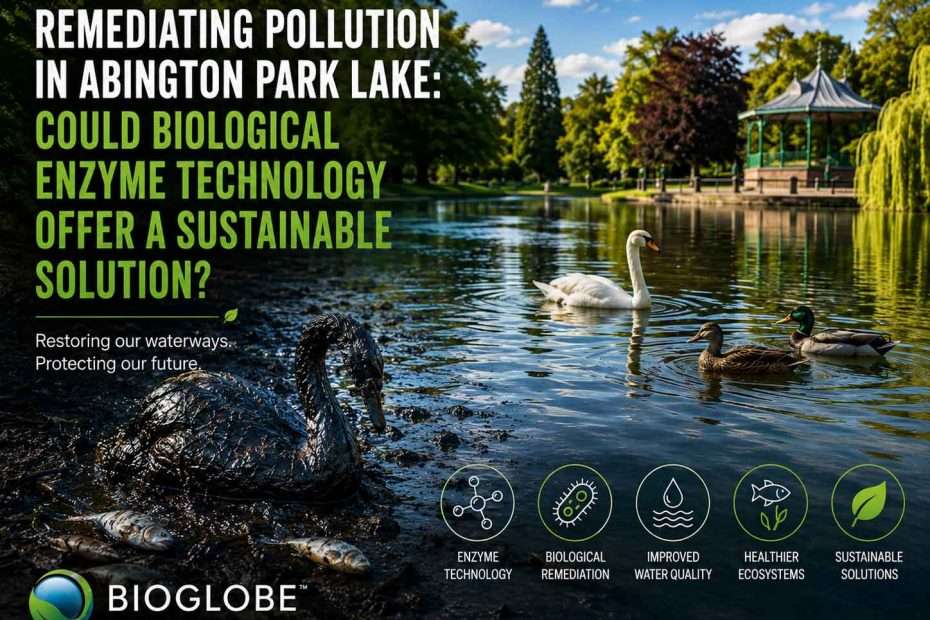
Remediating Pollution in Abington Park Lake
Could Biological Enzyme Technology Offer a Sustainable Solution?
A Pollution Incident That Still Raises Questions
In March 2020, visitors to Abington Park in Northampton were confronted with a disturbing sight. The park’s iconic lake, a focal point for residents, wildlife enthusiasts and anglers, appeared to be covered by a thick black contaminant. Witnesses reported a strong oily odour, dead fish floating on the water’s surface, and ducks and swans coated in black sludge.
The incident quickly attracted local attention and prompted a clean-up operation. Wildlife rescue organisations became involved, while contractors worked to remove contaminated material from the lake. Despite these efforts, questions remain about the precise cause of the pollution and whether the underlying environmental issues have ever been fully resolved.
Six years later, local concerns regarding the health of the lake continue to surface, highlighting a broader challenge faced by many urban waterways across the United Kingdom.
The Environmental Impact of Oil and Hydrocarbon Pollution
Whether originating from fuel leaks, surface water runoff, industrial discharges, vehicle contamination or historical pollution deposits, oil-based contaminants can have severe consequences for aquatic ecosystems.
When hydrocarbons enter a lake or river, they can create a film on the water’s surface that reduces oxygen transfer between the atmosphere and the water below. This can lead to declining oxygen levels, placing fish and other aquatic organisms under significant stress.
Oil contamination can also:
- Coat the feathers of waterfowl, reducing their insulation and buoyancy.
- Damage aquatic plants and microorganisms.
- Disrupt food chains throughout the ecosystem.
- Accumulate within sediments on the lake bed.
- Create unpleasant odours and visual pollution.
- Contribute to long-term ecological degradation.
Even after visible contamination has been removed, pollutants can remain trapped within sediments for years, potentially being reintroduced into the water column whenever the lake bed is disturbed.
This is one reason why many contaminated water bodies continue to experience environmental challenges long after an initial pollution event appears to have been addressed.
The Challenge of Traditional Remediation Methods
Historically, the response to oil contamination in lakes and waterways has focused on containment and physical removal.
Typical methods include:
- Absorbent booms and pads.
- Mechanical skimming.
- Sediment dredging.
- Chemical treatments.
- Disposal of contaminated materials.
While these approaches can be effective in removing visible contamination, they often come with significant limitations.
Physical removal can be expensive and disruptive to wildlife habitats. Dredging may disturb sediments and release additional pollutants into the water. Chemical treatments can introduce new environmental concerns and may impact non-target organisms.
In many cases, the contamination is not truly eliminated but simply transferred elsewhere for disposal.
As environmental standards evolve, there is increasing interest in technologies that can address pollution at its source while minimising ecological disruption.
The Role of Biological Remediation
Nature already possesses remarkable mechanisms for breaking down pollution.
Throughout the environment, naturally occurring microorganisms consume hydrocarbons and other organic contaminants as part of their normal metabolic processes. However, these processes can be slow, particularly when contamination levels are high or environmental conditions are unfavourable.
Biological remediation seeks to accelerate these natural processes rather than relying solely on physical removal.
By enhancing the activity of beneficial microorganisms, it becomes possible to increase the rate at which pollutants are broken down into simpler and less harmful compounds.
This approach has gained significant attention worldwide as industries and environmental organisations search for sustainable methods of restoring polluted ecosystems.
How Bioglobe’s Enzyme Technology Works
Bioglobe has been developing advanced enzyme-based remediation solutions designed to support the natural breakdown of environmental pollutants.
Unlike traditional chemical treatments, enzyme technology works by stimulating biological processes that already occur in nature.
Enzymes act as catalysts, accelerating biochemical reactions that would otherwise proceed much more slowly. When applied appropriately within contaminated environments, these biological catalysts can help support the degradation of:
- Hydrocarbon contamination.
- Oil residues.
- Organic sludge.
- Wastewater pollutants.
- Algae-producing nutrient accumulations.
- Various forms of biodegradable organic waste.
Rather than masking pollution or transferring it elsewhere, the objective is to facilitate the natural conversion of contaminants into simpler compounds that can be safely integrated back into the environment.
This approach aligns closely with modern environmental principles that prioritise sustainability, ecological restoration and reduced chemical intervention.
Potential Applications for Abington Park Lake
Although any remediation programme would require detailed environmental assessment and site-specific testing, enzyme-based treatment could potentially offer several advantages for a water body such as Abington Park Lake.
Sediment Management
If hydrocarbon contamination or organic pollution remains trapped within lake sediments, biological treatment could help accelerate natural degradation processes within those sediments.
This may reduce the long-term environmental burden associated with accumulated pollutants.
Water Quality Improvement
Urban lakes frequently experience declining water quality due to nutrient loading, organic waste accumulation and reduced oxygen levels.
Biological remediation may assist in reducing organic build-up and supporting healthier aquatic conditions.
Wildlife Protection
By targeting pollutants directly rather than relying on harsh chemicals, enzyme-based systems can provide a more environmentally sensitive approach to restoration.
Protecting fish, birds and aquatic organisms remains a critical objective in any lake management strategy.
Reduced Environmental Disruption
Compared with large-scale dredging operations, biological treatment can often be implemented with significantly less disruption to existing habitats and recreational use.
For public parks and community spaces, this can be an important consideration.
Lessons for Urban Waterways Across Britain
The situation at Abington Park is not unique.
Across the United Kingdom, thousands of ponds, lakes, canals and rivers face similar challenges arising from decades of pollution, urban runoff and sediment accumulation.
Climate change is adding further pressure through:
- Higher summer temperatures.
- Increased algal blooms.
- Lower water levels during drought periods.
- More intense rainfall events.
- Greater pollutant loading from urban environments.
As these pressures increase, councils, environmental agencies and landowners will need innovative tools capable of restoring ecosystems in a cost-effective and sustainable manner.
Biological remediation technologies are increasingly being recognised as part of that solution.
Looking Forward
The events of 2020 highlighted the vulnerability of one of Northampton’s most valued public spaces. While the immediate contamination was addressed, many residents continue to ask important questions about the long-term health of Abington Park Lake and the wider environmental challenges facing urban waterways.
Restoring polluted ecosystems requires more than simply removing visible contamination. It demands a deeper understanding of the biological processes that govern environmental recovery and a commitment to sustainable solutions that work with nature rather than against it.
Bioglobe’s enzyme-based remediation technology represents one such approach. By harnessing the power of biological processes to break down pollutants naturally, it offers the potential to address contamination in a way that supports ecosystem recovery, protects wildlife and promotes long-term environmental resilience.
As communities across Britain seek better ways to restore and protect their waterways, innovative biological solutions may play an increasingly important role in creating cleaner, healthier environments for future generations.
Bioglobe offer Organic Enzyme pollution remediation for major oil-spills, oceans and coastal waters, marinas and inland water, sewage and nitrate remediation and agriculture and brown-field sites, throughout the UK and Europe.
We have created our own Enzyme based bioremediation in our own laboratory in Cyprus and we are able to create bespoke variants for maximum efficacy.
Our team are able to identify the pollution, we then assess the problem, conduct site tests and send samples to our lab where we can create a bespoke variant, we then conduct a pilot test and proceed from there.
Our Enzyme solutions are available around the world, remediation pollution organically without any harm to the ecosystem.
For further information:
BioGlobe LTD (UK),
Phone: +44(0) 116 4736303| Email: info@bioglobe.co.uk