

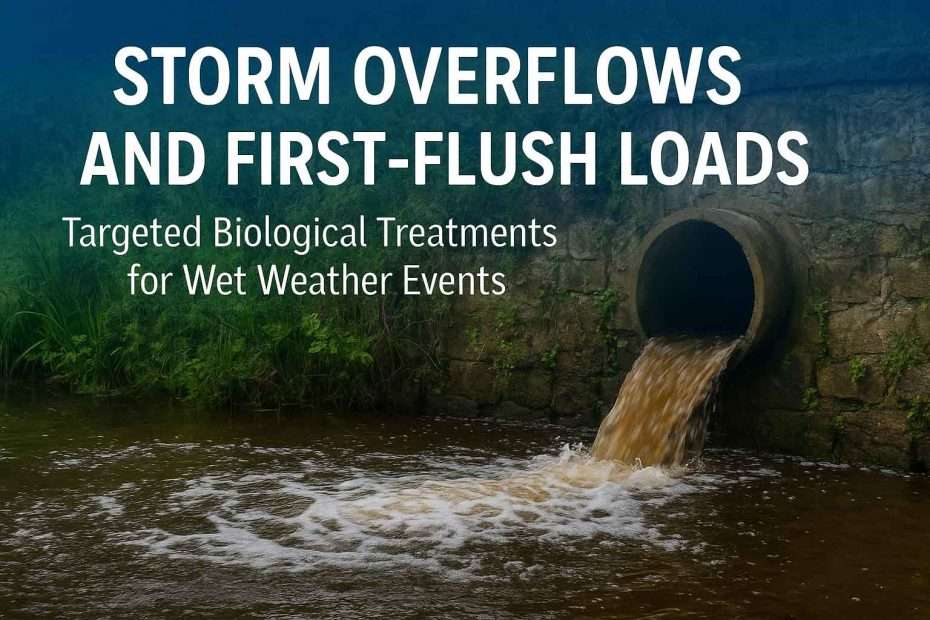
Storm Overflows and First-Flush Loads
Targeted Biological Treatments for Wet Weather Events
Summary
When sudden heavy rainfall hits ageing combined sewer systems, large volumes of polluted water are pushed through the network at speed. The first surge — known as the first flush — carries exceptionally high concentrations of harmful contaminants including BOD, COD, fats, oils and grease (FOG), pathogens and sediments that have built up in the sewer system over dry periods. This first flush is responsible for a disproportionate amount of the pollution released into rivers, canals, estuaries and coastal waters during storm overflow events.
With increasing public concern, tighter regulation, and growing environmental commitments, there is a pressing need for solutions that not only mitigate the impact of storm overflows but do so in ways that are sustainable, organic and fully aligned with nature. Bioglobe’s bespoke enzyme-based bioremediation systems offer a powerful, environmentally gentle way to reduce pollutant loads before storm overflows activate — blunting harmful peaks, improving water quality, and supporting compliance with overflow reduction targets.
This article explains the science of first-flush pollution, the consequences for communities and ecosystems, and how Bioglobe’s natural enzyme solutions can make a meaningful difference without introducing any chemicals, toxins or adverse ecological effects.
Introduction
Across the UK — and particularly in urban areas with older sewer networks — storm overflows have become a central topic in environmental discussions. These systems were originally designed as safety mechanisms, allowing excess water to bypass treatment works during extreme rainfall and flow directly into natural watercourses. The idea was simple: prevent sewage backing up into homes and streets.
However, as weather patterns become more unpredictable, periods of drought alternate with sudden intense storms, and urban development adds more impermeable surfaces, storm overflows now activate far more frequently than originally intended. Many rivers and coastal areas experience hundreds or even thousands of overflow events each year. The public is understandably frustrated, environmental groups are increasingly vocal, and governments are under pressure to enforce higher standards on water utilities.
But not all overflow pollution is the same. A single storm event typically produces a highly uneven pollution profile. The earliest portion — the first flush — is the most potent. It carries the highest concentration of organic waste, FOG, sediments, litter fragments, chemical residues and pathogenic organisms.
Understanding this phenomenon is essential to solving it. Equally essential is recognising that solutions do not always need to be large-scale engineering works. While new storage tanks, improved sewer separation and treatment-plant upgrades are needed, these are long-term investments. In the meantime, scalable, rapid-deployment, environmentally safe interventions are urgently required.
Bioglobe’s enzyme-based bioremediation systems provide exactly that: a natural, organic, scientifically tuned way to reduce pollutant loads upstream, smoothe out dangerous first-flush spikes, and support cleaner, healthier waterways — all while avoiding any adverse ecological impact.
Understanding the First Flush
What is the First Flush?
During dry periods, solids, organic matter, oils, sediments and microbial colonies accumulate inside sewer pipes and associated infrastructure. This build-up may go unnoticed during everyday flows, but when the system is hit by sudden rain, the initial surge of water scours the inside of the pipes and lifts everything that has collected.
This scouring action produces the first flush: a short but intense period of highly concentrated pollution. In many cases, the first flush carries more contaminants than the rest of the storm event combined.
The concept is simple but critical:
- Everyday sewer flow carries waste steadily and predictably.
- The first flush carries accumulated pollution that has been sitting, thickening and fermenting in the system for days or weeks.
- This flush reaches storm overflows before it reaches treatment works, meaning raw sewage pollution can enter rivers even if the bulk of the stormwater later goes to a treatment plant.
Why Are First Flush Loads So High?
There are several natural and human-driven reasons:
1. Accumulated Organic Waste
Organic materials—food waste, human waste, detergents, biodegradable matter—decompose and settle inside sewers during dry weather. Without the dilution of regular flushing, concentrations can become extremely high.
2. Fats, Oils and Grease (FOG)
FOG deposits solidify on the inner surfaces of pipes, forming layers or sometimes complete blockages (fatbergs). During sudden rainfall, the turbulent water shears away these deposits and carries them forward. FOG is one of the most persistent and oxygen-depleting pollutants.
3. Pathogens and Microbial Growth
Stagnant sections of sewer systems allow bacteria, viruses and other pathogens to multiply. These organisms are then released in large numbers during first flush events, posing potential health risks when they enter recreational waters.
4. Chemical Oxygen Demand (COD) and Biological Oxygen Demand (BOD)
High COD and BOD values indicate pollution that consumes oxygen as it breaks down. First flush water often contains extremely high COD and BOD levels, which, when released into rivers, rapidly reduce dissolved oxygen and threaten aquatic life.
5. Heavy Particulates, Sediments and Trash
Street litter, grit, soil, debris from construction, microplastics and other particles accumulate in drainage channels. Heavy rainfall pushes these into the sewer system rapidly and in concentrated bursts.
6. Temperature Effects
Long warm periods encourage microbial activity and the breakdown of organic matter, increasing the strength of accumulated waste.
This toxic mixture makes the first flush uniquely damaging — far more so than diluted stormwater later in the event.
Consequences of First-Flush Pollution
Storm overflows have a host of consequences, but the first flush amplifies each of them. Because the most concentrated pollution arrives first, it also tends to be the portion most likely to enter rivers, canals and coastal waters. When this highly concentrated cocktail is released untreated, the harm is immediate, visible and often long-lasting.
Below are the main categories of consequences, framed for public understanding.
1. Environmental Consequences
Oxygen Depletion in Rivers and Streams
High COD and BOD values mean that microorganisms consume large amounts of oxygen as they break down organic pollutants. When dissolved oxygen levels fall, fish, aquatic insects and other wildlife struggle to survive. In severe cases, fish die-offs occur.
Algal Blooms
Nutrients such as nitrogen and phosphates can feed excessive algal growth. While algae are natural, too much of them creates imbalances that reduce oxygen and disrupt ecosystems.
Toxic Contamination
Pathogens from raw sewage can contaminate water used by wildlife. Some pathogens persist for days or weeks, posing prolonged risks.
Loss of Biodiversity
Sensitive species, such as freshwater invertebrates and juvenile fish, are often the first to be affected. Over time, polluted waterways lose ecological richness and resilience.
2. Public Health Impacts
Risks for Swimmers and Water Users
People using rivers or coastal waters for swimming, paddle-boarding or kayaking may be exposed to bacteria, viruses and other harmful organisms from sewage.
Contamination of Shellfish Areas
Coastal first flush discharges can affect shellfish beds. Shellfish filter water constantly, so pathogens and pollutants can accumulate, presenting a risk to human consumers.
Exposure During Flooding
When floods occur, polluted waters may also reach streets, parks, or even homes. First flush water is particularly hazardous due to its concentration.
3. Social and Economic Impacts
Reduced Recreation and Tourism
Polluted rivers and beaches deter visitors, affecting local businesses. Repeated beach closures or poor water-quality ratings can have long-term economic costs.
Damage to Public Trust
Communities increasingly expect transparency and accountability from water companies. Frequent overflow events — especially ones that appear preventable — erode trust.
Financial Penalties for Water Companies
Water companies face increasing fines for pollution events, as well as public pressure and shareholder scrutiny.
4. Infrastructure Strain
Blockages and Pump Failures
FOG accumulation and sudden release can overwhelm pumps or cause blockages. This increases maintenance costs and the risk of operational failure during peak rainfall.
Reduced Treatment Efficiency
First flush events can shock the biological processes in treatment works if high-strength water arrives too quickly. This can affect treatment quality downstream.
The Need for Immediate, Scalable, Nature-Aligned Solutions
Large-scale engineering projects — such as separated sewer systems, expanded treatment works, and giant storage tanks — are long-term solutions that may take years or decades to implement.
In the meantime, the frequency and severity of storm overflows continue to rise.
This creates a clear need for interim solutions that:
- Can be deployed rapidly
- Do not require major construction
- Are environmentally safe
- Reduce pollution at source
- Lower peak loads during storm events
- Complement long-term infrastructure investment
Bioglobe’s organic enzyme bioremediation systems are designed precisely for this purpose.
Bioglobe’s Organic Response: A Nature-Based, Science-Driven Solution
Bioglobe develops enzyme-based bioremediation solutions in its laboratory in Cyprus, with manufacturing and deployment capacity in the UK. These solutions focus on supporting natural processes, avoiding chemicals, and delivering reliable, measurable reductions in pollution.
Below is a structured explanation of how Bioglobe addresses the problem, its consequences and the sustainable solution.
Problem – High First-Flush Loads and Storm Overflow Pollution
The core problem
Water companies face a dual challenge: ageing infrastructure and increasingly volatile weather. Combined sewer systems perform well in stable conditions but struggle during intense rainfall when large volumes of stormwater enter the system rapidly.
Because the first flush carries a highly concentrated load of harmful pollutants — BOD, COD, FOG, pathogens and sediments — it overwhelms both sewer capacity and treatment capabilities.
As a result:
- Overflows activate more often
- Waterways receive large amounts of raw sewage
- Compliance targets become harder to achieve
- Public dissatisfaction grows
The underlying issue is not simply the total volume of water, but the quality of that water at key moments.
Consequences – Environmental, Health, Economic and Reputational Damage
The consequences are broad and interconnected:
- Rivers suffer oxygen depletion
- Wildlife is harmed
- Beaches may close
- Treatment works face operational stress
- Water companies experience financial and reputational impacts
The first flush acts like a sudden pulse of toxicity — small in duration but enormous in effect.
Solution – Bioglobe’s Organic Enzyme Bioremediation
Bioglobe’s approach directly targets the source of the pollution, not just the symptoms. Instead of waiting for contaminants to enter rivers or reach treatment works, Bioglobe introduces naturally derived enzymes upstream, before storm events cause the system to overflow.
1. Bespoke Enzyme Formulations
Every catchment has a unique pollutant profile. Bioglobe analyses samples in its controlled laboratory environment and creates bespoke enzyme blends that target:
- Organic matter
- Proteins
- Fats and oils
- Sewage-borne solids
- Pathogens
- Nutrients
- Odour-causing compounds
This ensures that treatments are precisely matched to the site’s needs, delivering maximum efficacy.
2. Pre-Seeding the System
Because enzymes must be present when the first flush arrives, Bioglobe uses a strategy called pre-seeding. Enzymes are dosed into the system ahead of heavy rainfall, so when scouring begins, the enzymes are already in place and active.
This has two major benefits:
- Waste is broken down before it accumulates into harmful concentrations.
- Pollutant spikes are flattened, reducing the load during overflow events.
3. Upstream Dosing at Hotspots
Bioglobe works with water utilities to identify hotspots such as:
- Areas with heavy FOG accumulation
- Pumping stations prone to blockages
- Sections of sewer with low flow or stagnant zones
- Catchments with high first-flush pollution
- Industrial or commercial inputs that increase COD and BOD
By targeting these locations, pollutants are reduced where they cause the most harm.
4. How Enzymes Work
Enzymes function as biological catalysts. They accelerate natural breakdown processes without becoming part of the reaction themselves. Once they have completed their work, they degrade naturally into harmless amino acids.
Bioglobe uses enzymes such as:
- Lipases – break down fats and oils
- Proteases – break down proteins
- Amylases – break down starches
- Cellulases – break down organic fibres
- Oxidative enzymes – reduce COD levels
These enzymes convert complex pollutants into simple, benign substances such as:
- Water
- Carbon dioxide
- Non-toxic organic acids
- Fully biodegradable particulates
5. No Adverse Impact on Ecosystems
Bioglobe’s solutions are fully organic and non-toxic.
They do not:
- Harm fish, plants, insects or soil life
- Alter the pH of waterways
- Persist in the environment
- Introduce chemicals
- Affect nutrient balance unnaturally
Instead, they support natural microbial communities and enhance the ecosystem’s ability to restore itself.
6. Benefits for Water Companies
- Immediate impact without large capital expenditure
- Reduced overflow pollution during wet weather
- Lower maintenance costs from fewer FOG-related blockages or pump failures
- Better compliance performance in line with regulatory expectations
- Improved public trust by adopting a visible, environmentally friendly approach
Bioglobe’s methods complement long-term infrastructure upgrades and provide an effective bridge solution during transition periods.
A Clear, Public-Friendly Explanation of the Science
Sometimes, scientific explanations sound abstract. Below is a simple breakdown of what Bioglobe’s approach means for ordinary people concerned about river health.
Before the Rain
Enzymes are placed into specific parts of the sewer system where waste tends to build up. These enzymes immediately start breaking down fats, organic waste and other pollutants.
When Rain Arrives
Because the system has already been “cleaned” biologically, the first flush contains far fewer harmful substances. The water that reaches a storm overflow is less polluted, reducing the impact on rivers.
After the Storm
Enzymes naturally degrade. No chemicals remain, and the system stays cleaner for longer.
Over Time
The sewer system becomes easier and cheaper to maintain. Rivers and coasts receive fewer dangerous pollution spikes. Communities can enjoy cleaner water.
A Human Story: Why It Matters
For many people, storm overflows feel like distant technical problems — something for engineers and regulators. But the truth is far simpler and far more human.
Cleaner rivers mean:
- Families can swim in local waters again.
- Children can play outdoors without worry.
- Anglers can enjoy thriving fish populations.
- Tourism can grow in coastal towns.
- Wildlife can recover and flourish.
Most importantly, the community can trust that their environment is being protected in ways that respect nature itself.
Bioglobe’s approach is aligned with this vision. By working with nature instead of against it, the solutions are kinder, safer and more sustainable.
Looking to the Future
The UK is undergoing significant reform in how storm overflows are monitored and managed. Technology, public pressure and regulation are pushing utilities to adopt cleaner, greener interventions.
Nature-based solutions are a key part of this. They are:
- Cost-effective
- Scalable
- Safe
- Publicly acceptable
- Environmentally restorative
Bioglobe’s organic enzyme solutions fit perfectly into this landscape. They offer immediate benefits without waiting years for new infrastructure. They reinforce natural recovery rather than stifle it. And they provide measurable improvements that communities can see and value.
Conclusion
Storm overflows and first-flush events represent one of the most pressing environmental challenges facing the UK. While long-term engineering upgrades are essential, communities need solutions today — solutions that work with nature, protect ecosystems and support cleaner rivers and coasts.
Bioglobe’s bespoke enzyme bioremediation systems offer a powerful answer. By targeting pollution at its source, using safe and natural biological processes, Bioglobe helps reduce the harm caused by storm overflows even during intense rainfall.
This approach does more than treat pollution. It builds resilience, restores nature and reassures communities that a cleaner future is possible — without chemicals, without ecological impact, and without delay.
FAQs
1. What exactly is the “first flush” during a storm?
The first flush is the initial surge of water that washes through sewers when heavy rain begins. It contains the highest concentration of pollutants because it scours away everything that has built up during dry periods, including organic waste, fats, oils, grease, pathogens and sediments.
2. Are Bioglobe’s enzyme treatments safe for wildlife?
Yes. All enzyme formulations used by Bioglobe are organic and fully biodegradable. They do not harm fish, plants, insects or microorganisms. Once they break down pollutants, the enzymes naturally degrade into harmless amino acids.
3. Can enzymes really reduce pollution before it reaches rivers?
Absolutely. By pre-seeding sewer systems with bespoke enzyme blends, pollutants are broken down at source. This means the first flush contains far lower concentrations of harmful substances, reducing the severity of storm overflow pollution.
4. How do these solutions help water companies meet regulatory targets?
Enzyme treatments reduce peak pollution loads, making it easier for water companies to demonstrate improvement in water quality and comply with overflow reduction goals. These solutions also reduce blockages and maintenance issues.
5. Are enzyme treatments a replacement for infrastructure upgrades?
No — they are a complementary measure. While new sewer systems and storage tanks are important, they take years to build. Enzyme bioremediation provides an effective, low-impact solution that can be deployed immediately to reduce pollution during that timeframe.
Bioglobe offer Organic Enzyme pollution remediation for major oil-spills, oceans and coastal waters, marinas and inland water, sewage and nitrate remediation and agriculture and brown-field sites, throughout the UK and Europe.
We have created our own Enzyme based bioremediation in our own laboratory in Cyprus and we are able to create bespoke variants for maximum efficacy.
Our team are able to identify the pollution, we then assess the problem, conduct site tests and send samples to our lab where we can create a bespoke variant, we then conduct a pilot test and proceed from there.
Our Enzyme solutions are available around the world, remediation pollution organically without any harm to the ecosystem.
For further information:
BioGlobe LTD (UK),
Phone: +44(0) 116 4736303| Email: info@bioglobe.co.uk