

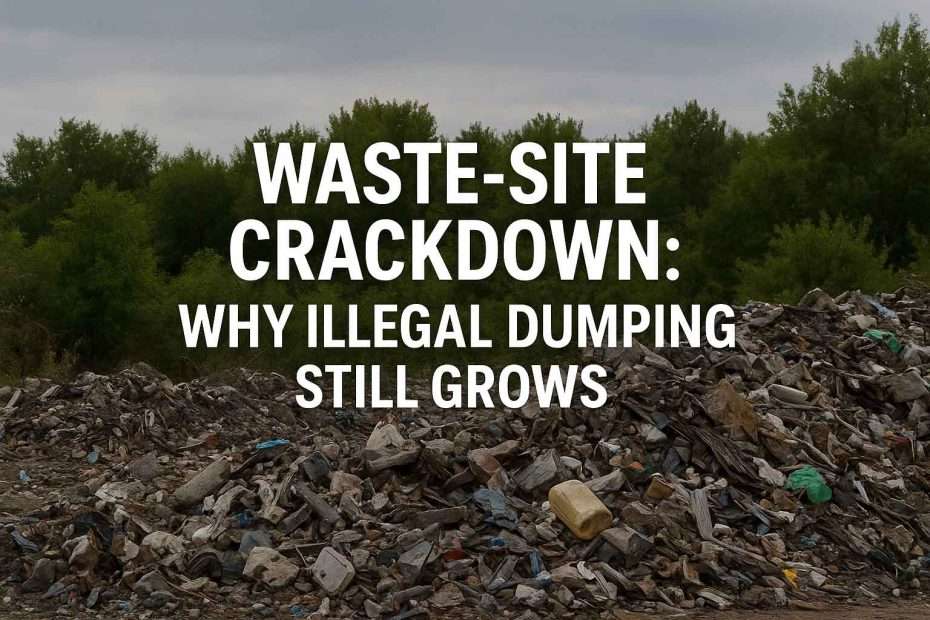
Waste-Site Crackdown: Why Illegal Dumping Still Grows
Thousands of unregulated waste sites leaking pollutants — and what it means for the UK environment
Introduction
Across the United Kingdom, an environmental crisis has been unfolding quietly, often out of public view. Hidden in woodlands, abandoned quarries, farm fields, industrial backlots and brownfield corners are thousands of illegal waste-dumping sites — many of them vast, many of them toxic, and many of them operating for years without any regulation, monitoring, or enforcement. While fly-tipping has long been a nuisance for councils and landowners, what the UK faces today is on a far greater scale: a landscape dotted with unregulated dumps containing millions of tonnes of waste, from building rubble and plastics to hazardous chemicals, heavy metals, and sewage-laden sludges.
Despite government crackdowns, tougher penalties, and rising public awareness, the number of illegal waste sites appears to be growing. Waste crime has evolved from opportunistic dumping at night to organised, large-scale, profit-driven operations that undercut legitimate businesses, dodge landfill tax, and leave communities and ecosystems to suffer the consequences.
This article examines why illegal waste sites continue to grow, what kinds of pollutants they contain, the risks they pose to ordinary people and the environment, and crucially, how solutions such as organic enzyme-based bioremediation — including the bespoke remediation work developed by BioGlobe — can help clean up contaminated land without harming ecosystems.
The article follows the structure:
- Problem
- Consequences
- Solution
It concludes with five FAQs to support readers and improve SEO.
Problem
A hidden epidemic of illegal dumping
Illegal waste sites are not isolated or rare; depending on the methodology used, estimates suggest that thousands exist across the UK. Some are small and sporadic. Others are vast, organised, and deliberately concealed. In many cases, the true scale is unknown because the sites are discovered only by accident: a ramblers’ group stumbling across an old quarry filled with building waste; a farmer finding drums of unknown industrial sludge dumped on their land; or a council discovering methane emissions from a long-forgotten tip.
These sites accumulate over years, and with rising landfill taxes, some individuals and criminal groups see an opportunity to maximise profit by simply avoiding the cost of legal disposal. A truckload of construction waste that would cost hundreds of pounds to dispose of properly can be dumped illegally for free — or for a fraction of the cost if landowners are deceived or paid to look the other way.
This creates a thriving underground industry where waste is mis-labelled, mixed, stored unlawfully, or dumped outright. Some operations take in waste under the guise of recycling or land reclamation, then simply stockpile it, creating mountains of rotting, leaking rubbish.
Why so many sites remain unregulated
There are several reasons the UK struggles to control illegal waste sites:
1. High landfill taxes and disposal costs
Landfill tax, originally designed to incentivise recycling and reduce landfill use, created a profitable incentive for criminals. For legitimate businesses, the waste-disposal cost is significant; for criminals, it represents profit. For every tonne of waste illegally dumped, landfill tax is avoided. With enormous profit margins available, illegal dumping has become highly attractive to organised groups.
2. Organised crime involvement
Waste crime today is not merely opportunistic. Networks of criminals have stepped into the market, treating waste like any other high-reward illicit commodity. They operate covert sites, falsify paperwork, use unregistered waste carriers, and exploit gaps in enforcement.
3. Weak enforcement and limited resources
Even though regulators shut down hundreds of illegal sites yearly, many more appear. Enforcement teams face limited budgets, legal constraints, and large backlogs. Some sites take years to close, leaving contaminants leaking into the environment all the while.
4. Complex waste-tracking systems
Although reforms are underway to modernise digital waste tracking, historic systems allowed too many loopholes. Waste could be reclassified, mislabelled, mixed, or passed between carriers without proper oversight.
5. Rural locations and lack of monitoring
Illegal dumps thrive in out-of-sight locations: remote fields, woodland clearings, disused industrial land. Without active surveillance — such as satellite imaging, drones, or community reporting — these sites can remain hidden for years.
6. Lack of clarity around older landfills
Many “historic” or disused landfill sites predate modern environmental regulations. Some never had proper lining, containment, or documentation. They may now be leaking complex pollutants, yet the type and volume of waste inside is unknown.
Consequences
Illegal waste sites are not just unsightly or inconvenient — they are dangerous. The environmental and public-health impacts can be significant and long-lasting.
Pollution of soil, water and air
Leachate contamination
Illegal sites often have no protective lining or containment system. When rainwater percolates through the waste, it dissolves chemicals, producing a toxic liquid called leachate. This can contain:
- heavy metals (lead, arsenic, mercury, cadmium)
- hydrocarbons (oils, fuels, solvents)
- ammonia and nitrates
- chemical residues
- biological wastes
- microplastics and chemical plasticisers
- pathogens from sewage or food waste
Leachate can seep directly into soil and groundwater, contaminating farmland, wells, and watercourses.
Surface water pollution
Streams and rivers near waste sites may become polluted after heavy rainfall or flooding. Illegal landfills situated near water bodies carry particular risk, especially those on floodplains.
Air pollution
Illegal dumping frequently leads to fires, either accidental or deliberately set to reduce the volume of waste. Burning plastics, tyres, or chemical waste releases toxic smoke, particulate matter, and carcinogenic compounds.
Threats to wildlife and biodiversity
Illegal waste introduces toxins into ecosystems. Wildlife can ingest plastics, be poisoned by contaminated soil or water, or be harmed by sharp or hazardous materials. Wetlands and sensitive habitats are especially vulnerable; heavy metals and organic pollutants can disrupt breeding, feeding and plant growth.
Public-health risks
Communities living near illegal waste sites often report:
- respiratory problems
- foul odours
- headaches, nausea, or irritation from fumes
- increased presence of vermin and flies
- contamination of private water supplies
- concerns about long-term health impacts
Fires on such sites may burn for days, releasing smoke that can drift across residential areas.
Economic costs
Cleaning up illegal dumps costs councils, landowners, and the public millions of pounds. Landowners may be held liable if waste is on their property, even if they were deceived. Meanwhile, legitimate waste operators are undercut by criminal activity, distorting the market and reducing recycling standards.
Erosion of public trust
When illegal dumping appears persistent and unchecked, public confidence in environmental regulation erodes. Communities may feel abandoned or unsafe, particularly when reports of contamination or poor enforcement become widespread.
Solution
Illegal dumps require two responses:
- Stop the dumping — through better enforcement, monitoring, and waste-tracking
- Clean up contaminated land — safely, sustainably, and without further harming ecosystems
The second of these is where organic enzyme remediation, pioneered by BioGlobe, becomes uniquely important.
BioGlobe, with research facilities in Cyprus and operations in the UK, has developed a natural, non-toxic approach to pollution remediation using bespoke enzyme blends. These formulations are tailored to the specific contaminants found in soil, water, or industrial waste, making them ideal for dealing with the varied pollutants found in illegal dumping sites.
Why enzyme-based remediation is needed
Traditional remediation techniques often rely on mechanical removal, chemical treatments, or thermal processes. These methods can be costly, disruptive, and sometimes environmentally damaging. Excavation alone can cost tens of thousands of pounds for even a small site, with the removed soil then requiring disposal elsewhere.
Chemical treatments can sterilise soil or harm ecosystems. Thermal treatments consume high amounts of energy.
In contrast, enzyme-based remediation is:
- natural
- organic
- biodegradable
- non-toxic to plants and wildlife
- effective on a wide range of pollutants
- suitable for both small and large sites
- cost-effective
- compatible with sensitive environments
How BioGlobe’s enzyme remediation works
1. Pollutant analysis
Every site contains a unique mixture of pollutants. BioGlobe’s laboratory analyses soil or water samples to identify the exact contaminants present. This includes hydrocarbons, sewage, chemicals, organic waste, and more persistent compounds.
2. Creation of bespoke enzyme blends
Based on the analysis, BioGlobe formulates a blend of organic enzymes designed to catalyse the breakdown of those specific pollutants. Enzymes accelerate natural biodegradation, allowing microbes in the environment to complete the process efficiently.
3. Application to contaminated soil or water
The enzyme solution can be applied in multiple ways:
- sprayed across soil
- injected into groundwater
- mixed into waste material
- applied to contaminated water bodies
- used in bioreactors for wastewater from illegal dumps
4. Breakdown of pollutants
Enzymes convert complex organic pollutants into simpler, harmless molecules. For example:
- hydrocarbons become water and carbon dioxide
- sewage wastes become harmless organic matter
- oils and greases are broken down into fatty acids
- many chemical compounds become biodegradable
5. Natural recovery of ecosystems
Once pollutants are neutralised, soil biology begins to recover. Plants can grow again, water sources clear, and microbial balance returns. Because BioGlobe’s solutions are organic and non-toxic, they do not disrupt wildlife or soil ecology.
Suitability for illegal waste sites
Illegal dumps often contain unpredictable mixtures of waste; BioGlobe’s bespoke approach allows tailored solutions depending on the pollutant mix. Enzyme remediation is particularly effective for:
- hydrocarbon contamination
- sewage and organic waste
- chemical residues
- agricultural waste
- oils, greases, and industrial by-products
- contaminated soil on brownfield sites
- polluted ditches, streams, or wetlands
- leachate management
While heavy metals cannot be broken down, enzymes can support immobilisation or transformation processes that reduce mobility, preventing metals from leaching into water sources.
Benefits for communities
For local residents and landowners, BioGlobe’s approach offers:
- minimal disruption
- no chemical or toxic treatment
- restoration of land for future use
- improved local environment
- safer soil and water
- wildlife protection
- cost-effective clean-up
- a long-term sustainable solution
For councils, it provides a scalable, environmentally responsible remediation option that aligns with modern sustainability commitments.
Why enforcement must improve too
Remediation alone cannot solve the illegal waste crisis. Preventing future dumps requires:
- Better monitoring using drones, satellites, and community reporting
- Stricter waste-carrier regulation
- Digital tracking of all waste movements
- Targeting of organised waste-crime groups
- Consistent enforcement across regions
- Public education about the signs of illegal dumping
Illegal waste crime flourishes when enforcement is slow or inconsistent. A balance of strong regulation and natural remediation is essential to protect communities and ecosystems.
Conclusion
Illegal waste dumping continues to rise across the UK despite crackdowns, tougher penalties, and stronger regulation. The combination of landfill-tax avoidance, organised crime involvement, and gaps in monitoring has created thousands of unregulated sites leaking pollutants into soil, water and air. These sites threaten wildlife, public health, and local communities, and their clean-up places a financial burden on the public.
Yet solutions exist. Organic enzyme-based remediation — such as the bespoke formulations created by BioGlobe — offers a sustainable, natural, and effective method for treating contaminated land and water. By working with, not against, natural processes, enzyme remediation accelerates the breakdown of pollutants without harming ecosystems.
At the same time, the UK needs stronger monitoring, better waste-tracking, community engagement, and consistent enforcement to stop illegal dumping at the source.
The combination of nature-based remediation and robust regulation gives the UK an opportunity not only to address the current crisis but to restore contaminated landscapes to health — protecting communities, wildlife, and the environment for the future.
FAQs
1. What types of pollutants are found in illegal waste sites?
Illegal waste sites often contain construction waste, plastics, oils, chemicals, sewage, industrial sludge, heavy metals, and mixed commercial waste. Pollutants can vary widely between sites.
2. How does illegal dumping affect local communities?
Communities may experience bad odours, polluted water, toxic smoke from fires, increased vermin, respiratory problems, or contamination of soil and streams. Clean-up costs often fall on taxpayers or landowners.
3. What is enzyme-based bioremediation?
Enzyme bioremediation uses natural enzymes to break down pollutants into harmless components. It accelerates natural biodegradation processes, is non-toxic, and supports ecosystem recovery.
4. Can BioGlobe treat any type of pollution at an illegal dump?
BioGlobe can treat a wide range of pollutants, especially organic contaminants such as hydrocarbons, sewage, oils, and chemical residues. While heavy metals cannot be broken down, their mobility can sometimes be reduced using biological processes.
5. Why do illegal waste sites continue to appear?
High landfill taxes, profit motives, insufficient monitoring, organised crime involvement, and gaps in waste-tracking systems all contribute to the growth of illegal waste dumping across the UK.
Bioglobe offer Organic Enzyme pollution remediation for major oil-spills, oceans and coastal waters, marinas and inland water, sewage and nitrate remediation and agriculture and brown-field sites, throughout the UK and Europe.
We have created our own Enzyme based bioremediation in our own laboratory in Cyprus and we are able to create bespoke variants for maximum efficacy.
Our team are able to identify the pollution, we then assess the problem, conduct site tests and send samples to our lab where we can create a bespoke variant, we then conduct a pilot test and proceed from there.
Our Enzyme solutions are available around the world, remediation pollution organically without any harm to the ecosystem.
For further information:
BioGlobe LTD (UK),
Phone: +44(0) 116 4736303| Email: info@bioglobe.co.uk