

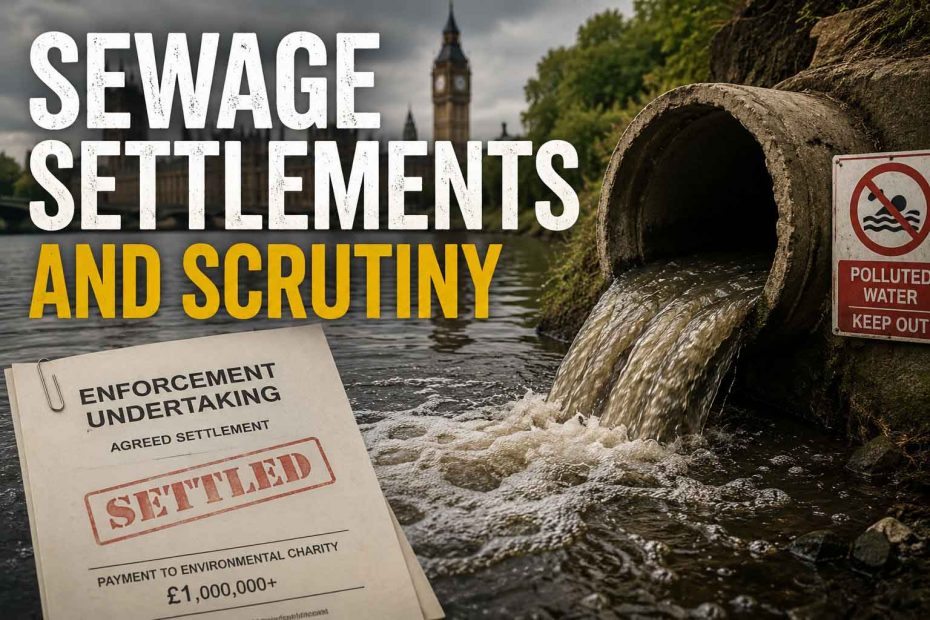
Sewage Settlements and Scrutiny
How England’s Water Polluters Are Avoiding Prosecution
England’s waterways are under increasing strain. Rivers and lakes that were once central to communities and ecosystems are now frequently contaminated by raw sewage discharges, prompting growing public anger and renewed scrutiny of the water industry. At the centre of this controversy lies a question that campaigners, whistleblowers and environmental advocates continue to ask: why are so few water companies being prosecuted?
A growing body of evidence suggests that one of the reasons may lie within the very regulatory system designed to hold polluters to account.
Recent revelations have cast fresh light on the Environment Agency’s use of “enforcement undertakings” — voluntary payments made by companies to environmental charities in lieu of criminal prosecution. Critics argue the system has evolved into what amounts to a legal escape route for repeat offenders, allowing serious environmental breaches to be settled quietly, away from the courts.
The issue has gained renewed prominence following Channel 4’s Dirty Business, a docu-drama inspired by whistleblower accounts from inside the Environment Agency itself. The programme depicted a regulator under pressure, accused of failing to act decisively against major polluters.
That portrayal closely mirrors the concerns of Robert Forrester, a former Environment Agency employee with more than two decades of experience. During his time at the organisation, Forrester says he became increasingly alarmed by what he witnessed.
According to campaigners like Forrester, the deterrent effect of prosecution has all but disappeared.
At the heart of their criticism is the widespread use of enforcement undertakings (EUs). Originally intended for lower-level environmental offences, EUs now appear increasingly common in cases involving major water companies responsible for serious pollution incidents.
Under the scheme, companies can avoid criminal prosecution by agreeing to make financial contributions — sometimes exceeding £1 million — to environmental projects or charities.
For critics, this is deeply troubling.
They argue that water monopolies are being afforded a privilege unavailable to ordinary citizens or businesses: the ability to sidestep criminal conviction for serious environmental harm.
The Environment Agency strongly disputes that characterisation. Officials maintain that enforcement undertakings are a practical and effective tool, enabling quicker resolutions than lengthy court proceedings while securing substantial investment for local environmental recovery.
In the past year alone, the regulator says it has secured £8.5 million for environmental projects through such agreements.
Yet opponents remain unconvinced.
One striking case involved the River Taw in North Devon, where a major pollution incident six years ago resulted in the deaths of approximately 15,000 fish. Rather than pursuing prosecution, the Environment Agency accepted an enforcement undertaking.
Local anglers and campaigners were outraged. A private prosecution was subsequently brought — and succeeded.
To some, the payments offered under these arrangements resemble what they describe as “blood money”: compensation that may fund restoration, but which fails to deliver justice or meaningful deterrence.
Environmental charities, however, defend their role in the system.
The Rivers Trust, one of the organisations that accepts EU payments, argues the funds allow vital work to be carried out directly in affected catchments. The charity insists that, while it would always prefer pollution incidents not to happen at all, it can ensure the money is targeted where it is most needed.
But critics see an uncomfortable contradiction: the worse the pollution, the larger the potential financial award for restoration.
Data obtained from the Environment Agency raises further questions.
Over the past five years, thousands of serious pollution incidents have been linked to water companies — yet not a single completed prosecution has been brought for any of them.
Looking over a ten-year period between 2015 and 2025, official figures show 11,474 investigations into water company incidents. Of those, just 58 resulted in prosecution — a rate of approximately 0.5 per cent.
Campaigners argue this represents a collapse in regulatory enforcement.
Particularly controversial are allegations that serious pollution incidents are routinely downgraded without direct inspection. Environment Agency data reportedly shows nearly 6,000 category 1 and 2 incidents — the most severe classifications — being reclassified as minor incidents over the past decade.
Critics claim this practice reduces both public scrutiny and the likelihood of prosecution.
The Environment Agency rejects these claims, insisting all incidents are assessed thoroughly and that precautionary reporting systems can initially overstate severity.
But examples continue to fuel concern.
At Blackminster Sewage Works in the Midlands, Severn Trent was fined £1 million in 2021 for a serious pollution incident. Less than a year later, another incident occurred at the same site. Instead of prosecution, the company was permitted to settle through an enforcement undertaking.
For campaigners, this illustrates a fundamental flaw in the system: repeat offenders are still being allowed to avoid court.
The water industry, represented by Water UK, says enforcement undertakings can be in the public interest, particularly when lengthy legal battles may delay environmental repair. The industry points to independent reviews suggesting quicker accountability can benefit affected communities.
Yet for veteran campaigner Feargal Sharkey, the arrangement amounts to little more than a “get out of jail free card”.
Sharkey argues that financial penalties alone have failed to change behaviour. In his view, only personal accountability — including potential prison sentences for executives — will force meaningful reform.
He believes the current system treats pollution as a manageable business cost rather than a criminal act.
The Government insists it is taking action. Ministers say reforms are underway, including tighter rules on executive bonuses, stronger penalties for obstructing investigations, and the creation of a new single water regulator with greater enforcement powers.
But critics argue many of these measures simply repackage powers that already exist.
For them, the central issue remains unchanged: laws designed to protect rivers and hold polluters accountable are not being fully enforced.
As England faces worsening water quality and growing public distrust, the debate over enforcement undertakings has become about far more than regulatory efficiency. It raises deeper questions about accountability, justice and whether the country’s environmental watchdog is truly serving the public interest — or enabling those it was created to regulate.
Bioglobe offer Organic Enzyme pollution remediation for major oil-spills, oceans and coastal waters, marinas and inland water, sewage and nitrate remediation and agriculture and brown-field sites, throughout the UK and Europe.
We have created our own Enzyme based bioremediation in our own laboratory in Cyprus and we are able to create bespoke variants for maximum efficacy.
Our team are able to identify the pollution, we then assess the problem, conduct site tests and send samples to our lab where we can create a bespoke variant, we then conduct a pilot test and proceed from there.
Our Enzyme solutions are available around the world, remediation pollution organically without any harm to the ecosystem.
For further information:
BioGlobe LTD (UK),
Phone: +44(0) 116 4736303| Email: info@bioglobe.co.uk