

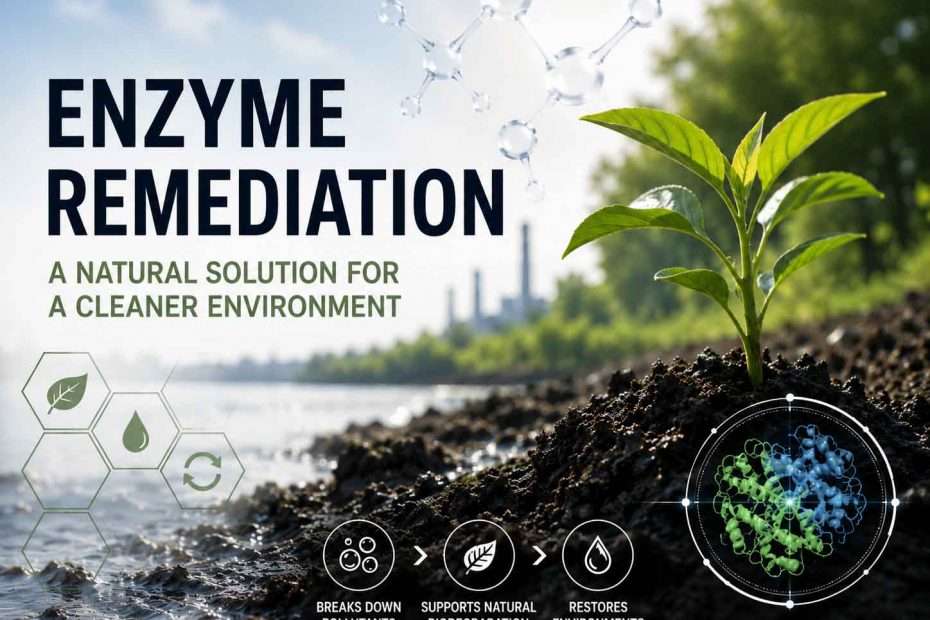
Understanding Enzyme Remediation
A Sustainable Solution for Environmental Clean-Up
As environmental regulations become increasingly stringent and businesses seek more sustainable methods of managing contamination, enzyme remediation is emerging as an effective and environmentally responsible solution. Used across a wide range of industries, from property development and waste management to environmental restoration, enzyme remediation offers a natural way to break down pollutants and restore contaminated land and water.
What Is Enzyme Remediation?
Enzyme remediation is the process of using naturally occurring enzymes to break down contaminants into simpler, less harmful substances. Enzymes are biological catalysts that accelerate chemical reactions without being consumed in the process. By targeting specific compounds, enzymes can significantly speed up the degradation of pollutants that would otherwise persist in the environment for many years.
Unlike traditional remediation methods that may involve excavation, transportation and disposal of contaminated material, enzyme remediation seeks to treat pollution at its source, reducing both environmental impact and remediation costs.
How Does Enzyme Remediation Work?
The process begins with the identification of the contaminant. Different enzymes are effective against different types of pollutants, making it essential to select the appropriate treatment for the specific contamination present.
Once applied, the enzymes begin breaking down complex molecules into smaller compounds. These simpler substances are often easier for naturally occurring microorganisms to consume and degrade further. In many cases, the remediation process ultimately converts pollutants into harmless by-products such as water, carbon dioxide and organic matter.
The treatment may be applied directly to contaminated soil, groundwater, wastewater systems or industrial sites, depending on the nature and location of the contamination.
Common Applications
Enzyme remediation is widely used to address a variety of environmental challenges, including:
Hydrocarbon and Oil Contamination
Fuel spills, leaking storage tanks and industrial accidents can leave soils contaminated with petroleum hydrocarbons. Enzymes help break down the long-chain hydrocarbon molecules found in oils and fuels, accelerating their natural degradation.
Grease and Fat Accumulation
Commercial kitchens, food processing facilities and wastewater systems often use enzyme treatments to reduce the build-up of fats, oils and grease. This can help prevent blockages and improve system efficiency.
Sewage and Organic Waste
Enzyme remediation can assist in the breakdown of organic matter found in sewage systems, reducing odours and supporting biological treatment processes.
Agricultural and Industrial Pollutants
Certain enzyme formulations can be used to help degrade pesticides, solvents and other organic contaminants commonly found in agricultural and industrial environments.
Advantages of Enzyme Remediation
One of the primary reasons for the growing popularity of enzyme remediation is its environmental sustainability.
Environmentally Friendly
Enzymes occur naturally and work alongside existing biological processes, making them a low-impact alternative to many chemical remediation techniques.
Cost-Effective
Because contamination can often be treated in situ, there is less need for costly excavation, transportation and landfill disposal.
Minimal Site Disruption
Many remediation projects can be carried out while minimising disruption to surrounding operations, making the process attractive for commercial and industrial sites.
Reduced Secondary Waste
Unlike some traditional clean-up methods, enzyme remediation generally produces very little secondary waste requiring further treatment or disposal.
Targeted Treatment
Specific enzymes can be selected to address particular contaminants, allowing for highly focused remediation strategies.
Limitations and Considerations
While enzyme remediation offers many benefits, it is not suitable for every situation.
The effectiveness of enzyme activity depends on environmental conditions such as temperature, moisture levels and pH. In some cases, remediation may require ongoing monitoring and repeated applications to achieve the desired results.
Additionally, certain contaminants may not respond effectively to enzyme treatment alone and may require a combination of physical, chemical or biological remediation techniques.
For heavily contaminated sites, a comprehensive remediation strategy incorporating multiple treatment methods may provide the best outcome.
Enzyme Remediation and Bioremediation
The terms enzyme remediation and bioremediation are often used interchangeably, but they are not exactly the same.
Enzyme remediation relies on isolated enzymes to initiate the breakdown of contaminants. Bioremediation, on the other hand, uses living microorganisms such as bacteria and fungi to consume and metabolise pollutants.
In practice, many modern remediation systems combine both approaches. Enzymes first break complex contaminants into smaller, more manageable compounds, which are then consumed by naturally occurring microorganisms. This combined approach can significantly accelerate the overall clean-up process.
The Future of Environmental Remediation
As industries and governments continue to prioritise sustainability and environmental responsibility, enzyme remediation is likely to play an increasingly important role in contamination management.
Its ability to harness natural biological processes, reduce waste and minimise environmental impact makes it an attractive alternative to traditional remediation methods. Whether addressing fuel spills, industrial pollution or wastewater treatment challenges, enzyme remediation offers a practical and effective solution for restoring contaminated environments while supporting long-term environmental stewardship.
Read our Enzyme Bioremediation brochure HERE
Bioglobe offer Organic Enzyme pollution remediation for major oil-spills, oceans and coastal waters, marinas and inland water, sewage and nitrate remediation and agriculture and brown-field sites, throughout the UK and Europe.
We have created our own Enzyme based bioremediation in our own laboratory in Cyprus and we are able to create bespoke variants for maximum efficacy.
Our team are able to identify the pollution, we then assess the problem, conduct site tests and send samples to our lab where we can create a bespoke variant, we then conduct a pilot test and proceed from there.
Our Enzyme solutions are available around the world, remediation pollution organically without any harm to the ecosystem.
For further information:
BioGlobe LTD (UK),
Phone: +44(0) 116 4736303| Email: info@bioglobe.co.uk