

Constructed Wetlands Working with Enzymes
The Next Frontier in Sustainable Wastewater Engineering
The global push towards nutrient neutrality and net-zero infrastructure has placed nature-based solutions at the forefront of wastewater engineering. Among these, constructed wetlands—engineered systems mimicking natural floodplains and bogs—have proven highly effective at polishing stormwater and secondary effluents. However, when tasked with treating raw municipal or agricultural sewage, standard constructed wetlands face severe operational bottlenecks: substantial land footprints, odour complaints, and a high vulnerability to substrate clogging from fats, oils, and grease (FOG).
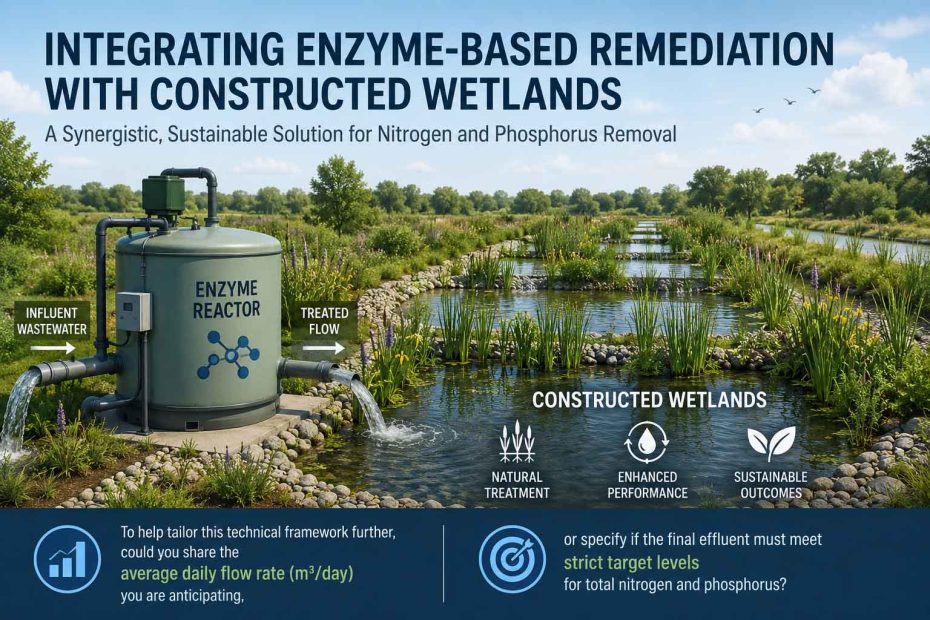
A revolutionary approach lies in the integration of natural enzyme-based remediation solutions with constructed wetlands. By pairing biochemical pre-treatment with ecological filtration, engineers can deploy an enhanced bioremediation hybrid system that processes raw sewage completely, reliably, and with a fraction of the traditional footprint.
The Hybrid Mechanism: A Two-Stage Purification Process
In a standard constructed wetland, up to 90% of pollutant breakdown relies on the periphyton—a dense microbial biofilm attached to plant roots and gravel substrates. When raw sewage enters this environment unmodified, the sheer volume of complex organic solids can suffocate this biofilm and clog the subsurface pathways.
An enzyme-integrated system mitigates this risk by establishing a distinct two-stage treatment train:
[Raw Sewage] ➔ 🧪 [Enzyme Dosing Stage] ➔ 🌾 [Constructed Wetland] ➔ [Clean Effluent]
(Rapidly breaks down solids & organic matter) (Absorbs nutrients, filters fine particles)
Stage 1: The Biochemical Catalyst
Raw sewage is initially directed into an enclosed primary reception or bio-reactor tank where the natural enzyme solution is introduced. Operating as molecular scissors, specific enzyme classes—including lipases, proteases, and cellulases—rapidly hydrolyse complex lipids, proteins, and carbohydrates. This biochemical reaction liquefies heavy solids and significantly reduces the initial biochemical oxygen demand (BOD) and chemical oxygen demand (COD) within hours rather than days.
Stage 2: The Ecological Polishing Filter
Once the organic matter has been pre-digested and liquefied, the wastewater transitions into the constructed wetland. Because the heavy organic load has already been dismantled at a molecular level, the wetland’s macrophytes (such as Phragmites australis or Typha) and native soil microbes can seamlessly absorb dissolved nutrients—primarily nitrogen and phosphorus—without the risk of physical overload.
Operational and Economic Advantages
Integrating enzyme pre-treatment directly addresses the historical pain points of wetland engineering, offering distinct advantages for developers and water utilities alike:
- Mitigation of Substrate Clogging: The single greatest cause of subsurface wetland failure is the accumulation of FOG and particulate organic matter within the gravel media. Enzyme liquefaction ensures that these binding agents are broken down prior to entry, vastly extending the operational lifespan of the gravel beds and reducing maintenance costs.
- Drastic Reduction in Land Footprint: Traditional surface flow wetlands require extensive land areas to achieve the hydraulic retention times necessary for raw sewage digestion. By shifting the heavy organic breakdown to an upstream enzyme tank, engineers can utilize highly compact Vertical Flow (VF) or hybrid wetland designs, opening the door for nature-based solutions in space-constrained peri-urban or agricultural developments.
- Odour Elimination: The anaerobic breakdown of raw sewage inherently generates volatile sulphur compounds, leading to significant odour issues. Rapid enzymatic digestion accelerates carbon stabilization, suppressing hydrogen sulphide formation before the wastewater is exposed to open-air wetland cells.
- Resilience to Shock Loading: Biological treatment facilities are notoriously sensitive to sudden surges in volume or chemical concentration. An enzyme-hybrid system allows operators to dynamically adjust dosing at the intake point during peak flows, buffering the downstream wetland ecology from toxic or hypoxic shocks.
Engineering Challenges and Design Considerations
While theoretically profound, successfully executing an enzyme-wetland hybrid system requires precise engineering at the interface of biochemistry and ecology.
Managing the Oxygen Profile
Rapid enzymatic breakdown triggers accelerated microbial consumption, which can cause an immediate drop in dissolved oxygen within the pre-treatment zone. If completely hypoxic water enters the wetland, it can suffocate root systems and disrupt the aerobic nitrifying bacteria. Designing adequate aeration or utilizing an intermittent-feed Vertical Flow wetland is critical to re-oxygenating the influent.
Biofilm Protection and Washout
Enzymes remain active as they travel through the hydraulic system. Operators must calibrate retention times precisely to ensure that active enzymes do not wash out into the wetland cells in concentrations high enough to inadvertently degrade the beneficial root biofilms that drive final nutrient removal.
Regulatory and Structural Safeguards
In accordance with UK Environment Agency and Natural Resources Wales guidelines, the entire facility must features robust safeguards. The wetland cells require high-specification synthetic liners or structural clay barriers to prevent any untreated or partially treated effluent from seeping into local groundwater aquifers. Furthermore, layouts must be positioned strictly outside designated high-risk flood zones to eliminate the risk of washouts during severe weather events.
Conclusion
The fusion of enzyme-based remediation with constructed wetlands represents a major evolutionary step for nature-based wastewater treatment. By taking the mechanical and structural burden of solid digestion off the plants and handing it to target biocatalysts, this hybrid approach delivers a clean, low-energy, and highly resilient infrastructure solution. It bridges the gap between industrial efficiency and ecological harmony, providing a scalable blueprint for sustainable water management in the UK and beyond.